Video PM reminded of past fracking calls
Category: POLITICS
-
PMQs: Philp and May on UK exit payment to EU on Brexit
Video UK still paying EU divorce bill? -
Brexit: Theresa May will reconsider £39bn bill if there’s no deal
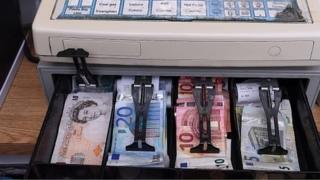 Image copyright Reuters
Theresa May has said she will reconsider paying the £39bn Brexit divorce bill if the UK is unable to reach a deal with the EU.
Speaking in Parliament, she said the UK was a law-abiding nation which would honour its international commitments.
But asked by Tory MP Chris Philp what would happen in the event of a no deal, she said the “position changes”.
“The specific offer was made in the spirit of our desire to reach an agreement with the EU,” she added.
The proposed financial settlement is part of the withdrawal negotiations that both sides hope to complete by November at the latest ahead of the UK’s exit next March.
The UK and EU agreed in principle in December that the UK would pay about £39bn to cover outstanding financial obligations and future liabilities arising from its EU membership.
Mrs May was asked by Chris Philp whether the payment was dependent on reaching an agreement on the UK’s future relations with the EU that was “satisfactory” to MPs.
He also urged the prime minister not to be “locked into” any financial agreement unless there were guarantees the UK would be free to work on new trade agreements during the proposed transition period ending in December 2020 and to sign them the moment it leaves.
In response, Mrs May said the negotiations were being conducted on the basis that “nothing is agreed until everything is agreed”.
“We are very clear we need to have a link between the future relationship and the withdrawal agreement.”
Tory MPs have expressed concerns that the UK could find itself paying the money with no guarantees over its future trade relationship, Boris Johnson suggesting the UK has agreed to “hand over £40bn of taxpayers’ money for two-thirds of diddly squat”.
-
Prime Minister’s Questions: The key bits and the verdict
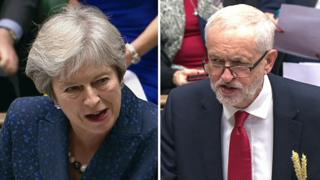 Image copyright HoC
Theresa May went head-to-head with Jeremy Corbyn in the House of Commons. Here’s what happened.
Passions were running high in the Commons at the final Prime Minister’s Questions before the party conference season gets under way.
But Jeremy Corbyn began in a low-key way, with a riddle designed to knock Theresa May off balance.
What did the National Farmers’ Union, the Federation of Small Businesses, the National Audit Office, the National Housing Federation, Gingerbread and the Royal Society of Arts all have in common, he asked.
A grinning Mrs May was momentarily flummoxed, perhaps thinking he was trying to lay a Brexit trap for her.

All MPs were aware of the “pain” Universal Credit was causing from people at their advice surgeries, said Mr Corbyn. Did she agree with the National Audit Office that it would create hardship, force more people to use food banks and “could end up costing the system even more”.
Mrs May said she remembered from years back a constituent, a single mother, who had been told by the job centre that she would be “better off on benefits”. That was the last Labour government’s legacy, she told him.
The Labour leader accused the government of putting vulnerable people at risk with its benefit changes, something immediately denied by the PM.
It was Labour that was “speaking up for the poorest in this country”, shouted a visibly angry Mr Corbyn amid a growing wall of noise from MPs on all sides.
“The government’s Brexit negotiations are an abject failure – I can see that by the sullen faces behind her, and that’s not just the ERG group it’s the whole lot of them,” he cried.
“The prime minister is not challenging the burning injustices in our society. She is pouring petrol on them. When will she stop inflicting misery on the people of this country?”
Mrs May launched into a full-throated defence of her own record on “burning injustice” such as the government’s “racial disparity audit” and a crackdown on stop and search (“that was me as home secretary”).
Then, knowing that Mr Corbyn would not get a comeback, she laid into Labour’s recent internal troubles, ending with a quote from Labour MP Chuka Umunna, who had claimed his party was “institutionally racist”. This left Conservative MPs baying loudly for “more”.
What else came up?
The SNP’s leader at Westminster, Ian Blackford, called on the PM to “end her austerity programme or admit that her party is unfit to govern”.
Skip Twitter post 3 by @BBCPolitics“The PM is unfit to govern, she is incapable of leadership” – Leader of SNP at Westminster Ian Blackford highlights anniversary of #FinancialCrisis saying “people are poorer” and could suffer if there is a no deal #Brexit https://t.co/QUP3a2ywxi #PMQs pic.twitter.com/t4RZYGDMfb
— BBC Politics (@BBCPolitics) September 12, 2018
ReportEnd of Twitter post 3 by @BBCPolitics
The Verdict
Here is BBC Political Editor Laura Kuenssberg’s take on the session:
Skip Twitter post 4 by @BBCPolitics“By the end of their exchanges, Theresa May looked absolutely furious, just as Jeremy Corbyn had done in his last question to her” @bbclaurak on #pmqs#politicslive https://t.co/qOzgoqYVDb pic.twitter.com/vJqqZgBivE
— BBC Politics (@BBCPolitics) September 12, 2018
ReportEnd of Twitter post 4 by @BBCPolitics
BBC parliamentary correspondent Mark D’Arcy’s verdict:
Well that was nasty. Shouty, a bit more personal and very, very loud. This finger-jabbing, heckle-heavy PMQs demonstrated the rising political temperature in Parliament.
Pre-prepared attack lines were deployed and the respective parties howled their delight, but no-one was trounced, or even bruised in the encounters between the main players.
It was telling that, either from herd instinct or conscious organisation, there was quite an effort to provide the PM with helpful questions which allowed her to pivot to good news stories. One way or another loyalist Tories are coming to their leader’s assistance.
Maybe the hyper-partisan atmosphere deterred any MPs from the various rebel factions on the Tory and Labour benches from breaking ranks.
The most telling moment came when former Army officer Jonny Mercer raised the continuing historic investigations into military veterans over allegations dating from the Iraq war or the Northern Ireland troubles.
Mr Mercer has irritated Downing Street with his continuing parliamentary campaign on this issue, and on veterans’ mental health, which stretch back to his maiden speech in 2015 – and here he was again with a critical question to the PM.
Her answer using terms like “flawed” and “disproportionate” seemed to hint at a softening of the Government’s position, and Mr Mercer’s frown in response suggests he will be following up to pin down exactly what she might mean.
-
Labour’s Tom Watson ‘reversed’ type-2 diabetes through diet and exercise
 Image copyright PA
Labour’s deputy leader Tom Watson has revealed he was diagnosed with type-2 diabetes but has “reversed” the condition through diet and exercise.
He has now come off medication after losing seven stone (44.5kg) since last summer.
He cut out junk food, starchy carbohydrates and refined sugar and took up cycling and running.
The MP has vowed to launch a crusade against diabetes if Labour wins power at the next election.
“I feel great. I feel absolutely fantastic. Chilled out, I feel like my IQ has gone up. I feel younger. It’s a great feeling,” he told BBC Radio 4’s Today programme.
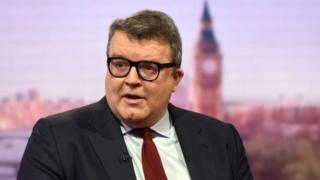 Image caption Mr Watson says he reached 22 stone before he began his diet
 After researching the subject, he started a diet by “giving up sugar” and cut out beer and curry. He then began to exercise, starting with walking then cycling, running, boxing and weight-training.
About four million people in the UK have diabetes, with the condition accounting for 10% of all NHS spending.
Poor diet and a lack of exercise mean it’s possible a million more people in this country could be diagnosed with diabetes over the next 20 years, according to a report by Public Health England.

What is type-2 diabetes?
Type-2 diabetes is a chronic condition associated with obesity and family history and is more likely to be diagnosed in older people. It’s more common than type-1 diabetes.
It is caused by problems with controlling blood sugar levels – either because the pancreas does not produce enough insulin, or if a body’s cells do not react to insulin as they should.
The condition is treated by medication or controlling a person’s diet.
Diabetes UK offers advice on preventing and coping with type-2 diabetes.
The changes that could prevent diabetes
Mr Watson has vowed to set up an independent, cross-party commission to investigate ways of preventing the condition if Labour wins power, with the aim of eliminating the estimated rise in cases within five years.
“I think a lot of people feel shame when they are diagnosed with it because you kind of know, you get warning signs,” he told Today.
“But for many millions of people, it’s an entirely preventable and reversible condition” with “the right nutrition and exercise”.
“It is a public health scandal that so many millions of people are having to suffer this condition when they don’t have to,” he added.
One of the most important risk factors for type-2 diabetes is being overweight or obese.
According to a World Health Organization report, the UK is the third fattest among 53 countries in Europe, with heavy drinking a key cause.
The United Nations body found 27.8% of adults in the UK are obese compared with 32.1% of people in Turkey and 28.9% in Malta.
Those whose body mass index is at least 30 are deemed to be obese.
-
Brexit: Tory MPs say technology key to avoiding hard Irish border
 Image copyright Getty Images Image caption The future management of the Irish border is one of three main priorities in UK-EU Brexit talks
A hard border on the island of Ireland can be avoided by using “established” technology and “modifying” existing arrangements, Brexiteer Tory MPs say.
The European Research Group said the issue had been allowed to “frame” the talks but need not block a trade deal.
They call for “effective co-operation” between Belfast and Dublin to address smuggling concerns and extra customs forms to be included in VAT returns.
The EU has insisted on a “backstop” to ensure the single market is protected.
Both the UK and the EU want to avoid a return to physical checks at the Northern Ireland border, but have yet to agree how this can be achieved.
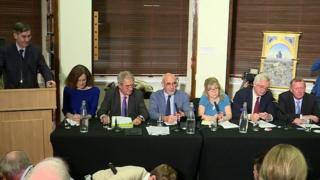 Image caption Two former Northern Ireland secretaries were among Tory MPs endorsing the proposals
 The report acknowledges a range of new checks will be needed on goods passing across the 310 mile border between Northern Ireland and the Republic of Ireland after Brexit, including extra customs declarations and declarations of origin as well as sanitary, phytosanitary and product compliance procedures.
Among the proposals put forward in the document to deal with these are:
Extra customs declarations should be incorporated into existing system of VAT returns Simplified customs procedures for the majority of cross-border trade Trusted trader-type schemes for large companies Equivalence of UK and EU regulations for agricultural produce Declaring the island of Ireland a Common Biosecurity Zone
The report concluded: “The proposals can be realised within the existing legal and operational frameworks of the UK and EU, based on the mutual trust on which regular trade depends.
“They do nothing to alter the constitutional position of Northern Ireland and do not violate the principle of consent of the enshrined in the Belfast Agreement.”
Are Tory MPs set to move against Theresa May?
By BBC political editor Laura Kuenssberg
There is massive frustration with her leadership, her position on Chequers and the way her proposals tuck the UK closely into the EU in perpetuity. And yes, there are some MPs who want to see her gone immediately.
However senior voices in the European Research Group – yes them – are adamant that it is not the time to try to oust the PM. It would be “stupid”, one told me last night.
Imagine in these critical weeks of the Brexit negotiations if the UK started to try to change the prime minister.
Right now those jostling to remove her know they don’t have any guarantees they would have the numbers to force her out, even though they may well be able to pull together enough MPs to submit letters to the chair of 1922 committee to trigger a contest.
Read Laura’s blog
John Campbell, the BBC’s Northern Ireland business and economics editor, said the document offered more detail than before and put forward a number of “plausible technocratic solutions”.
But he said they placed a lot of store on the EU agreeing to mutual recognition of standards and the UK having access to its VAT system – which was far from clear.
Former Northern Ireland First Minister Lord Trimble dismissed suggestions the Good Friday agreement could be put in peril by Brexit, saying fears of a “reversion to violence were wrong”.
“There is no serious threat from violence because we have sorted that issue,” he said.
Former Brexit Secretary David Davis said the proposals were “fabulously practical” and could “unlock” the current dispute over the PM’s Chequers proposals – which scores of Tory MPs have said they cannot support.
Both Mr Davis and Jacob Rees-Mogg, the ERG’s chair, dismissed talk of a leadership challenge to the prime minister – after it emerged the issue was discussed openly by Tory MPs at a meeting on Tuesday night.
“We’ve got a very good prime minister,” Mr Davis said.
“I disagree with her on one issue, it’s this issue. She should stay in place because we need stability, and we need decent government as the backdrop for what we’re doing in the coming next six months.”
-
Are Eurosceptic Tories really ready to move against May?
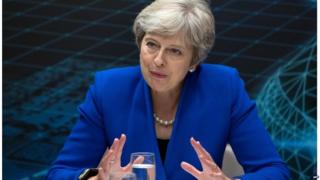 Image copyright AFP
As the BBC has been reporting, conversations about how and when to remove Theresa May took place with deadly seriousness last night among a group of Eurosceptic MPs.
There is massive frustration with her leadership, her position on Chequers and the way her proposals tuck the UK closely into the EU in perpetuity. And yes, there are some MPs who want to see her gone immediately.
However senior voices in the European Research Group – yes them – are adamant that it is not the time to try to oust the PM. It would be “stupid”, one told me last night.
Imagine in these critical weeks of the Brexit negotiations if the UK started to try to change the prime minister.
Right now those jostling to remove her know they don’t have any guarantees they would have the numbers to force her out, even though they may well be able to pull together enough MPs to submit letters to the chair of 1922 committee to trigger a contest.
So are the Eurosceptics coldly gaming the options for how to get their way? Does that include discussing if, when and how, they could try to push the prime minister out of office? Absolutely.
But does it mean we are on the verge of a coup being launched against Number 10? Things can change very fast these days. But don’t be so sure.
-
UKIP AM Caroline Jones quits party over ‘far-right move’
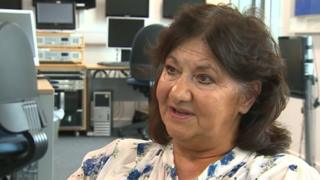 Image caption Caroline Jones lost a leadership election to Gareth Bennett in the summer
The former leader of the UKIP group in the Welsh Assembly has resigned from the party.
Caroline Jones claimed UKIP leader Gerard Batten was alienating his members by moving the party to the far-right.
The AM for South Wales West, who will now sit as an independent, said UKIP was taking “a direction that I’m not comfortable with”.
But Mr Batten said her statement was “politically correct twaddle”.
The resignation means the UKIP group has four AMs left from the seven which entered the Senedd in 2016.
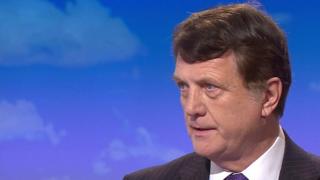 Image caption Gerard Batten has taken the party in “a direction I’m not comfortable with”, Caroline Jones said
 She told BBC Wales: “The party has taken a direction that I’m not comfortable with.”
Mrs Jones said Mr Batten was changing the party “to a more far-right position, which a lot of the long-standing members are finding quite unfavourable, including myself”.
“I never joined the party to be part of a far-right organisation. I joined the party because I wanted to come out of the European Union. I still do.”
“Gerard Batten should listen to all sides and try to mediate and bring people together, as opposed to alienating them”, she added.
‘Politically ineffective’
Mr Batten was appointed leader earlier this year, after former UKIP leader Henry Bolton was sacked.
He is the fourth person to lead UKIP following the EU referendum.
Caroline Jones took over the UKIP group in May after she was backed by David Rowlands and Michelle Brown in a vote.
However, Welsh UKIP members voted over the summer for Gareth Bennett to succeed her and lead the assembly group.
Mr Batten said: “I have brought the party back from financial meltdown, raised funds, raised membership numbers, and raised UKIP in the polls. Ms Jones has contributed nothing that I am aware of.”
He added: “Her statement is politically correct twaddle to disguise the fact that Mrs Jones is politically ineffective. I wish her well languishing in the outer realms of irrelevance.”
-
Arlene Foster to meet prime minister in London
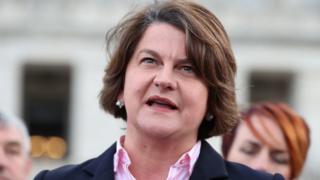 Image copyright PA Image caption DUP leader Arlene Foster had given a cautious welcome to plans to cut MLA pay and give civil servants more power
DUP leader Arlene Foster is expected to meet the prime minister and secretary of state in London on Wednesday to discuss the government’s latest proposals over the Stormont deadlock.
Karen Bradley has proposed a cut to MLA pay and plans to provide greater powers to local civil servants.
The DUP gave the development a cautious welcome.
It described it as a small step, but argued that there remains a need for ministerial decision making.
NI secretary announces MLA pay cut Who’s calling the shots on NI policy? Stormont still dormant after 541 days
The Northern Ireland Assembly has not sat for 20 months.
Separately, pro-Brexit Conservaties are expected to publish a paper later on Wednesday focusing on the border and the backstop policy, which is central to the UK’s current negotiations with the EU.
Tory Brexiteers have been strongly critical of Theresa May’s decision to sign up to a backstop.
The launch of their paper is expected to be attended by former Brexit Secretary David Davis, former Northern Ireland Secretaries Owen Paterson and Theresa Villiers, former Northern Ireland First Minister Lord Trimble and Jacob Rees-Mogg, the chairman of the eurosceptic European Research Group.
-
Fresh call for smacking to be outlawed in the home
 Image copyright Getty Images
Smacking is harmful to children’s mental health and should be banned, school psychologists say.
The Association of Educational Psychologists has tabled a motion to the TUC Conference calling for physical punishment to be outlawed.
Presently, although corporal punishment is banned in schools, parents can “smack” or physically chastise a child as long as it is deemed “reasonable”.
Psychologists say there are many better ways of teaching right from wrong.
Member of the AEP national executive committee, John Drewicz, will tell the conference in Manchester: “Smacking is harmful to a child’s mental health, it models aggressive behaviour and it says to them that it is OK to use violence.”
He will add: “Sixty countries already have full bans, including Sweden, Ireland, Spain, Germany and Portugal, and it is time to make violence against children illegal in the UK in all settings, including the home.”
The motion also notes that the Welsh government is taking steps towards removing the defence of reasonable chastisement for parents.
But some campaigners have argued that parents would be criminalised if a smacking ban were to be passed.
There are also moves in the Scottish Parliament to ban physical chastisement of children.
‘Higher aggression’
A bill, lodged by Green MSP John Finnie, has been backed by the government and looks certain to pass at Holyrood.
Psychologists cite research suggesting that when force is used by parents, there are changes in their brain activity which mean the degree of force used on the child can escalate.
They argue that physical chastisement also leads to a lower quality of parent-child relationship, poorer mental health in childhood and adulthood, as well as higher levels of aggression in the child and more anti-social behaviour.
The biggest teaching union, the National Education Union, is seconding the motion.
Dr Mary Bousted, joint general secretary of the union, said parents and carers had a right to set boundaries for their children to help them develop social skills and good behaviour.
“However we need to ensure that children are legally safeguarded in their own homes.
“We are not talking about dictating to parents how this is done but what we are saying is that it in 2018 beating children in anger, or as part of a pre-meditated punishment, is neither acceptable or defensible.”