Category: WORLDS

  • Kim Jong-un, Moon Jae-in meeting failure could scuttle Trump summit

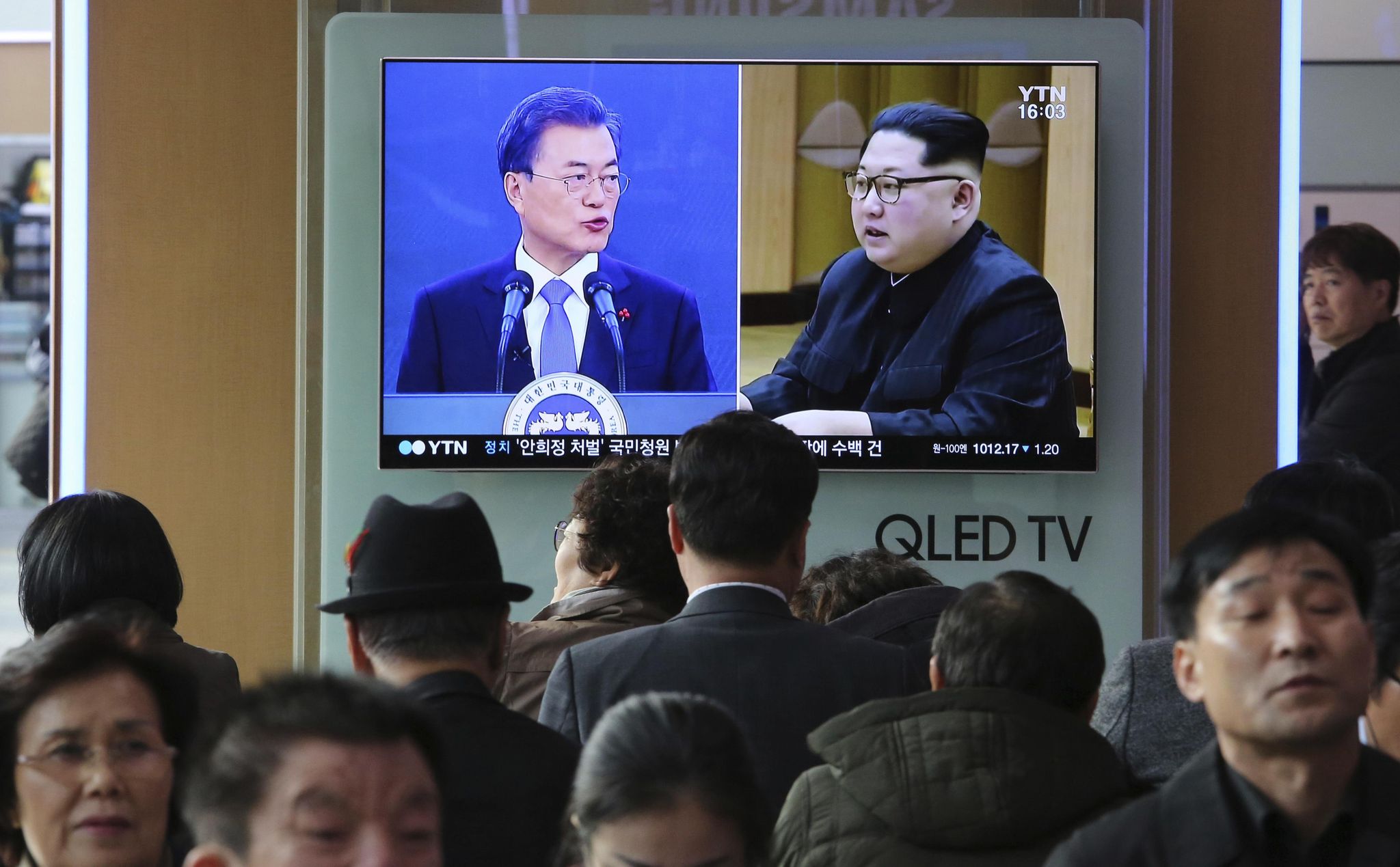
    The prospect for a historic summit between President Trump and Kim Jong-un is rising, but it won’t happen if things don’t go smoothly Friday when the North Korean leader first meets with South Korean

    SEOUL — The prospect for a historic summit between President Trump and Kim Jong-un is rising, but it won’t happen if things don’t go smoothly Friday when the North Korean leader first meets with South Korean President Moon Jae-in for their own high-stakes one-on-one meeting.

    North Korea says it is ready to halt testing of its nuclear weapons programs indefinitely, but Mr. Moon is still under immense pressure to get Mr. Kim to publicly declare that he is willing to discuss total abandonment and dismantling of the weapons he already has. Washington has drawn the red line for serious talks toward sanctions relief to proceed.

    South Korean officials said Mr. Kim signaled such willingness to them during a private meeting last month, but the North Korean leader hasn’t said anything in public.

    “So President Moon knows that if he cannot get some kind of denuclearization statement from Kim on April 27, people will consider the summit a failure,” said Joonhyung Kim, a regional geopolitics researcher at South Korea’s Handong University who is part of a circle of analysts advising the Moon administration.

    “We need to hear it from Kim Jong-un’s mouth,” Mr. Kim told The Washington Times.

    The likelihood of a Trump-Kim summit even without a clear denuclearization statement from Mr. Kim seemed to get a boost with the revelation last week that CIA Director Mike Pompeo held a secret meeting with the North Korean leader in Pyongyang early this month.

    But concern over the issue has persisted amid Pyongyang’s claim that it is willing to scrap a major nuclear test site and indefinitely halt nuclear and missile tests because it is confident it has achieved its goal of developing a nuclear arsenal that can ward off attacks and ensure the survival of the regime.

    Denuclearization is just one of the major issues looming over the Moon-Kim summit Friday in the village of Panmunjom, along the heavily guarded Demilitarized Zone that has divided the Korean Peninsula since the armistice that ended the 1950-1953 hostilities.

    Another major question centers on the extent to which Mr. Moon makes promises to the North that diverge from views of hard-liners in the Trump administration. Such promises could relate to Pyongyang’s desired retention of intercontinental ballistic missiles or the speed at which the Kim regime can expect relief from crippling international sanctions.

    Mr. Moon, who has long advocated a policy of outreach to Pyongyang, may simply seek to keep talks alive with the North, regardless of pressure from Washington.

    Where the Trump administration is seen to desire an “all-or-nothing deal” that can be reached quickly, many here say Mr. Moon is committed to a slower approach — one that has denuclearization as a goal to be achieved over a significant time frame.

    One senior official, who spoke on the condition of anonymity, said Mr. Moon’s advisers are confident that they have persuaded the Trump administration to go along with this “very gradual approach that will eventually lead to reaching our collective goal of denuclearization.”

    The official said the “situation is complex,” with Mr. Moon playing the delicate role of “mediator between Trump and Kim.”

    Mr. Moon’s conservative critics here fear that the South Korean president may be overconfident and risk losing Washington’s trust by yielding too eagerly to Pyongyang. “I wouldn’t be surprised if some of these [expletives] in the Moon administration are talking more to the North Koreans than they are to the Americans at this point,” one former high-level official told The Times.

    But most South Korean analysts say Mr. Moon knows what’s at stake.

    “President Moon is going to be trying with maximum effort to persuade Kim Jong-un to keep his commitment to denuclearize and to not step back from the commitment he already made in private to a special delegation that went to Pyongyang,” said Paik Hak-soon, a top North Korea specialist with the Sejong Institute think tank outside Seoul.

    But Mr. Paik said a range of other issues will likely be discussed Friday, including a push to set clear guidelines for regular high-level military-to-military communications between North and South, with the goal of avoiding a clash should the diplomatic push melt down.

    ‘Anything is possible’

    Mr. Paik said he is confident that the Moon-Kim summit could set the stage for a major and swift breakthrough in the subsequent Trump-Kim summit, especially because it won’t be mired by the presence of other regional powers.

    The last major attempt at diplomacy with North Korea — the yearslong “six-party talks” that melted down in 2009 — involved high-level representatives from China, Russia, the U.S., Japan and South Korea.

    “This bilateral format this time around, coupled with the timing of this U.S.-North Korea summit taking place at a quite early stage of the Trump administration’s tenure, and also the Trump administration’s special leadership style, could give both sides a lot of confidence in making a deal,” said Mr. Paik. “Anything is possible in this format if the personal chemistry is there.

    “Getting Trump and Kim alone together gives an incentive to both sides,” he said. “Donald Trump thinks that in a bilateral format he can exercise whatever power he has to induce Kim Jong-un to make concessions, and Kim Jong-un might be in the same position, thinking he can talk to American leadership directly and put all the key issues on the table and do a comprehensive package deal.”

    The bilateral approach also leaves China and Japan on the outside looking in, which some here argue has been Mr. Moon’s strategy all along. “I was advising Moon on foreign policy in last year’s election,” said Mr. Kim, the geopolitics researcher at Handong University. “The idea is that the smaller the number of players the better.”

    Jun Bong-geun, who oversees security and unification studies at the Korea National Diplomatic Academy in Seoul, suggested that even if North Korea is only posturing in the talks, Mr. Kim will have to commit quickly to something in a one-on-one setting with Mr. Trump.

    “If the North Koreans want to truly buy time, they’re going to have to come up with some kind of denuclearization measures,” said Mr. Jun, although he added that he won’t be surprised if Pyongyang first makes an offer to get rid of its ballistic missiles as a way to delay a serious confrontation on the nuclear issue.

    Others warn against believing in anything that the North Koreans bring to the table.

    “I have experience dealing with them, and I know they are not simply going to get rid of their nuclear weapons,” said Kim Hee-sang of the Korea Institute for National Security Affairs think tank in Seoul.

    ‘Missed chance’

    A former longtime adviser to the South Korean government, Mr. Kim told The Times that “the simple reality is that the North Koreans will be disingenuous throughout these upcoming summits.”

    He added that North Korea’s leader may offer to break up his nuclear program but said the offer will be superficial and that Pyongyang will make it known that pieces of the program can be hidden and restarted in the future.

    On a separate front, Mr. Kim expressed concern that Mr. Moon may be planning to offer the North Korean leader something well beyond the American comfort level regarding the size or positioning of U.S. forces stationed in South Korea.

    Pyongyang has long asserted that it would consider denuclearization only in conjunction with the departure of the 30,000 U.S. forces deployed to the South since the Korean War ended in a stalemate.

    Although the Moon administration claimed to have received back-channel assurances that Pyongyang is willing to drop the demand for troop withdrawal, Mr. Kim said there is reason for concern.

    “I don’t think Moon will make promises that cannot be kept, but I am concerned because everyone knows that when it comes to serious peace negotiations on the Korean Peninsula, the [troops] issue always arises,” he said. “There should never be a case where the U.S. military leaves South Korea.”

    Mr. Kim added flatly that whatever happens with the upcoming talks, the long-term policy toward North Korea should be some form of regime change.

    Mr. Kim lamented that the downside of the push for peaceful negotiations is that it has given a hue of legitimacy to the regime in Pyongyang and, as a result, pushed the “regime change issue off the table.”

    “The Trump administration has made an effective outcome here so far by making North Korea think they are in a very severe and desperate situation and that they have no choice but to try talking,” he said. “But when Trump brought about the ‘maximum pressure’ campaign of the past year, there was a chance to bring about regime change in Pyongyang.

    “Right now,” he said, “we’ve missed that chance.”
  • Van hits at least 10 people in Toronto, say Canada police

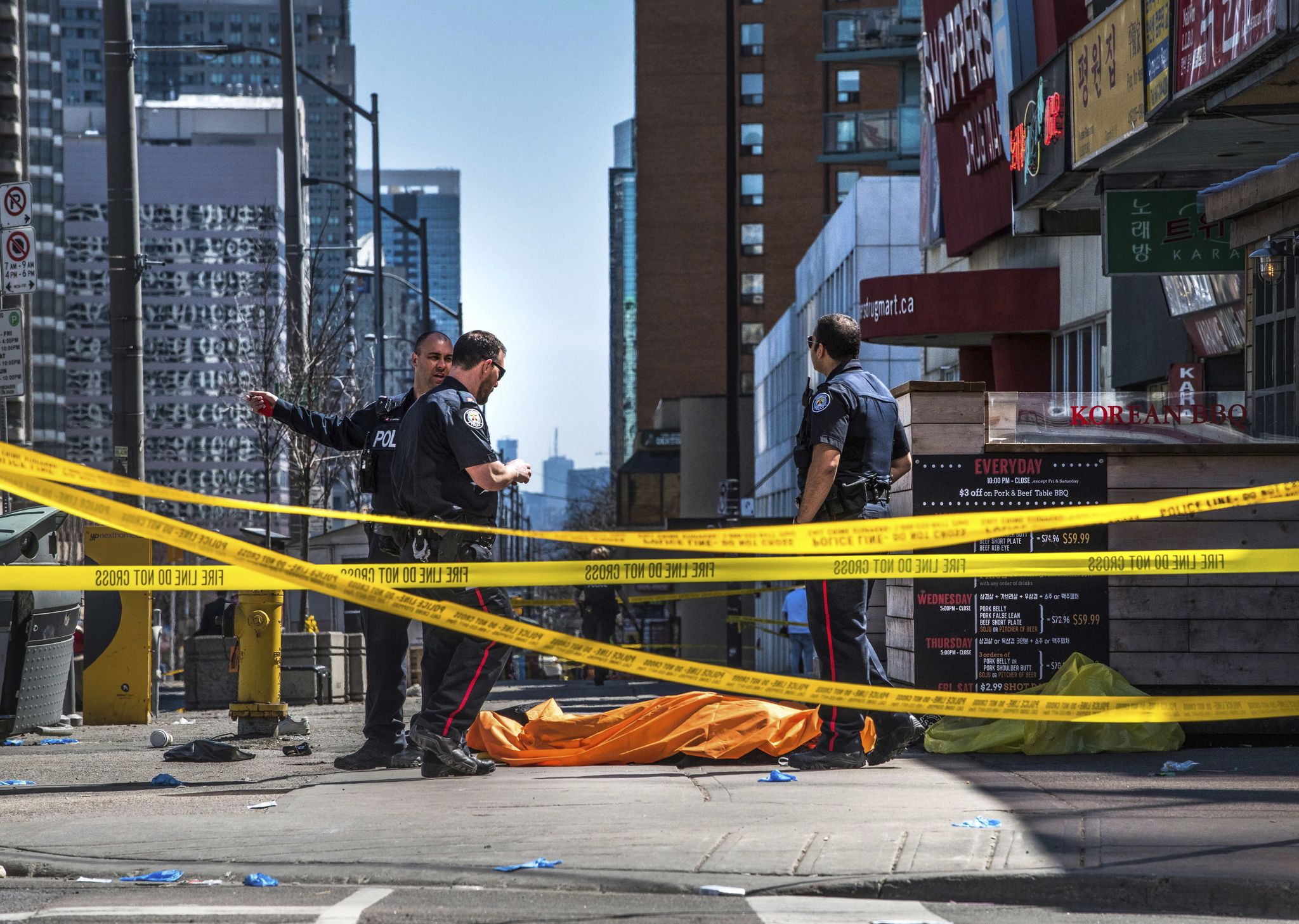
    A van apparently jumped onto a sidewalk Monday at a busy intersection in Toronto and struck down pedestrians before the vehicle was found and the driver taken into custody, Canadian police said.

    TORONTO — A rented van plowed down a crowded Toronto sidewalk Monday, killing 10 people and injuring 15 before the driver fled and was quickly arrested in a confrontation with police, Canadian authorities said.

    Witnesses said the driver was moving fast and appeared to be acting deliberately, but police officials would not comment on the cause or any possible motive.

    Speaking at a news conference Monday night, Toronto Police Chief Mark Saunders raised the initial death toll of nine to 10, saying another victim had died at a hospital. He said 15 others were hospitalized.

    Saunders identified the man detained after the incident as Alek Minassian, 25, a resident of the Toronto suburb of Richmond Hill. He said the suspect had not been known to police previously.

    Asked if there was any evidence of a connection to international terrorism, the chief said only, “Based on what we have there’s nothing that has it to compromise the national security at this time.”

    But a senior national government official said earlier that authorities had not turned over the investigation to the Royal Canadian Mounted Police, a sign that investigators believed it unlikely terrorism was the motive. The official agreed to reveal that information only if not quoted by name.

    Authorities released few details in the case, saying the investigation was still underway, with witnesses being interviewed and surveillance video being examined.

    “I can assure the public all our available resources have been brought in to investigate this tragic situation,” Toronto Police Services Deputy Chief Peter Yuen said earlier.

    The incident occurred as Cabinet ministers from the major industrial countries were gathered in Canada to discuss a range of international issues in the run-up to the G7 meeting near Quebec City in June.

    Minister of Public Safety Ralph Goodale said that it was too soon to say whether the crash was a case of international terrorism and that the government had not raised its terrorism alert.

    The driver was heading south on busy Yonge Street around 1:30 p.m. and the streets were crowded with people enjoying an unseasonably warm day when the van jumped onto the sidewalk.

    Ali Shaker, who was driving near the van at the time, told Canadian broadcast outlet CP24 that the driver appeared to be moving deliberately through the crowd at more than 30 mph.

    “He just went on the sidewalk,” a distraught Shaker said. “He just started hitting everybody, man. He hit every single person on the sidewalk. Anybody in his way he would hit.”

    Witness Peter Kang told CTV News that the driver did not seem to make any effort to stop.

    “If it was an accident he would have stopped,” Kang said. “But the person just went through the sidewalk. He could have stopped.”

    Video broadcast on several Canadian outlets showed police arresting the driver, dressed in dark clothes, after officers surrounded him and his rental Ryder van several blocks from where the incident occurred in the North York neighborhood of northern Toronto. He appeared to make some sort of gesture at the police with an object in his hand just before they ordered him to lie down on the ground and took him away.

    Witness Phil Zullo told Canadian Press that he saw police arresting the suspect and people “strewn all over the road” where the incident occurred.

    “I must have seen about five, six people being resuscitated by bystanders and by ambulance drivers,” Zullo said. “It was awful. Brutal.”

    Police shut down the Yonge and Finch intersection following the incident and Toronto’s transit agency said it had suspended service on the subway line running through the area.

    Prime Minister Justin Trudeau expressed his sympathies for those involved. “Our hearts go out to everyone affected,” Trudeau said in Ottawa. “We are going to have more to learn and more to say in the coming hours.”

  • Donald Trump, Emmanuel Macron state visit to focus on Iran nuclear deal

    President Trump welcomed French President Emmanuel Macron on Monday for the administration’s first state visit, cementing the close alliance between the two countries with a whirlwind of events that i

    President Trump welcomed French President Emmanuel Macron on Monday for the administration’s first state visit, cementing the close alliance between the two countries with a whirlwind of events that include a Marine One helicopter tour of Washington and a private dinner at Mount Vernon.

    On the business side of visit, Mr. Trump and Mr. Macron will broach trade and military issues, including the touchy subject of the Iran nuclear deal in which the two men take opposite views.

    Mr. Trump wants to scuttle the Obama-era agreement with Iran, and he could move to withdraw the U.S. as soon as next month. Mr. Macron has urged Mr. Trump to reconsider.

    “The president has been extremely clear that he thinks it is a bad deal. That certainly hasn’t changed,” said White House spokeswoman Sarah Huckabee Sanders.

    Still, she said the president would listen to arguments for how the deal could be improved to benefit the American people.

    In New York City on Monday, Iranian Foreign Minister Mohammad Javad Zarif said it’s up to the European signatories of the nuclear deal to convince President Trump not to exit the controversial accord.

    “It is either all or nothing,” Mr. Zarif tweeted. “European leaders should encourage Trump not just to stay in the nuclear deal, but more important to begin implementing his part of the bargain in good faith.”

    Mr. Zarif’s comments followed vows from other Iranian officials to “shred” the nuclear agreement if Washington withdraws.

    On Tuesday night, Mr. Trump and first lady Melania Trump will host the French president and his wife, Bridgette Macron, at his presidency’s first state dinner. The main course will be rack of spring lamb, and the entertainment will be a performance by the Washington National Opera from the John F. Kennedy Center for the Performing Arts, according to the White House.

    “This visit will celebrate the long and enduring friendship between France and the U.S.,” said Mrs. Sanders.

    Mr. Trump waited longer than many of his predecessors to host a state visit. He is the first president since Calvin Coolidge in the 1920s to finish his first year in office without one.

    Although they appear to be political opposites, Mr. Trump and Mr. Macron made fast friends when they met at a NATO summit. The bond grew stronger when Mr. Macron hosted Mr. Trump in Paris for Bastille Day.

    “They are not such an odd couple when you scratch the surface,” said Michael C. Desch, director of the Notre Dame International Security Center.

    He referred to Mr. Trump as a Francophile.

    “At least in terms of the pomp and circumstance of French governmental ceremonies. Remember that it was at a Bastille Day parade that the president got the idea for a military parade here,” said Mr. Desch. “Also, they share a surprising number of similarities, both personal, both political outsiders and businessmen, to substantive: Syria and the war on ISIS.”

    For the state dinner, Mr. Trump broke with tradition by not inviting journalists or any Democratic members of Congress.

    He also is hosting a smaller gathering than the White House soirees thrown by his predecessor.

    Mr. Trump has about 150 guests on the list. The guests at President Obama’s state dinners numbered in the hundreds, which required a huge tent on the South Lawn because there wasn’t a room large enough inside the White House to accommodate so many people.

    Mr. Obama’s first state dinner was for Indian Prime Minister Manmohan Singh and featured vegetarian food. The event was marred by party crashers Michaele and Tareq Salahi, winemakers from Virginia who were angling for a spot on the reality TV show “Real Housewives of D.C.”

    The couple’s ability to crash the state dinner, including getting photos with Vice President Joseph R. Biden, prompted a Secret Service security review and led to the resignation of White House social secretary Desiree Rogers.

    Mr. Obama and President Clinton held their first state dinners in November of their first year in office. President George W. Bush had his in September of his first year.

    In their eight years as president, Mr. Obama and Mr. Bush hosted 13 state dinners. Mr. Clinton threw 28 state dinners.

    Mrs. Trump, who is responsible for organizing nearly every detail of the visit and the grand state dinner, has spent months planning events for the Macrons’ three-day visit to the capital.

    “The menu will be a showcase of the best of America’s cuisines and traditions, with nuances of French influences prepared by the renowned White House Executive Chef, Christeta Comerford,” the White House said in a statement outlining details of the state visit and dinner.

    The first course at the state dinner will be goat cheese gateau, tomato jam, buttermilk biscuit crumbles and young variegated lettuces. The main course includes rack of spring lamb, burnt cipollini soubise and Carolina gold rice jambalaya.

    Dessert will be nectarine tart and creme fraiche ice cream.

    “The wines were selected to complement the menu and embody the historic friendship between the United States and France, which dates back to the American Revolution,” said the White House.

    Mr. Trump does not drink alcohol, but Mr. Macron, who has a reputation for following a strict diet, is known to drink wine for lunch and dinner.

    The wines for the state dinner include Domaine Serene Chardonnay Evenstad Reserve from 2015, which is the product of American and French collaboration. The wine was aged in 40 percent French oak barrels for more than 12 months, according to the White House.

  • Prince William and wife Kate welcome a son, their third child

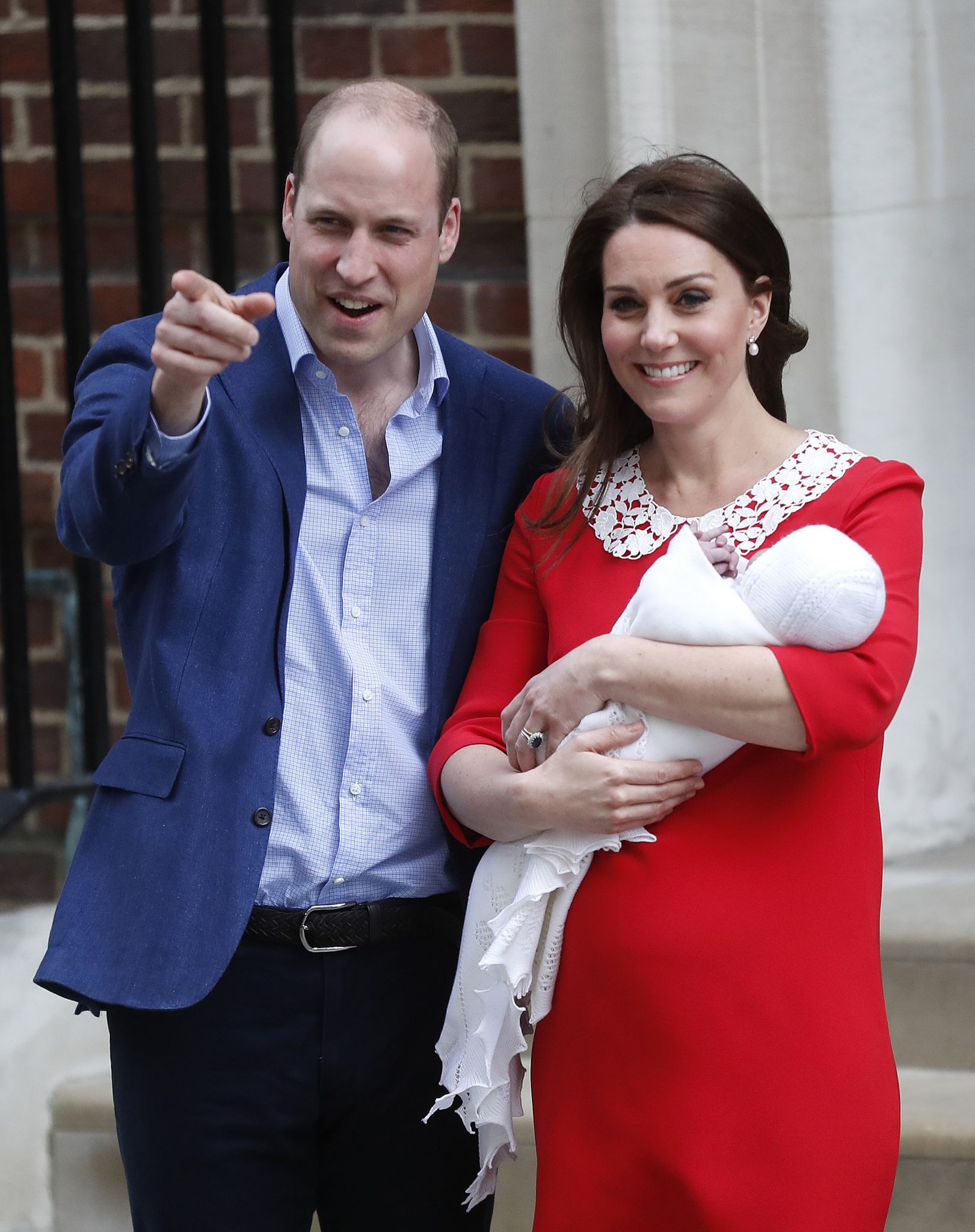
    Duchess of Cambridge Kate Middleton gave birth to a baby boy, her third child with Prince William, on Monday at St. Mary’s Hospital, Kensington Palace announced.

    Duchess of Cambridge Kate Middleton gave birth to a baby boy, her third child with Prince William, on Monday at St. Mary’s Hospital, Kensington Palaceannounced.

    The baby weighed 8 pounds and 7 ounces.

    The palace also notes that both the mother and baby are doing well.

    “The queen, the Duke of Edinburgh, the Prince of Wales, the Duchess of Cornwall, Prince Harry and members of both families have been informed and are delighted with the news,” the palace said in a statement, The Associated Press reported.

    The baby is a younger brother to 4-year-old Prince George and Princess Charlotte, who turns 3 next week, AP said.

    Her Royal Highness The Duchess of Cambridge was safely delivered of a son at 1101hrs.The baby weighs 8lbs 7oz.The Duke of Cambridge was present for the birth.Her Royal Highness and her child are both doing well.

    — Kensington Palace (@KensingtonRoyal) April 23, 2018

  • Javad Zarif: Up to Europe to swing Trump on nuclear deal

    Iranian foreign minister says it’s up to Europe to convince President Trump not to exit the controversial accord.

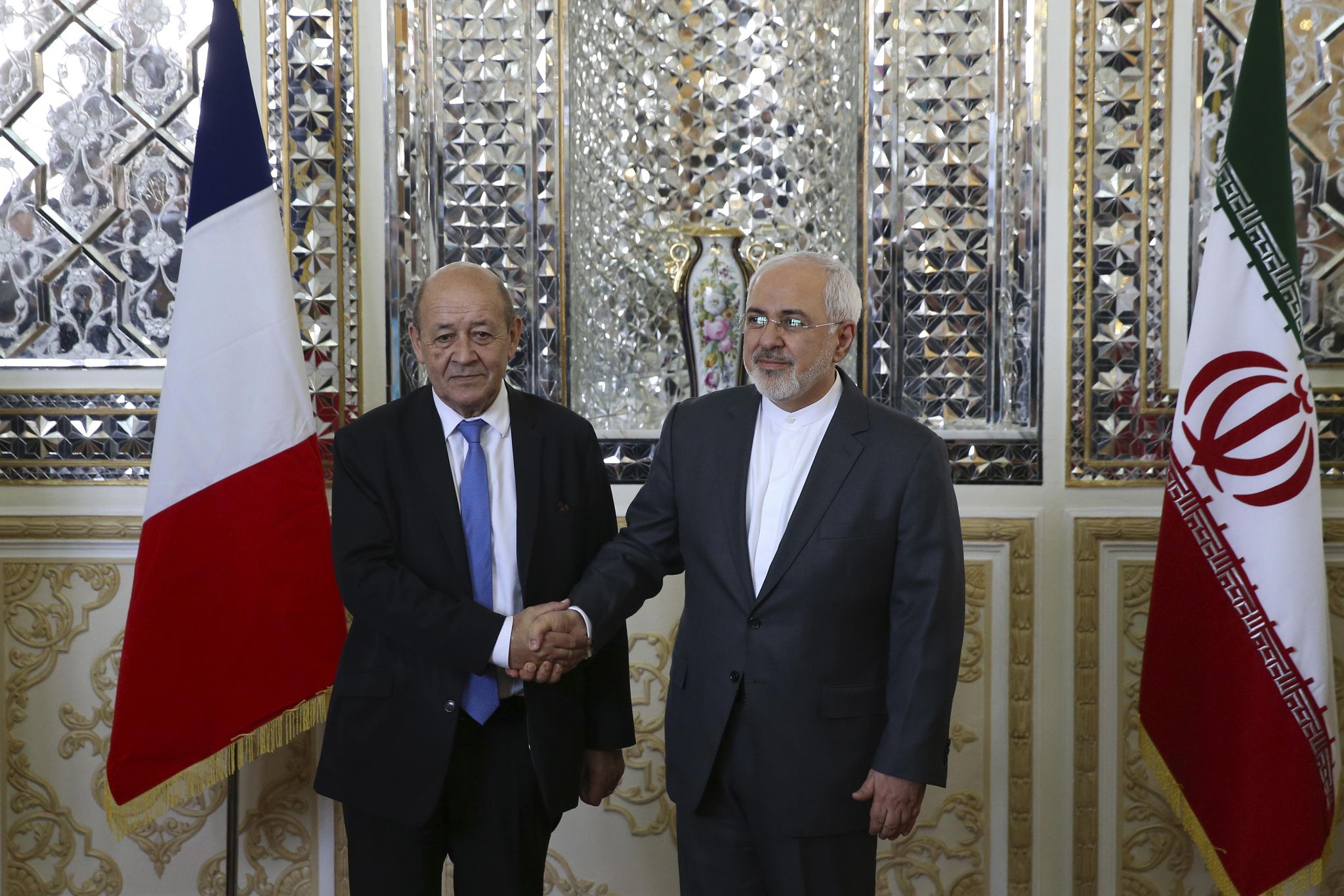
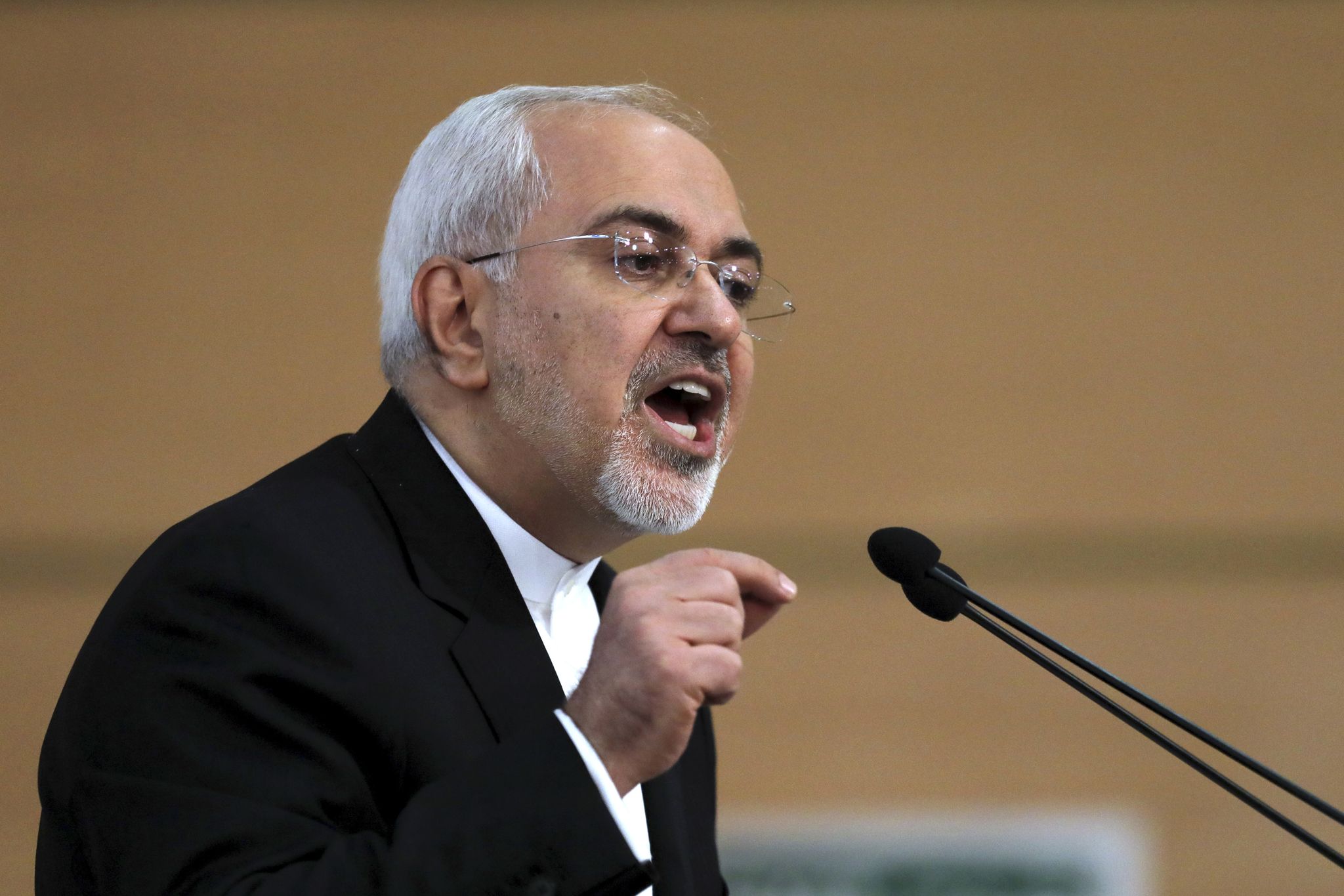
    Iranian Foreign Minister Mohammad Javad Zarif said Monday the European signatories of the Iranian nuclear deal should convince President Trump not to exit the controversial accord.

    “It is either all or nothing,” Mr. Zarif tweeted. “European leaders should encourage Trump not just to stay in the nuclear deal, but more important to begin implementing his part of the bargain in good faith.”

    Mr. Zarif’s comments during a visit to New York City this week followed vows from other Iranian officials to “shred” the nuclear agreement if Washington withdraws from it and to resume the Islamic republic’s nuclear program “at much greater speed.”

    Formally known as the JCPOA, or Joint Comprehensive Plan of Action, the 2015 deal saw Iran agree with the U.S., France, Germany, Britain, Russia and China to stop its nuclear weapons development in exchange for the lifting of international economic sanctions.

    But Washington opposition has grown as doubts — especially among conservatives and Mr. Trump — have multiplied over Iran’s trustworthiness and compliance.

    Mr. Trump has made revisiting the deal one of his top foreign policy priorities and attempted to leverage its quarterly reauthorization process as a negotiating chip while lashing out at Tehran for its ballistic missile program and continued support of Syrian President Bashar al Assad.

    Under U.S. law, the president must reauthorize the deal every 120-180 days by signing a waiver. For months, Mr. Trump has threatened to dump the deal unless it is tightened up. During the last reauthorization waiver extension in January, he said it was a “last chance” to change the accord before Washington withdraws.

    European signatories now have a May 12 White House deadline to change the deal, or Mr. Trump will refuse to extend U.S. sanctions relief on Iran — effectively killing the contentious, landmark agreement.

    On Sunday, French President Emmanuel Macron urged Mr. Trump to stick with it, warning that there is no “plan B” if the U.S. opts out.

    “President Macron is correct in saying there is no “plan B” on JCPOA,” Mr. Zarif added on his Tweet Monday.

    The Iranian foreign minister sought to bolster the message during an appearance Monday evening at the Council on Foreign Relations, an American think tank in New York City, during which he argued that the nuclear deal as inked in 2015 was fair because all sides made serious concessions.

    “Nobody won when we were trying to up the ante against one another … in the nuclear talks,” Mr. Zarif said, adding that the deal worked because the various sides figured out that “everybody loses” in a successful negotiation.

    But Mr. Zarif went on to argue that America under the Trump administration is now “in violation” of the deal even as Iran has been repeatedly credited with performing satisfactorily by the International Atomic Energy Agency (IAEA) — the U.N. nuclear watchdog tasked with overseeing the deal’s implementation.

    The foreign minister claimed that Washington has failed to keep up its end of the deal by blocking licenses to international companies to invest in the Iranian economy. He suggested that the Trump administration is responsible for preventing the U.S. Treasury Department’s Office of Foreign Asset Control (OFAC) from issuing such licenses since coming to office last year.

    “We have 11 reports of the IAEA saying that Iran performed, but since President trump came to office, not a single license has been issued, not a single OFAC license,” Mr. Zarif said. “So the U.S. is already in violation.”

    Mr. Macron, meanwhile, is visiting Washington this week for three days of VIP events, including Mr. Trump’s first state dinner on Tuesday with first lady Melania Trump, Brigitte Macron and Mr. Macron.

    The Iran issue will likely be discussed — with Paris having previously suggested tougher measures against Iran’s ballistic missile programs to “supplement” the nuclear deal.

    Another deal ally, German Chancellor Angela Merkel, also visits the White House on April 27. While Mr. Trump and Mr. Macron have forged a close relationship, his bond with Mr. Merkel is said to be more distant.

    European commentators have noted that despite that, both Mr. Macron and Ms. Merkel seek to assure Mr. Trump that Europe shares his concerns about Iranian aggression across the Middle East.

    On a separate front Monday, Russian Foreign Minister Sergey Lavrov said China and Russia would block any attempts to “sabotage” the deal.

    “There are attempts to interfere with the international order upon which the United Nations depends,” Mr. Lavrov said, after talks with Chinese officials before a meeting of the Shanghai Cooperation Organisation, a regional security bloc spearheaded by Moscow and Beijing.

    Praising the JCPOA as “one of the biggest achievements in international diplomacy in recent times,” Mr. Lavrov added that “revising this document is unacceptable.”

    Guy Taylor contributed to this report.

  • Donald Trump goes all out for first state visit, will welcome Emmanuel Macron

    President Trump’s first state visit will welcome French President Emmanuel Macron with pomp and grandeur including a traditional review of U.S. troops, a diner showcasing the “best of American cuisine

    President Trump’s first state visit will welcome French President Emmanuel Macron with pomp and grandeur including a traditional review of U.S. troops, a diner showcasing the “best of American cuisines” and a performance by the Washington National Opera, the White House said Monday.

    First lady Melania Trump, whose office organized the grand affair, released details of the visit by Mr. Macron and his wife Brigitte Macron for three days of events that include a state dinner Tuesday.

    “First Lady Melania Trump and President Donald J. Trump are excited to welcome President Emmanuel Macron and Mrs. Brigitte Macron of France for the Trump Administration’s first state visit,” the White House said.

    Mr. Trump is the first president since Calvin Coolidge in the 1920s to not host a state visit during his first year in office. The week’s events, however, are designed to make up for any lost time.

    The visit kicks off Monday with the president and first lady welcoming the Macrons with a tree-planting ceremony on the South Lawn of the White House.

    Monday evening, the two couples will depart the White House on the presidential helicopter Marine One, for a scenic tour of historic monuments in Washington, ending at Mount Vernon — the iconic home of America’s first president, George Washington.

    The White House released details of Tuesday’s events:

    Arrival Ceremony:

    On Tuesday Morning, April 24, the President and First Lady will host the State Arrival Ceremony on the South Lawn of the White House. With the practice tracing back to the 17th century, the Trump Administration is proud to carry on the traditional military arrival ceremony. Nearly 500 members of the United States Armed Forces from all five military branches will be on the South Lawn for the traditional “Review of the Troops.” Guests invited to attend the ceremony include Cabinet Secretaries, Members of Congress, military families, and students from the Maya Angelou French Immersion School in Temple Hills, Maryland.

    State Dinner:

    The color scheme is cream and gold and the china settings consist of the Clinton china for the baseplate, along with both Bush (43) and Clinton china for the dinner service. The First Lady chose the Bush china with the green color palette to complement the spring green and white flowers that will be featured in the State Dining Room. Mrs. Trump has also selected pieces from the extensive Vermeil collection as well as American Silver from the White House Collection — from Tiffany & Co. and S. Kirk & Sons — to add to the décor in the State Dining Room.

    Entertainment:

    Washington National Opera from the John F. Kennedy Center for Performing Arts.

    Floral Arrangements:

    The Cross Hall will feature over 1,200 branches of cherry blossom, all grown in the United States.

    The State Dining Room will feature more than 2,500 stems of white sweet peas and nearly 1,000 stems of white lilac — both California and Dutch grown mixed.

    The parlors will feature a variety of mixed garden flowers. The Stephanotis vines, which will also be featured in the parlors, are from California.

    The Menu:

    The menu will be a showcase of the best of America’s cuisines and traditions, with nuances of French influences prepared by the renowned White House Executive Chef, Christeta Comerford.

    The first course celebrates the wondrous first harvest of spring, using greens from the White House kitchen garden.

    The main course will be a Rack of Spring Lamb and Carolina Gold Rice Jambalaya, which will be cooked in a New Orleans tradition and scented with the trinity of Cajun cooking — celery, peppers, and onions, and spiced with herbs from the South Lawn.

    Dessert will be a Nectarine Tart infused with White House honey and accented by crème fraîche ice cream.

    Wines:

    The wines were selected to complement the menu and embody the historic friendship between the United States and France, which dates back to the American Revolution.

    The Domaine Serene Chardonnay “Evenstad Reserve” 2015 is the product of American and French collaboration — a combination of French plants from Dijon that thrive in the volcanic Oregon soil and colder temperatures. The wine was aged in 40 percent French oak barrels for more than 12 months.

    The Domaine Drouhin Pinot Noir “Laurène” 2014 — This wine uses the motto “French soul–Oregon soil.” The grapes at Domaine Drouhin are harvested and sorted by hand and fermented in French Oak barrels.

    Schramsberg Demi-Sec “Crémant” has been served in the White House for official and ceremonial events many times over the years. The subtle sweetness and creamy effervescence of the 2014 vintage is the perfect accompaniment for a nectarine tart.

  • Tension mounts between Donald Trump and Tehran over Iran nuclear deal

    Iranian Foreign Minister Mohammad Javad Zarif said Monday the European signatories of the Iranian nuclear deal should convince President Trump not to exit the controversial accord.

    Iranian Foreign Minister Mohammad Javad Zarif said Monday the European signatories of the Iranian nuclear deal should convince President Trump not to exit the controversial accord.

    “It is either all or nothing,” Mr. Zarif tweeted. “European leaders should encourage Trump not just to stay in the nuclear deal, but more important to begin implementing his part of the bargain in good faith.”

    Mr. Zarif is scheduled to deliver a speech Monday night at the Council on Foreign Relations, an American think tank in New York City. He is expected to address Tehran’s vision of the deal’s future, in addition to accusing key U.S. ally, Saudi Arabia, of destabilizing the Middle East.

    Officials in Tehran have announced they will “shred” the agreement if Washington withdraws and vowed to then resume their nuclear program “at much greater speed.”

    Formally known as the JCPOA, or Joint Comprehensive Plan of Action, the 2015 deal saw Iran agree with the U.S., France, Germany, Britain, Russia and China to stop its nuclear weapons development in exchange for the lifting of international economic sanctions.

    But Washington opposition has grown as doubts — especially among conservatives and Mr. Trump — have multiplied over Iran’s trustworthiness and compliance.

    Mr. Trump has made revisiting the deal one of his top foreign policy priorities and attempted to leverage its quarterly reauthorization process as a negotiating chip.

    Under U.S. law, the president must reauthorize the deal every 120-180 days by signing a waiver. For months, Mr. Trump has threatened to dump the deal unless it is tightened up. During the last reauthorization waiver extension in January, he said it was a “last chance” to change the accord before Washington withdraws.

    European signatories now have a May 12 White House deadline to change the deal, or Mr. Trump will refuse to extend U.S. sanctions relief on Iran — effectively killing the contentious, landmark agreement.

    On Sunday, French President Emmanuel Macron urged Mr. Trump to stick with it, warning that there is no “plan B” if the U.S. opts out.

    “President Macron is correct in saying there is no “plan B” on JCPOA,” Mr. Zarif added on his Tweet Monday.

    Mr. Macron is visiting Washington this week for three days of VIP events, including Mr. Trump’s first state dinner on Tuesday with first lady Melania Trump, Brigitte Macron and Mr. Macron. The Iran issue will likely be discussed.

    Meanwhile on Monday, Russian Foreign Minister Sergey Lavrov said China and Russia would block any attempts to “sabotage” the deal.

    “There are attempts to interfere with the international order upon which the United Nations depends,” Mr. Lavrov said, after talks with Chinese officials before a meeting of the Shanghai Cooperation Organisation, a regional security bloc spearheaded by Moscow and Beijing.

    Praising the JCPOA as “one of the biggest achievements in international diplomacy in recent times,” Mr. Lavrov added that “revising this document is unacceptable.”

  • Red Cross worker killed in Yemen highlights danger in world’s worst humanitarian crisis: U.N.

    A Red Cross employee was shot and killed in the Taiz Governorate in Yemen last week, which international organizations are condemning as a targeted killing on a humanitarian aid worker.

    A Red Cross employee was shot and killed in the Taiz Governorate in Yemen last week, which international organizations are condemning as a targeted killing on a humanitarian aid worker.

    Hanna Lahoud, a Lebanese national, was gunned down by unknown assailants while traveling as a member and with other workers of the International Committee of the Red Cross.

    He was traveling for a detention visit to check conditions and well-being of prisoners when he was attacked, the ICRCsaid in a statement. Lahoud was taken to the hospital where he died of his injuries. Other colleagues in the car were unharmed.

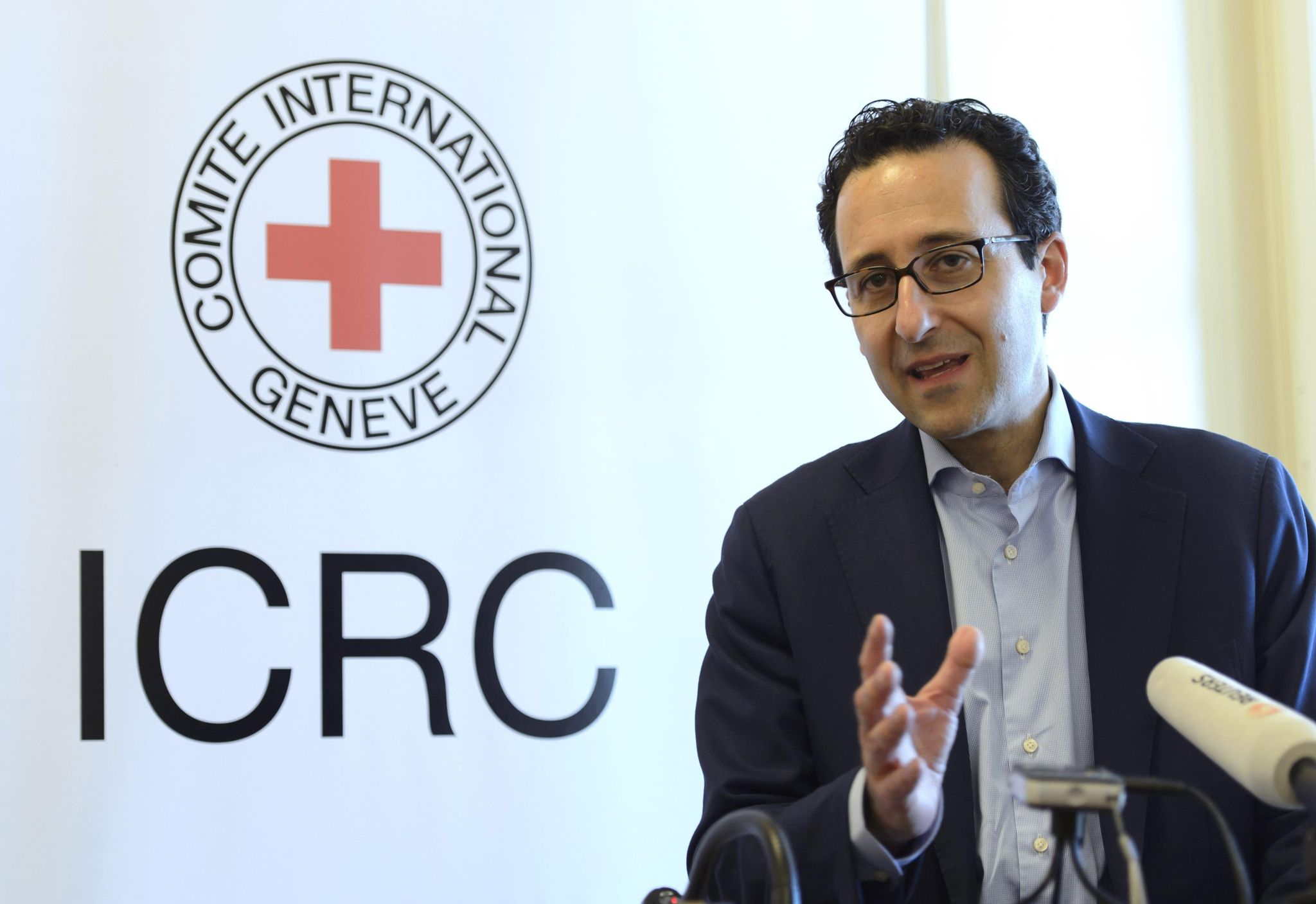
    “We condemn this brutal and apparently deliberate attack on a dedicated humanitarian worker,” Robert Mardini, the ICRC’s Middle East director, said in a statement.

    “We are all in shock. Hanna was a young man full of life and was widely known and liked. Nothing can justify Hanna’s murder and we are in deep mourning for our dear friend and colleague. Our hearts and thoughts are with Hanna’s loved ones and friends.”

    Lahoud had worked for the ICRC for about eight years, the organization said. Before joining the ICRC he was a first aid volunteer and staff with the Lebanese Red Cross.

    Ralph El Have, a spokesman for the ICRC, told the BBC that not all Red Cross vehicles are marked but that “everyone knows who we are.”

    “… Attacks on humanitarian workers, whether they are intended towards humanitarian workers or whether they are just intended against any civilian or any person who happens to be at the wrong place or the wrong time, they continue to happen in war-torn countries,” he told the radio service.

    Mr. El Have described Taiz as one of the most devastated cities and provinces in Yemen, with active fighting between different parties and individuals.

    “Proliferation of arms has unfortunately come to an extent you don’t know who is an armed man or an armed person part of an organized group,” he said.

    The ICRC goes to great lengths to maintain its neutrality in conflict zones, dismissing outright the idea of arming their staff or providing armed security. They’ll instead remove their aid workers for a time if they can’t guarantee their safety.

    On Sunday, a spokesman for the United Nations Secretary-General issued a statement condemning the killing and emphasized that all parties to the conflict protect aid workers servicing an estimated 22 million people in the war-torn country.

    Yemen is in the third year of a brutal civil war between Iranian-backed Houthi rebel extremists in the north of the country, against government forces backed by Saudi Arabia and the U.S. in the South.

    The conflict has plunged the Middle East’s poorest country into the world’s worst humanitarian crisis, with three-quarters of the population needing aid and protection, according to the U.N.

    At least 60 percent of the population are food insecure with 8.4 million people not knowing where their next meal is coming from.

    Less than 50 percent of health facilities are functioning and 18 percent of districts have no doctors — 16 million people do not have regular access to basic healthcare.

    Fifty percent of all children are stunted from lack of adequate nutrition.

    A cholera outbreak has largely come under control, but at least 55 percent of the population does not have regular access to safe water and basic hygiene.

  • Business and pleasure on menu for Macron’s second day in US

    A sit-down between President Donald Trump and French President Emmanuel Macron followed by a joint news conference highlight the business portion of the French leader’s second day in Washington.

    WASHINGTON (AP) – A sit-down between President Donald Trump and French President Emmanuel Macron followed by a joint news conference highlight the business portion of the French leader’s second day in Washington.

    The pageantry of Macron’s official state visit, the first of the Trump presidency, comes Tuesday night with a lavish state dinner at the White House. About 150 guests are expected to dine on rack of lamb and nectarine tart and enjoy an after-dinner performance by the Washington National Opera.

    Monday night was more relaxed, featuring a helicopter tour of Washington landmarks and a trip to the Potomac River home of George Washington with their wives for dinner. The presidents and their spouses hopped on a helicopter bound for Mount Vernon, Washington’s historic riverside home, for a private dinner one night before the leaders sit down for talks on a weighty agenda including security, trade and the Iran nuclear deal.

    “This is a great honor and I think a very important state visit given the moment of our current environment,” Macron said Monday after his plane landed at a U.S. military base near Washington.

    Macron’s pomp-filled three-day state visit to Washington underscores the importance that both sides attach to the relationship: Macron, who calls Trump often, has emerged as something of a “Trump whisperer” at a time when the American president’s relationships with other European leaders are more strained. Trump, who attaches great importance to the optics of pageantry and ceremony, chose to honor Macron with the first state visit of his administration as he woos the French president.

    For all their camaraderie, Macron and Trump disagree on some fundamental issues, including the multinational nuclear deal, which is aimed at restricting Iran’s development of nuclear weapons. Trump, skeptical of the pact’s effectiveness, has been eager to pull out as a May 12 deadline nears. Macron says he is not satisfied with the situation in Iran and thinks the agreement is imperfect, but he has argued for the U.S. sticking with the deal on the grounds that there is not yet a “Plan B.”

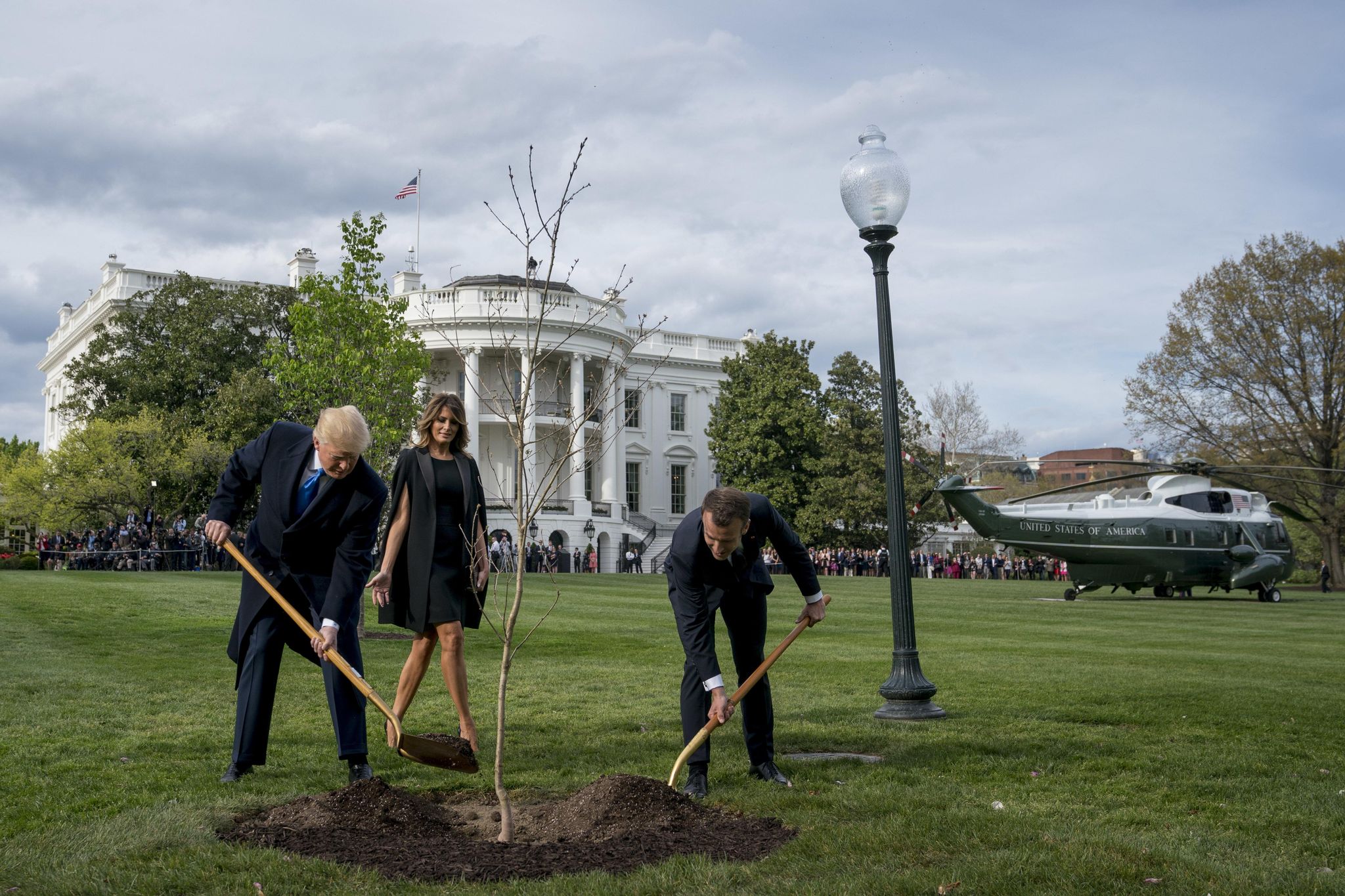
    The Trumps and Macrons helped plant a tree on the White House grounds together before boarding Trump’s Marine One helicopter for a scenic tour of monuments built in the capital city designed by French-born Pierre L’Enfant as they flew south to Mount Vernon, the first U.S. president’s home along the Potomac River.

    The young oak is an environmentally friendly gift to the White House from Macron, and one that also bears historical significance. It sprouted at a World War I site in France, the Battle of Belleau Wood, that became part of U.S. Marine Corps lore.

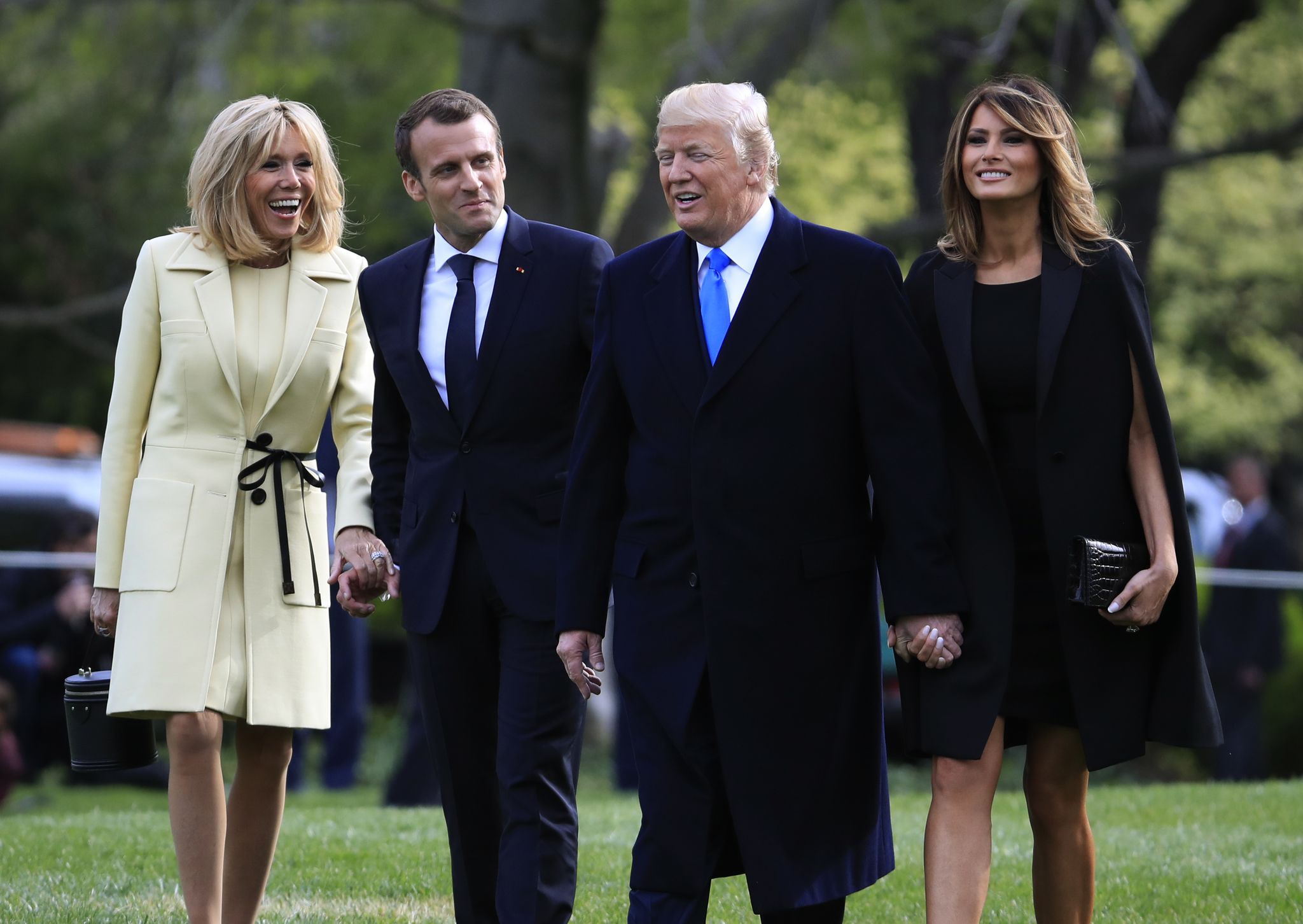
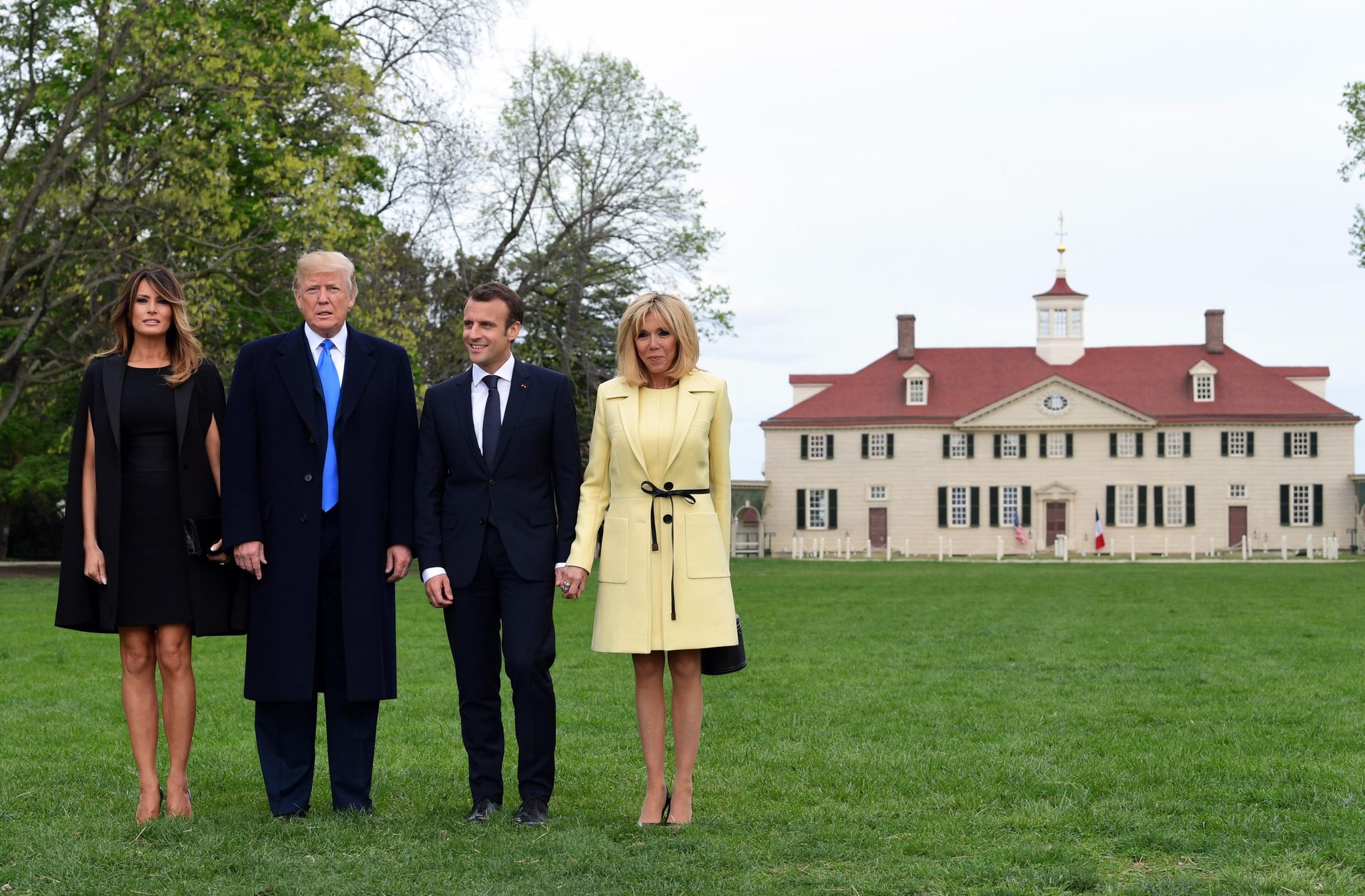
    After Trump’s helicopter landed at Mount Vernon, the two presidents, each holding his wife’s hand, walked a short distance and posed for pictures before they boarded golf carts that ferried them to the front door of Washington’s plantation house. The couples were led on a brief outdoor tour before they entered the pale yellow building for dinner of Dover sole, pasta stuffed with lemon ricotta, and chocolate souffle and cherry vanilla ice cream.

    Trump declared the dinner “really fantastic” before returning to the White House.

    He ended his first year in office without receiving a foreign leader on a state visit, the first president in nearly 100 years to fail to do so. He was Macron’s guest last July at the annual Bastille Day military parade in the center of Paris. Macron and his wife also took Trump and America’s first lady on a tour of Napoleon’s tomb and whisked them up in the Eiffel Tower for dinner overlooking the City of Light.

    Macron will be welcomed back to the White House on Tuesday with a traditional arrival ceremony featuring nearly 500 members of the U.S. military and a booming 21-gun salute. The state visit also offers Macron his first Oval Office sit-down with Trump and a joint White House news conference. There’s also a State Department lunch hosted by Vice President Mike Pence.

    The French president’s White House day will be capped Tuesday night with a state dinner, the highest social tribute a president bestows on an ally and partner.

    Melania Trump played an active role in every detail of the visit, said White House spokeswoman Sarah Huckabee Sanders.

    The first lady settled on a state dinner menu of rack of lamb and nectarine tart, along with after-dinner entertainment provided by the Washington National Opera for about 150 guests. On Monday, she released details of the glitzy affair being planned to dazzle Macron and his wife, Brigitte.

    Dinner will be served in the State Dining Room, which will feature more than 2,500 stems of white sweet pea flowers and nearly 1,000 stems of white lilac. Separately, more than 1,200 branches of cherry blossoms will adorn the majestic Cross Hall.

    The first lady opted for a cream-and-gold color scheme, and will use a mix of china services from the presidencies of Bill Clinton and George W. Bush.

    State dinner tickets are highly sought after by Washington’s political and business elite. A few of those expected to attend: Christine Lagarde, head of the International Monetary Fund and a former top French government official; House Speaker Paul Ryan, R-Wis.; Treasury Secretary Steven Mnuchin and his wife, Louise Linton; Defense Secretary Jim Mattis, Sen. Bill Cassidy, R-La., and Mike Pompeo, Trump’s choice to be the next secretary of state.

    In a break with tradition, Trump has invited no congressional Democrats or journalists, said a White House official who was not authorized to discuss the arrangements publicly. But some Democrats did make the cut, including Louisiana Gov. John Bel Edwards, whose office confirmed his attendance.

    ___

    Follow Darlene Superville on Twitter: http://www.twitter.com/dsupervilleap

  • The Latest: Macron, Trump plant tree together at White House

    The Latest on the state visit by President Emmanuel Macron of France (all times local):

    WASHINGTON (AP) – The Latest on the state visit by President Emmanuel Macron of France (all times local):

    6 p.m.

    President Donald Trump and French President Emmanuel Macron have ceremonially planted a tree together on the South Lawn of the White House as they kick off the first state visit of the Trump presidency.

    Holding brass shovels, the two leaders threw dirt onto the newly installed tree, a European Sessile Oak from Belleau Woods, where thousands of U.S. Marines died in a 1918 battle during World War I.

    Trump told reporters on Monday that France is “a very special country,” adding, “I love the tree.”

    Trump, Macron and their wives are taking Marine One from the White House to George Washington’s Mount Vernon for a private dinner Monday ahead of a formal day of business events Tuesday.

    ___

    5:35 p.m.

    French President Emmanuel Macron has arrived at the White House at the start of his meetings with President Donald Trump.

    Macron and his wife, Brigitte, were embraced by the president and first lady Melania Trump when their car pulled into the West Wing driveway Monday. The handshakes and pleasantries kicked off Macron’s state visit to Washington with Trump.

    The Macrons took an unscheduled walk along Pennsylvania Avenue earlier in the day.

    The two planned to present the Trumps with a tree on the South Lawn of the White House and then were flying aboard Marine One for dinner at Mount Vernon, George Washington’s historic riverside home.

    ___

    2:40 p.m.

    French President Emmanuel Macron is taking a stroll around the White House before he is set to kick off his state visit to Washington with President Donald Trump Monday evening.

    Macron says in a Monday afternoon tweet: “Before our first work meetings, let’s have a walk on Washington’s streets.”

    Moments earlier, Secret Service officers and agents rushed to keep up with his entourage as Macron departed Blair House for an unscheduled walk, greeting well-wishers along Pennsylvania Avenue. Macron is joined by his wife, Brigitte Macron, on the walk.

    The Macrons are being received by Trump and First Lady Melania Trump at the White House later Monday, before flying aboard Marine One for dinner at Mount Vernon. Following business meetings Tuesday morning, Macron will be the guest of honor at the Trump’s first State Dinner Tuesday evening at the White House.

    ___

    1:55 p.m.

    President Emmanuel Macron of France has arrived on a state visit to the United States. It’s the first such visit of President Donald Trump’s administration.

    Macron said after his plane landed Monday at a U.S. military base near Washington that he and Trump will discuss issues important to their countries.

    Macron calls the visit a “great honor.” It’s his first trip to Washington since his election last year.

    Trump and first lady Melania Trump are taking Macron and his wife, Brigitte, to dinner Monday at Mount Vernon, George Washington’s home along the Potomac River.

    On Tuesday at the White House, Macron will be treated to a military arrival ceremony, Oval Office time with Trump, a joint news conference and a glitzy state dinner with nearly 150 guests.

    ___

    12:05 p.m.

    Melania Trump is serving rack of lamb and nectarine tart at Tuesday’s White House state dinner for President Emmanuel Macron of France.

    It’s the first state dinner of President Donald Trump’s administration.

    The first lady also chose the Washington National Opera to entertain the approximately 150 guests after dinner.

    Mrs. Trump’s office on Monday released details of the affair being planned to dazzle Macron and his wife, Brigitte. House Speaker Paul Ryan, Defense Secretary Jim Mattis and Louisiana Gov. John Bel Edwards are among those who have said they are attending.

    The first lady has saved a few choice details for the last minute. They include the full guest list and what she’s wearing.