Category: WORLDS

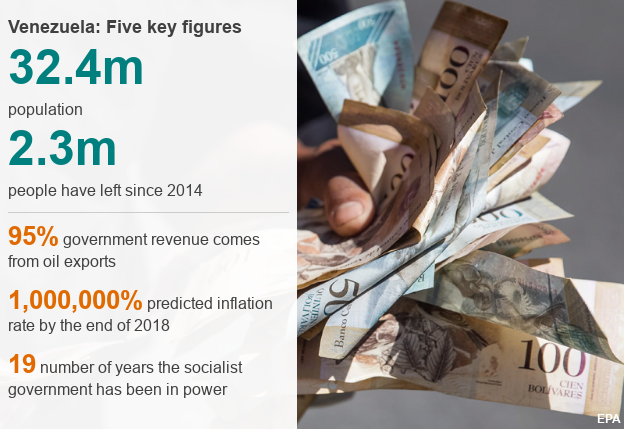
  • Venezuelan ex-officials charged in Andorra over $2.3bn graft scheme

    The logo of Venezuelan state-owned oil company PDVSA at a gas station in Caracas. Image copyright AFP Image caption Those charged are accused of taking bribes in return for lucrative PDVSA contracts

    A judge in Andorra has charged 29 Venezuelans with corruption – among them two former deputy ministers.

    Prosecutors allege that they were part of a network of corrupt officials who received $2.3bn (£1.8bn) in bribes from companies in return for lucrative contracts with Venezuela’s state-run oil company, PDVSA.

    They allegedly hid the money in the Banca Privada d’Andorra (BPA) bank.

    BPA is defunct after it was named as a “primary money-laundering concern”.

    How Venezuela’s crisis developed Venezuela ex-prosecutor: I have proof of Maduro corruption Venezuela to investigate ex-oil tsar over corruption

    Judge Canòlic Mingorance in Andorra, a tiny financial haven located between France and Spain, charged the Venezuelans with taking kickbacks of up to 15% to facilitate contracts with PDVSA, Spanish daily El País reports [in Spanish].

    A number of other high-ranking government officials have had sanctions placed on them and had their assets frozen. Among them is Industry Minister Tarek El Aissaimi, who has been blacklisted by the US for alleged drug trafficking.

    Venezuela’s government says it is being attacked by “imperialist foes”. It blames US sanctions for the dire state of Venezuela’s economy, and the poor performance of PDVSA.

  • Amazon chief Jeff Bezos gives $2bn to help the homeless

    Jeff Bezos Image copyright Reuters

    Amazon chief Jeff Bezos is putting $2bn (£1.5bn) into a charitable fund he has established to help the homeless and set up a new network of schools.

    The world’s richest man announced the move in a tweet, saying the charity would be called the Day One Fund.

    Mr Bezos – reportedly worth more than $164bn – has faced criticism for not doing more philanthropic work.

    And US Senator Bernie Sanders has criticised working conditions in Amazon warehouses.

    Mr Bezos asked on Twitter last year for suggestions on how he might use his personal fortune, which this year has soared due to Amazon’s surging share price and US tax cuts.

    He said on Thursday that the “Bezos Day One Fund” will contribute to “existing nonprofits that help homeless families” and also fund “a network of new, nonprofit, tier-one preschools in low-income communities”.

    The fund will be split between Day 1 Families Fund and Day 1 Academies Fund.

    Skip Twitter post by @JeffBezos

    pic.twitter.com/2GlgjztK1u

    — Jeff Bezos (@JeffBezos) September 13, 2018

    Report

    End of Twitter post by @JeffBezos

    “The Day 1 Families Fund will issue annual leadership awards to organizations and civic groups doing compassionate, needle-moving work to provide shelter and hunger support to address the immediate needs of young families,” Mr Bezos said in a tweet.

    The Day 1 Academies Fund will launch and operate a network of high-quality, full-scholarship, Montessori-inspired pre-schools in low-income and underserved communities, he said. “We will build an organization to directly operate these schools,” he added.

    Despite the huge amount of money being given, it is far less than the philanthropy of other billionaires such as Microsoft’s Bill Gates, who has donated tens of billions to his foundation, and Facebook’s Mark Zuckerberg, who has pledged to donate 99% of his shares in the social media giant to an organization focused on public good.

    The $2bn also falls short of the “giving pledge” initiative launched by Mr Gates and billionaire investor Warren Buffett, who have encouraged wealthy individuals to pledge half their fortunes for philanthropy.

    Mr Bezos, who operates the Blue Origin space rocket project and who owns the Washington Post newspaper, has given donations to a scheme to help the children of immigrants, cancer research, and Princeton University.

  • Cliff collapse on Greece’s ‘shipwreck beach’ injures tourists

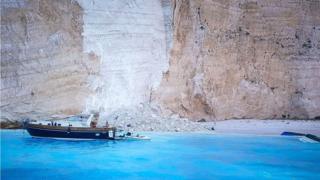
    Navagio beach, or Shipwreck Beach, following a rockfall on the island of Zakynthos, Greece, 13 September 2018 Image copyright Reuters Image caption “Shipwreck beach” on Zakynthos, or Zante, is one of the Ionian island’s main attractions

    At least seven people were injured when part of a cliff face broke away at the popular Navagio beach on the Greek island of Zakynthos, officials say.

    “We haven’t found any trapped people but we will continue searching,” a spokesperson for the fire brigade said.

    None of the injuries sustained in the incident on Thursday afternoon are believed to be life-threatening.

    The beach, also known as “shipwreck beach”, is popular with tourists and can be reached only by boat.

    “There was a noise and a small piece of rock fell, then a second bigger and finally a third big piece of rock that during the fall created a sea whirlpool that overturned the boats,” one eyewitness said.

    Image Copyright @WendyThorpeUK @WendyThorpeUK

    Greek authorities said they had received no reports of missing people but that search and rescue teams were continuing to operate by air and sea into the late afternoon as a precaution.

    Among those injured was a 34-year-old woman from the Czech Republic, who suffered a fractured vertebra. Her husband and two children were also treated for minor injuries by hospital staff, according to the Greek news website Kathimerini.

    Three others were also hurt in the incident.

    Footage posted on social media showed people running in panic as a large section of the cliff peeled off and crashed down close to several bathers.

    The port of Zakynthos, which is also known as Zante in Western Europe, was evacuated as a precaution.

    It is one of the Ionian island’s main attractions, in part because of the shipwreck on the shore and also because of its surrounding steep cliffs.

  • Algerian War: Macron in rare torture admission

    This file photo taken circa 1950 shows Maurice Audin, who went missing after being arrested in 1957 during the Algerian War Image copyright AFP

    France has admitted responsibility for the torture and killing of a communist activist in Algeria over 60 years ago.

    Maurice Audin, 25, was working as a mathematician at the University of Algiers when he was arrested in 1957.

    In a rare admission on Thursday, French President Emmanuel Macron said Audin had either been tortured to death or tortured and executed during French colonial rule.

    Algeria gained independence from France in 1962 after a bloody seven-year war.

    Audin was one of the few Europeans in the country to support Algerian calls for independence when he disappeared during the Battle of Algiers. He was married with three children.

    President Macron is due to pay a formal visit to Audin’s widow on Thursday, as well as to open the archives “on the subject of disappeared civilians and soldiers, both French and Algerian”.

    Long shadow

    In a visit to Algeria in February 2017 while still a presidential candidate, Mr Macron described colonialism as “a crime against humanity”. Later the same year, however, he ruled out reparations for any crimes committed under colonial rule.

    The Algerian war has left a long shadow in both France and Algeria. Over 1.5 million Algerians are thought to have died and it is only in recent years that Paris has begun to acknowledge some instances of abuse from the conflict.

    In September 2016, then President François Hollande admitted France’s role in the suffering of tens of thousands of Algerian soldiers who fought for France, known as harkis, and who were left without protection at the end of the war. Many of those who remained were brutally killed in reprisal attacks.

    He specifically mentioned the “responsibility of French governments in the abandonment of the harkis, the massacres of those who remained in Algeria and the inhumane reception of those transferred to France”.

    Eleven years earlier, France’s ambassador to Algeria apologised for the Sétif and Guelma massacre in 1945, when French police killed at least 1,000 Algerians after deadly attacks on settlers in the area. It is seen by some historians as a key moment leading to the war that broke out nine years later.

  • ‘A single piece of plastic’ can kill sea turtles, says study Ask a question

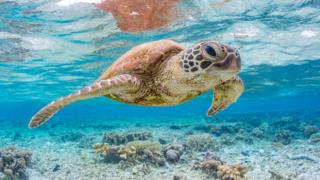
    sea turtle Image copyright Google

    A new study suggests that ingesting even a single piece of plastic can be deadly for sea turtles.

    Researchers found there was a one in five chance of death for a turtle who consumed just one item – rising to 50% for 14 pieces.

    The team found that younger turtles are at a higher risk of dying from exposure to plastic than adults.

    The authors say their research raises concerns over the long term survival of some turtle species.

    The never ending surge of plastic into the world’s oceans is taking an increasing toll on iconic marine species.
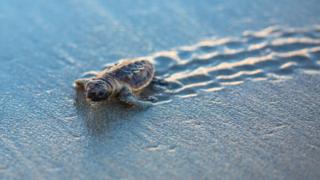
    Image copyright BBC Sport

    From that information they were able to deduce the role of plastic in causing death – if an animal had ingested more than 200 pieces of plastic, death was inevitable.

    Fourteen pieces meant a 50% chance of dying – while one piece gave a 22% chance of mortality.

    “Because of their digestive tract, they don’t regurgitate anything,” lead author Dr Britta Denise Hardesty from Australia’s Commonwealth Scientific and Industrial Research Organisation (CSIRO), told BBC News.

    “If it ends up in the wrong place, even one little thin, filmy piece of plastic can block that canal and mean that nothing can pass and ultimately the blockage can result in death.”

    As well as causing blockages, harder pieces caused internal injuries which often lead to death as well.

    The research team also found that younger turtles were taking in far more plastic than adults. Around 23% of juveniles and 54% of post-hatchling turtles had ingested plastic compared to 16% of adults. The scientists say that this greater susceptibility is down to where they live and how they feed.

    Image copyright Kathy Townsend

    “Young small turtles actually drift and float with the ocean currents as does much of the buoyant, small lightweight plastic,” said Dr Hardesty.

    “We think that small turtles are less selective in what they eat than large adults who eat sea grass and crustaceans, the young turtles are out in the oceanic area offshore and the older animals are feeding in closer to shore.”

    While sea turtles can live until they are about 80 and reproduce for decades, researchers are concerned for the longer term impact of so many juveniles consuming so much plastic.

    “We know that disproportionately finding it more in younger animals who won’t make it to the reproductive state will have long term consequences for the survival of the species,” said Dr Hardesty.

    “It’s very concerning.”

    Other experts in this field say the new study is an important step towards quantifying the scale of the threat that plastic poses to the lives of sea turtles.

    Image copyright Brazil Photo Press Image caption Turtles face external and internal dangers from plastic – this one was found wrapped in plastic, washed ashore in Brazil

    “The authors offer a very defensible framework for allowing us to measure the mortality risk resultant from plastic ingestion,” said Prof Brendan Godley, from the University of Exeter, who wasn’t involved with the study.

    “It also points to the likelihood that plastic may be a key threat to the smallest life stages. This is of particular concern as pieces of plastics and baby turtles are both likely to be aggregated together in similar areas.”

    The authors of the new study want to raise awareness among consumers and political leaders about the threat from plastic and to encourage creative solutions to the issue. One option may well be a plastic tax or deposit scheme.

    “Let’s rethink our relationship with plastic,” said Dr Hardesty.

    “Let’s put a true cost on plastic so they have a similar value to aluminium cans which we don’t find lost in the environment, they get picked up and they don’t get mismanaged and find their way out into the ocean,” she added.

    The study has been published in the journal Scientific Reports.

    Ask a question

    Share this chatbot.

  • Hurricane Florence: Prisons in hurricane’s path not evacuated

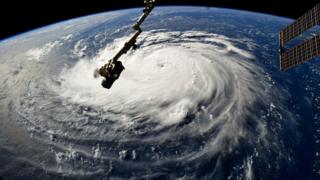
    Hurricane Florence gains strength in the Atlantic Ocean as it moves west, seen from the International Space Station on September 10, 2018 Image copyright NASA Image caption Hurricane Florence gains strength in the Atlantic Ocean as it moves west, seen from the International Space Station on Monday
    “Storm of a lifetime” hurricane Florence is predicted to bring deadly disaster to large parts of the eastern US coast when it makes landfall on Thursday.

    But as millions are under order to flee, some are being told they have to stay put.

    On Monday, South Carolina officials announced they would not remove inmates from at least two prisons inside mandatory evacuation zones.

    “In the past, it’s been safer to leave them there,” a spokesman for the South Carolina Department of Corrections said.

    One of those facilities is no longer in those zones but remains in Florence’s path.

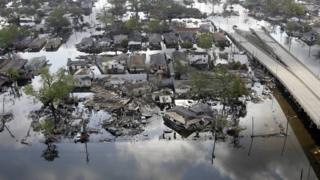
    Image copyright AFP Image caption Flooding in New Orleans after hurricane Katrina in 2005
    New Orleans was particularly badly hit but prisoners locked in cells in the city’s jail were not moved to another facility. A third of the inmates had been awaiting trial – not convicted of any crime.

    Power cuts and broken generators caused ventilation and lights to fail and electric cell doors to remain shut. One guard reported that officials had fled as the waters had risen.

    Prisoners were abandoned in cells without food or water for days as [toxic] floodwaters rose towards the ceiling, according to reports by the ACLU and Human Rights Watch based on more than 1000 eyewitness accounts.

    Prisoners of Katrina

    Orleans Parish Prison was eventually evacuated four days after the storm hit. Some inmates say they saw dead bodies and Human Rights Watch claimed that 517 prisoners had gone missing.

    In 2006, Sheriff Marlin Gusman maintained no prisoners had died and none had escaped. Later, it emerged that arrest warrants had been issued for 14 escaped inmates.

    Why are prisons not evacuated?

    South Carolina has not evacuated prisons in response to hurricanes since 1999, according to local media.

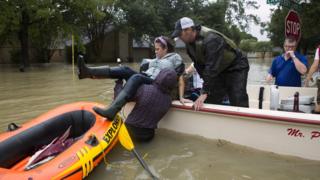
    Image copyright Getty Images Image caption Houston residents are rescued after flooding caused by heavy rain during hurricane Harvey in 2017

    In Texas, four county jails were evacuated before hurricane Harvey made landfall last year. Built to withstand the most severe hurricanes, they were evacuated as a precaution and sustained some structural damage.

    But in Houston, which was severely flooded, inmates left in prisons and jails reported minimal drinking water and food and poor access to medicine, as well as stifling heat.

    In 1992, hurricane Andrew slammed Florida, causing huge damage to one prison in Miami, after which about 4,000 prisoners were moved out.

    By Georgina Rannard, UGC and social news

    (more…)

  • BBC Trending

    Three K-pop artists pose for a photo Image copyright Cube Entertainment Image caption E’Dawn (left) and HyunA (middle) formed K-pop band Triple H with Hui (right)

    The head of a major music label in South Korea has denied reports HyunA and E’Dawn, two members of the pop trio Triple H, have been sacked after revealing their relationship.

    Cube Entertainment CEO Shin Dae-Nam released a statement after 720,000 tweets in 10 hours mentioned the K-pop stars’ supposed sacking.

    “We’ve yet to make an official decision on the rumour that HyunA and E’Dawn would be ousted,” reads the statement on Naver, a major South Korean website.

    “We are still discussing it, it is not a confirmed decision. Since the opinions of the artists are also important, this should be deliberately decided through the process of collecting opinions.”

    Many K-pop artists – often known as “idols” – are not allowed to enter into any form of romantic relationship while under contract.

    The change comes after many on social media specifically pointed to the fact HyunA has worked for Cube Entertainment for far longer than the CEO.

    You may also like:

    Furore at ‘racist’ Serena Williams cartoon US school to paddle students as punishment Arrested for having breakfast with a woman

    The decision to sack the pair was heavily criticised. Some fans defended HyunA by asking how her work for Cube Entertainment could be ignored simply because she was in a relationship.

    Others came to the defence of E’Dawn, with fans referencing his struggle to land a contract with the label on TV show Pentagon Maker – a reality talent show where people competed to be part of the band.

    Those not familiar with K-Pop might recognise HyunA from her appearance in the music video for Psy’s crossover hit Gangnam Style, where she can be seen dancing on an underground train before joining Psy in a larger routine.

    The success of the video led the pair to release a new version of Gangnam Style sung as a duet, which has been viewed over 720 million times on YouTube.

    (more…)