Video iPhone XR: Apple’s event in 90 seconds
Category: WORLDS
-
Pope Francis faces twin battle in Church split over sexual abuse
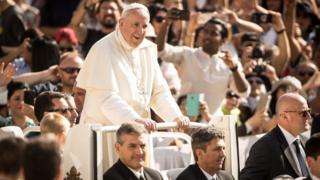 Image copyright Getty Images
The crowds are quieter than they used to be.
At the Pope’s weekly audience in St Peter’s Square, tourists and pilgrims barely filled half the piazza. It was easy to get to the front of the crowd to watch Francis go by in his Popemobile.
In his address, he reflected on his recent trip to Ireland. “The meeting with eight survivors [of abuse by priests] left a deep impact,” he said.
The audience was a sombre reminder that the novelty of this papacy has given way to two main battles, which are now tangled into one.
Who is challenging the Pope?
The first of these battles puts the Pope up against those who accuse him of not doing enough to tackle child abuse in the Church.
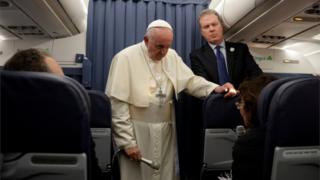 Image copyright Reuters Image caption Pope Francis refused to respond to Archbishop Vigano’s 11-page letter as he returned from Ireland
 “They sense this especially now, with questionable innovative teachings coming from the Vatican and reports of abuse cover up at the highest levels. I believe these Catholics’ voices should be heard, and, as a Catholic journalist, I see it as my job to try to make sure they are.”
Those voices include a number of cardinals.
In 2016, four of them wrote to Francis calling on him to clarify his teaching. It was seen as a highly unusual act of protest or even disobedience. Their letter, openly questioning the Pope’s judgement, foreshadowed the statement released by Archbishop Vigano.
Will Pope succeed?
Francis did not reply to the cardinals’ letter. Nor has he replied to Carlo Maria Vigano’s accusations.
The Pope has clearly decided that there is nothing to be gained by engaging in open battle with conservative critics.
“He is no pushover,” says Robert Mickens. “He is standing his ground.”
Popes can expect to find themselves taking on dissident factions within the Church.
In 1988, Pope John Paul II took the dramatic step of excommunicating some members of a renegade religious society led by the French Archbishop Marcel Lefebvre which had rejected Vatican reforms.
Benedict XVI took a strict line against priests who strayed from official teaching.
The fight against doctrinal opponents may be the easier of Francis’s two battles.
The Pope’s wider public fight to convince the other critics inside and outside the Church that he is capable of confronting the institution’s legacy of clerical sexual abuse may be much more difficult.
-
German Catholic priests ‘abused thousands of children’
 Image copyright Getty Images Image caption A study commissioned by the Catholic Church in Germany says clerics abused thousands of children over a 70-year period
More than 3,600 children in Germany were assaulted by Roman Catholic priests between 1946 and 2014, a leaked report has revealed.
The study was commissioned by the Church itself, and was due to be published on 25 September.
According to the report, some 1,670 clergymen in Germany committed some form of sex attack on 3,677 minors, German outlet Spiegel Online reported.
A Church spokesman said it was “dismayed and ashamed” by the findings.
Sex abuse and the Catholic Church explained
Only 38% of the alleged perpetrators were prosecuted, with most facing only minor disciplinary procedures, German media said. About one in six cases involved rape.
Most of the victims were boys, and more than half were aged 13 or younger.
Predatory clerics were often moved to new communities, where no warning was issued about their actions.
The study was compiled by three German universities, using 38,000 documents from 27 German dioceses. Its authors said the true extent of the abuse may be even greater, as some records were “destroyed or manipulated”.
How has the Catholic Church reacted?
“We know the extent of the sexual abuse that has been demonstrated by the study. We are dismayed and ashamed by it,” said Bishop Stephan Ackermann, a spokesman for the German Bishops’ Conference which commissioned the report.
He said the aim of the study was to shed light on “this dark side of our Church, for the sake of those affected, but also for us ourselves to see the errors and to do everything to prevent them from being repeated”.
“I stress that the study is a measure that we owe not only to the Church but first and foremost, to those affected,” the bishop added.
 Media playback is unsupported on your device
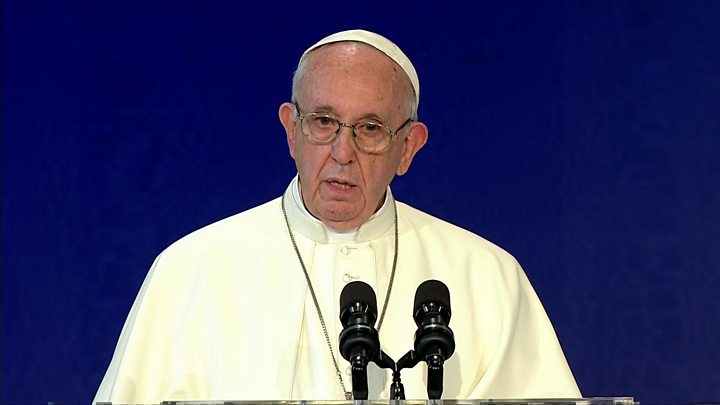
Media captionPope Francis and Irish PM Leo Varadkar spoke out on the abuse last month
Bishop Ackermann said the report had been leaked to the press before the Church itself had seen it. He said the Church had planned to provide counselling helplines for people affected by its contents.
What is the Church doing about abuse claims?
The Vatican did not immediately respond to Spiegel’s account of the report. But elsewhere on Wednesday, Pope Francis summoned Catholic bishops to the Vatican for a discussion on how to protect children in February next year.
The damning German study is the latest in a series of blows to the Roman Catholic Church.
Claims of clerical sex abuse have been levelled around the world, and with them allegations that Church leaders hushed up or ignored the wrongdoing.
Pope faces twin battle in Church split over sexual abuse Pope keeps silent on abuse claim letter
Pope Francis was caught up in the scandal last month, after a former Vatican diplomat accused him of ignoring allegations against a US cardinal for five years.
The Pope’s supporters vehemently question the credibility of this accusation, which the pontiff has refused to respond to.
In August, the Pope condemned the “atrocities” of child sex abuse in a letter to the world’s 1.2bn Roman Catholics.
It came after a grand jury report detailed seven decades of abuse in the US state of Pennsylvania. The investigation found more than 1,000 children had been abused by 300 priests there. It found evidence of systematic cover-ups by the Church.
 Media playback is unsupported on your device
Media caption”It’s your word against God’s”: The office of the attorney general in Pennsylvania released video testimony from three victims
-
Trump signs order to punish foreign meddlers in US votes
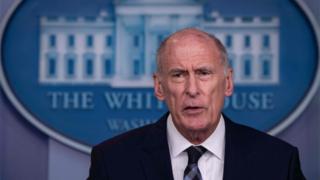 Image copyright Getty Images Image caption US Director of National Intelligence Dan Coats says officials are “taking nothing for granted” regarding election meddling.
US President Donald Trump has signed an executive order authorising sanctions against any countries or individuals found interfering in US elections.
The order instructs the intelligence community to monitor and report on attempts to disrupt election infrastructure as well as propaganda.
The directive itself is not a sanction, but imposes bans or restrictions on suspected culprits.
Mr Trump has been criticised for his response to alleged Russian meddling.
There is some frustration among lawmakers that Mr Trump’s executive order could undercut congressional efforts to deter any election meddling in the US by foreign powers, according to CBS News.
At a press briefing following the executive order, National Security Adviser John Bolton said the move was “intended to be a very broad effort to prevent foreign manipulation” of US politics, US media reported.
National Intelligence Director Dan Coats said the directive was in response to alleged Kremlin interference in the 2016 presidential election.
It is understood that Russia is not mentioned by name in the text, but US officials named that country along with China, North Korea and Iran as most likely to try to sway US elections.
“We’re taking nothing for granted here,” Mr Coats said.
Fraught subject for White House
Analysis by Anthony Zurcher, BBC News, Washington
With under two months until the first national US elections since 2016, the Trump administration is outlining how it would respond to the kind of election meddling senior intelligence officials say could be coming.
The threatened sanctions are notable because they aim not just at foreign companies and individuals seeking to disrupt US electoral infrastructure – electoral databases, vote tabulation processes and the like – but also of propaganda campaigns and leaks of sensitive political information.
The US intelligence community has concluded that in 2016 Russian operatives were unable to accomplish the former, but resoundingly successful in the latter.
That this announcement came first as a leak to US news outlets and then as an announcement from National Security Advisor John Bolton underlines how fraught a subject it is for this particular White House.
Donald Trump has repeatedly downplayed the seriousness of the 2016 Russian cyber-warfare efforts, asserting that the allegations are largely a result of Democrats seeking to shift responsibility for his victory away from their own failings.
Now the intelligence community that the president has frequently belittled will have the power to respond to new assaults on the American democratic process. The question is whether the tools at its disposal will be an adequate deterrent.
 Media playback is unsupported on your device
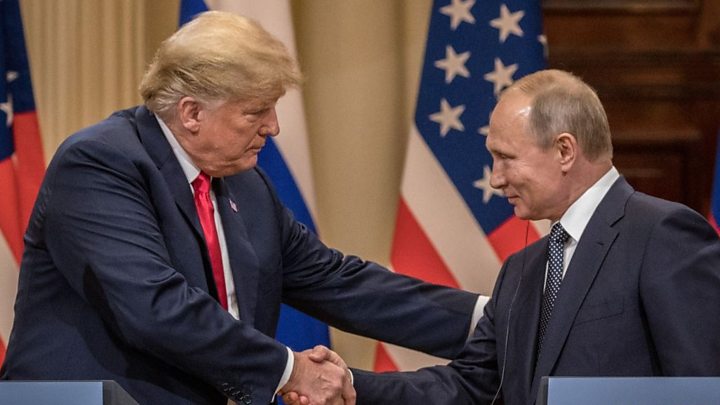
Media captionThe ways Trump and Putin see eye to eye
US intelligence agencies concluded in 2016 that Russia was behind an effort to tip the scale of the US election against Hillary Clinton, with a state-authorised campaign of cyber-attacks and fake news stories planted on social media.
Russia has denied these accusations.
The president has drawn criticism for his response to Russian interference in the 2016 elections, particularly after he seemed to side with President Vladimir Putin during their Helsinki summit in July.
Amid serious backlash from both sides of the aisle, the Republican president later explained that he “misspoke” and said he had “great confidence” in US intelligence.
In June, the US slapped sanctions on several Russian companies and individuals for allegedly aiding Russia’s intelligence agency in cyber-attacks against the US.
-
Sri Lanka to ban Hindu animal sacrifice
 Image copyright Getty Images Image caption Some Hindus sacrifice animals as an act of religious devotion – though the majority do not
Sri Lanka’s government has agreed to ban the ritual sacrifice of animals and birds at Hindu temples on the island.
A government spokesman told the BBC the move was proposed by the Hindu Religious Affairs ministry, and said most moderate Hindu groups support it.
Some Hindus sacrifice goats, buffalo calves and chickens at temples as an offering to their deities.
But the practice has attracted years of protests in Buddhist-majority Sri Lanka, where critics call it inhumane.
Animals sacrificed at Hindu and Muslim religious festivals are often left to bleed to death, which angers animal rights activists and some Buddhist groups.
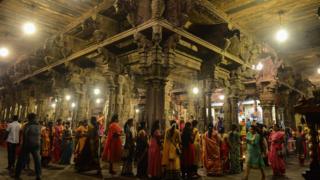 Image copyright Alamy Image caption Hindus make up around 12% of Sri Lanka’s population
 Sri Lanka has experienced deadly religious violence in recent years, including anti-Muslim riots that killed three people in March. Nearly 450 Muslim-owned homes and shops were damaged.
-
MEPs vote to ban ‘killer robots’ on battlefield
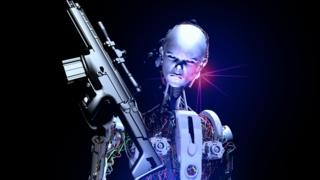 Image copyright Getty Images Image caption Killer robots are not science fiction, one MEP says – although they probably won’t look like this
The European Parliament has passed a resolution calling for an international ban on so-called killer robots.
It aims to pre-empt the development and use of autonomous weapon systems that can kill without human intervention.
Last month, talks at the UN failed to reach consensus on the issue, with some countries saying the benefits of autonomous weapons should be explored.
And some MEPs were concerned legislation could limit scientific progress of artificial intelligence.
While others said it could become a security issue if some countries allowed such weapons while others did not.
“I know this might look like a debate about some distant future or about science fiction. It’s not,” said Federica Mogherini, the EU chief of foreign and security policy during the debate at the European Parliament.
‘Arms race’
“Autonomous weapons systems must be banned internationally,” said Bodil Valero, security policy spokeswoman for the EU Parliament’s Greens/EFA Group.
“The power to decide over life and death should never be taken out of human hands and given to machines.”
The resolution comes ahead of negotiations scheduled at the United Nations in November, where it is hoped an agreement on an international ban can be reached.
In August, experts from a range of countries met at the UN headquarters in Geneva to discuss ways to define and deal with computer-controlled weapons.
“From artificially intelligent drones to automated guns that can choose their own targets, technological advances in weaponry are far outpacing international law,” Rasha Abdul Rahim, a researcher on artificial intelligence, at Amnesty International, said at the time.
“It’s not too late to change course. A ban on fully autonomous weapons systems could prevent some truly dystopian scenarios, like a new high-tech arms race between world superpowers which would cause autonomous weapons to proliferate widely,” he added.
But some countries – including Israel, Russia, South Korea and the US – opposed new measures at the August meeting, saying that they wanted to explore potential “advantages” from autonomous weapons systems.
-
Apple unveils next-generation Watch
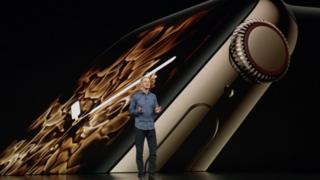 Image copyright Apple
Apple has revealed a new version of its smartwatch featuring a display that extends further towards its edges.
The firm said the Watch Series 4’s usable screen is now more than 30% larger despite the device itself having similar dimensions to its predecessor.
The device has also gained the ability to detect if its wearer has fallen.
The firm is also expected to unveil new handsets based on the design of the iPhone X later at its California press event.
Apple overtook Xiaomi and Fitbit to become the world’s bestselling wearable tech company in the second half of 2017 thanks to strong demand for the last generation of its smartwatch. It has held on to the top spot ever since, according to IDC.
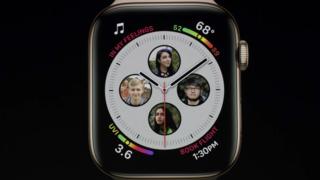 Image copyright Apple Image caption The bigger screen allows more information and shortcuts to be shown at once
 “The reason it performed so well is that many network operators are only willing to focus on smartwatches with their own [built-in cellular] connectivity,” commented IDC’s Francisco Jeronimo.
“That’s why they are shipping about as many watches as the whole Swiss watch-making industry.”
New iPhones
There had been concerns that the relatively high £999 entry price of the handset would limit its appeal when it was announced a year ago.
But Apple said it had consistently proven more popular than either of the lower-priced iPhone 8 models. Market research firms suggest it also outsold rival companies’ flagship devices.
That helped propel Apple to become the world’s first company with a market capitalisation above $1tn (£768m).
However, China’s Huawei still managed to overtake it in terms of overall smartphone market share in the April-to-June quarter, putting Apple into third place.
“Huawei was able to overtake it because Apple is not playing in the mid and low ends of the market,” commented Francisco Jeronimo from IDC.
“But Apple is very well positioned in the premium segment, and we don’t expect that to change over the next 18 months.”
iPhone demand grows despite Chinese gains


IBM Simon: The first mobile phone to offer a touchscreen user-interface – but its battery only lasted an hour.
Siemens S10: The first handset with a colour display – although only red, green, blue and white could be shown.
LG Prada: The handset debuted a capacitive touchscreen – detecting finger taps by changes in the display’s electrical field rather than pressure.
iPhone: Apple made use of “multi-touch”, detecting several points of contact – allowing pinch-to-zoom and other interactions.
Nokia N85: First phone with an OLED (organic light-emitting diode) display, letting it show deeper blacks and better contrast.
Samsung Galaxy Note: Although not the first “phablet”, the handset proved there was demand for a 5+ inch display, despite claims it was “comically huge”.
LG G Flex: The curved design was derided as being a gimmick, but points the way to the true “bendy” phones of the future.
Sharp Aquos Crystal: The phone’s “edgeless” look foreshadowed today’s trend to keep bezels to a minimum.
Samsung Galaxy Note Edge: Samsung’s first handset to wrap its screen over one its sides used the extra space for notifications and app shortcuts.
Sony Xperia Z5 Premium: The smartphone premiered a 4K display before it was easy to obtain such ultra-high definition mobile content.
Essential Phone: The start-up beat Apple to featuring a camera notch in its display, which allowed the rest of the screen to extend upwards.
Vivo X21: The Chinese firm beat rivals to offering a fingerprint reader beneath its screen.
-
Hurricane Florence: ‘Everybody’s frightened’
Video Hurricane Florence: ‘Everybody’s frightened’ -
US plans crackdown on e-cigarette firms citing ‘epidemic’ teen use
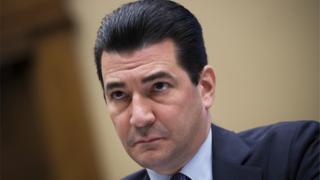 Image copyright Getty Images Image caption FDA Chief Scott Gottlieb has warned of a crackdown on e-cigarette companies
The US Food and Drug Administration is considering banning the sale of flavoured e-cigarettes, citing an “epidemic” of use among teens.
The proposal, announced on Wednesday, is part of a broader effort to curb teen use of the nicotine devices.
FDA chief Scott Gottlieb said: “The disturbing and accelerating trajectory of use we’re seeing in youth, and the resulting path to addiction, must end.”
The toughened approach comes after firms ignored prior concerns, he added.
“I’ve been warning the e-cigarette industry for more than a year that they needed to do much more to stem the youth trends,” he said.
“In my view, they treated these issues like a public relations challenge rather than seriously considering their legal obligations, the public health mandate, and the existential threat to these products.
“Well, I’m here to tell them that this prior approach is over.”