Tag: Politics

  • Jeremy Corbyn aide investigated over Commons pass claim

    Parliament Image copyright PA

    Claims that a Jeremy Corbyn aide has been working in the Labour leader’s Commons office without security clearance are being investigated by the parliamentary authorities.

    Iram Awan, the Labour leader’s private secretary, was reported by the Huffington Post to be routinely working in Parliament on a visitor pass.

    The Commons authorities say this is against the rules.

    Labour said it did not comment on “staffing matters”.

    The Huffington Post claims Ms Awan has for nine months been escorted to Mr Corbyn’s Commons office by other members of his team, who do have security clearance.

    This means she will have passed through airport-style X-ray machines and security checks, like other visitors to the parliamentary estate.

    A Labour source said: “We have not been told that any members of staff have been refused a pass or any reasons for why any pass may not have been granted.”

    A Commons spokesman said: “Visitor passes are for visitors only. They cannot be used to carry out work on the parliamentary estate.”

    The spokesman said they could not comment on individual cases but added an “investigation into an alleged breach of the Parliamentary rules has been launched”.

    The investigation is reported to have been launched after Conservative MP Leo Docherty wrote to the serjeant at arms, Kamal El-Hajji, who is in charge of security at the House of Commons, to request one.

  • ‘Abhorrent’ Jacob Rees-Mogg protest condemned

    Media playback is unsupported on your device

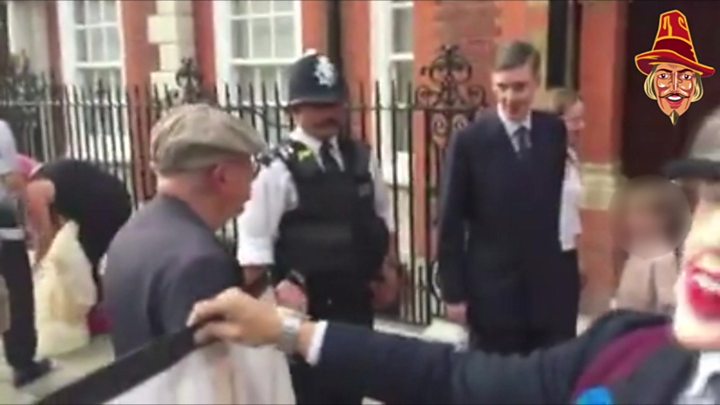
    Media captionProtesters shout at Jacob Rees-Mogg’s children during protest

    Protesters who targeted the home of Conservative Jacob Rees-Mogg and shouted at this children have been condemned by Downing Street and MPs.

    A video on the Facebook page of the Class War group shows a man telling one of the Tory MP’s children “your daddy is a horrible person”.

    Police officers stood between the protesters and the MP during the incident outside his Westminster home.

    Downing Street said the “intimidation” was “completely unacceptable”.

    “No elected member or their family should be subjected to intimidation or abuse in that way,” said the prime minister’s spokesman.

    Labour’s shadow Brexit minister Jenny Chapman said the protesters’ behaviour was “abhorrent”.

    She told the BBC’s Politics Live she was “ashamed if those people think they have anything to do with the Labour movement” and condemned the protest “without any reservation”, adding that the people in the video should “never be anywhere near someone’s children”.

    In the Class War video, a protester asked Mr Rees-Mogg how much he paid his family’s nanny, and when she too came out onto the street, demanded to know her salary and told her she had “Stockholm Syndrome”.

    A subsequent Class War Facebook post said people were getting their “knickers in a twist” over the footage, saying the MP’s family had come outside after the protesters arrived.

    The protest is believed to have been staged by veteran anarchist Ian Bone, who has taken part in similar stunts in the past.

    (more…)

  • China: Car rams into Hunan square killing three

    Map of China showing Hengyang

    A man has driven a car into a busy square in southern China, killing at least three people and injuring 43, local government officials say.

    The car drove into the square in Hengyang city, Hunan province, at 19:40 local time (12:40 BST). Local media say that some victims appeared to have been stabbed.

    The driver, who has a criminal record, has been detained, officials say.

    Officials have not said whether the incident is terror related.

  • Brexit: Tory MPs say technology key to avoiding hard Irish border

    A Northern Ireland border sign Image copyright Getty Images Image caption The future management of the Irish border is one of three main priorities in UK-EU Brexit talks

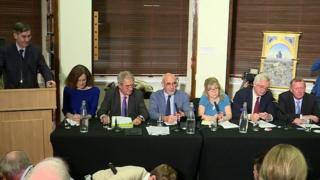
    A hard border on the island of Ireland can be avoided by using “established” technology and “modifying” existing arrangements, Brexiteer Tory MPs say.

    The European Research Group said the issue had been allowed to “frame” the talks but need not block a trade deal.

    They call for “effective co-operation” between Belfast and Dublin to address smuggling concerns and extra customs forms to be included in VAT returns.

    The EU has insisted on a “backstop” to ensure the single market is protected.

    Both the UK and the EU want to avoid a return to physical checks at the Northern Ireland border, but have yet to agree how this can be achieved.

    Image caption Two former Northern Ireland secretaries were among Tory MPs endorsing the proposals

    The report acknowledges a range of new checks will be needed on goods passing across the 310 mile border between Northern Ireland and the Republic of Ireland after Brexit, including extra customs declarations and declarations of origin as well as sanitary, phytosanitary and product compliance procedures.

    Among the proposals put forward in the document to deal with these are:

    Extra customs declarations should be incorporated into existing system of VAT returns Simplified customs procedures for the majority of cross-border trade Trusted trader-type schemes for large companies Equivalence of UK and EU regulations for agricultural produce Declaring the island of Ireland a Common Biosecurity Zone

    The report concluded: “The proposals can be realised within the existing legal and operational frameworks of the UK and EU, based on the mutual trust on which regular trade depends.

    “They do nothing to alter the constitutional position of Northern Ireland and do not violate the principle of consent of the enshrined in the Belfast Agreement.”

    Are Tory MPs set to move against Theresa May?

    By BBC political editor Laura Kuenssberg

    There is massive frustration with her leadership, her position on Chequers and the way her proposals tuck the UK closely into the EU in perpetuity. And yes, there are some MPs who want to see her gone immediately.

    However senior voices in the European Research Group – yes them – are adamant that it is not the time to try to oust the PM. It would be “stupid”, one told me last night.

    Imagine in these critical weeks of the Brexit negotiations if the UK started to try to change the prime minister.

    Right now those jostling to remove her know they don’t have any guarantees they would have the numbers to force her out, even though they may well be able to pull together enough MPs to submit letters to the chair of 1922 committee to trigger a contest.

    Read Laura’s blog

    John Campbell, the BBC’s Northern Ireland business and economics editor, said the document offered more detail than before and put forward a number of “plausible technocratic solutions”.

    But he said they placed a lot of store on the EU agreeing to mutual recognition of standards and the UK having access to its VAT system – which was far from clear.

    Former Northern Ireland First Minister Lord Trimble dismissed suggestions the Good Friday agreement could be put in peril by Brexit, saying fears of a “reversion to violence were wrong”.

    “There is no serious threat from violence because we have sorted that issue,” he said.

    Former Brexit Secretary David Davis said the proposals were “fabulously practical” and could “unlock” the current dispute over the PM’s Chequers proposals – which scores of Tory MPs have said they cannot support.

    Both Mr Davis and Jacob Rees-Mogg, the ERG’s chair, dismissed talk of a leadership challenge to the prime minister – after it emerged the issue was discussed openly by Tory MPs at a meeting on Tuesday night.

    “We’ve got a very good prime minister,” Mr Davis said.

    “I disagree with her on one issue, it’s this issue. She should stay in place because we need stability, and we need decent government as the backdrop for what we’re doing in the coming next six months.”

    (more…)

  • Fresh call for smacking to be outlawed in the home

    Woman smacking child Image copyright Getty Images

    Smacking is harmful to children’s mental health and should be banned, school psychologists say.

    The Association of Educational Psychologists has tabled a motion to the TUC Conference calling for physical punishment to be outlawed.

    Presently, although corporal punishment is banned in schools, parents can “smack” or physically chastise a child as long as it is deemed “reasonable”.

    Psychologists say there are many better ways of teaching right from wrong.

    Member of the AEP national executive committee, John Drewicz, will tell the conference in Manchester: “Smacking is harmful to a child’s mental health, it models aggressive behaviour and it says to them that it is OK to use violence.”

    He will add: “Sixty countries already have full bans, including Sweden, Ireland, Spain, Germany and Portugal, and it is time to make violence against children illegal in the UK in all settings, including the home.”

    The motion also notes that the Welsh government is taking steps towards removing the defence of reasonable chastisement for parents.

    But some campaigners have argued that parents would be criminalised if a smacking ban were to be passed.

    There are also moves in the Scottish Parliament to ban physical chastisement of children.

    ‘Higher aggression’

    A bill, lodged by Green MSP John Finnie, has been backed by the government and looks certain to pass at Holyrood.

    Psychologists cite research suggesting that when force is used by parents, there are changes in their brain activity which mean the degree of force used on the child can escalate.

    They argue that physical chastisement also leads to a lower quality of parent-child relationship, poorer mental health in childhood and adulthood, as well as higher levels of aggression in the child and more anti-social behaviour.

    The biggest teaching union, the National Education Union, is seconding the motion.

    Dr Mary Bousted, joint general secretary of the union, said parents and carers had a right to set boundaries for their children to help them develop social skills and good behaviour.

    “However we need to ensure that children are legally safeguarded in their own homes.

    “We are not talking about dictating to parents how this is done but what we are saying is that it in 2018 beating children in anger, or as part of a pre-meditated punishment, is neither acceptable or defensible.”

  • Exports risk delay at borders in no-deal Brexit, watchdog warns

    lambs are transported Image copyright Getty Images

    The UK’s lucrative food export industry could be at risk in the event of a no-deal Brexit, a report has warned.

    Food consignments and livestock could be delayed at UK borders if more vets aren’t recruited to process them, the National Audit Office has said.

    Defra said it has expanded its workforce and is preparing for a range of Brexit scenarios.

    But the Committee of Public Accounts chairwoman, Labour’s Meg Hillier, said: “We are rapidly running out of time.”

    The Department for Environment, Food and Rural Affairs (Defra) is one of the government departments most affected by Brexit.

    But the public spending watchdog has accused it of being unprepared for a no-deal scenario, saying many of its plans were of “poor quality and lack maturity”.

    Stopped at border

    The department has failed to hire enough vets, with the report highlighting that work to “engage publicly with the veterinary market” – due to start in April – had not been authorised by the government by September.

    “Without enough vets, consignments of food could be delayed at the border or prevented from leaving the UK,” the report said.

    More vets are needed to process the export health certificates – used to prove exports comply with animal health standards and regulations – which will increase if there is a no-deal Brexit.

    “Defra will have to introduce a UK equivalent for each of the 1,400 different versions of the current EU certificates, which currently refer to EU law, and agree these with 154 countries in order to continue to export these items,” the report explained.

    The NAO said Defra will not reach agreements with all 154 countries by March 2019, when Britain leave the European union.

    UK firms exporting to countries where agreements are not reached may not be able to do so for a period after Brexit, the report said.

    UK and France fail to agree scallop deal No-deal Brexit ‘disastrous’ for food firms

    Meanwhile, the environment secretary, Michael Gove, is due to set out plans to deliver a “Green Brexit”, in which farmers will be paid for “public goods” such as improving access to the countryside, and taking action to reduce flooding.

    The Agriculture Bill – to be introduced in Parliament later – could also see payments available for farmers to invest in new technologies and methods that boost productivity.

    Subsidies paid out under the Common Agricultural Policy will be phased out over seven years.

    More IT staff

    The NAO report also raised concerns for the fishing and chemical manufacturing industries.

    Amyas Morse, the head of the NAO, said while Defra had “achieved a great deal… gaps remain”.

    Defra said it had already started to build new IT systems and developed new services to replace those currently provided by the EU.

    The department has hired 1,307 more staff for Brexit-related work.

    “Since the report was written, we have continued to reprioritise our resources, expanded our workforce and made further progress on our extensive programme of work focused on preparing for a range of Brexit scenarios,” a Defra spokesperson said.

    “Our work will mean that environmental, welfare, and bio-security standards will continue to be met in a way that supports trade and the smooth flow of goods.”

  • The Brexit factions reshaping UK politics

    Parliament Image copyright Getty Images

    Westminster is buzzing with talk of splits, general elections, second referendums and even the formation of new political parties as Brexit strains traditional loyalties to breaking point.

    With votes on any deal struck by Theresa May with the EU expected to happen this autumn, here is a guide to the main factions in the Commons:

    Theresa May loyalists
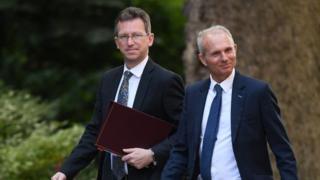
    Image copyright EPA Image caption Jeremy Wright and David Lidington – cabinet ministers loyal to the PM

    Government ministers, basically – there are just over 100 them out of a total of 316 Tory MPs – and those backbenchers who support Theresa May’s Brexit policies, or at least are not willing to vote against them and threaten her leadership.

    Most Tory MPs fall into this category but it is not enough for Mrs May to be sure of winning key Commons votes, even with the support of the DUP’s 10 MPs, who unlike Mrs May backed Leave in the EU referendum.

    Ten members of Mrs May’s government have quit in recent months – most of them because they are against her Chequers plan for post-Brexit trade, although Defence Minister Guto Bebb quit because he is in favour of it. Mr Bebb thought she had caved in to the hard Brexiteers (see below) over customs legislation. He has now joined the People’s Vote campaign (see below).

    Image copyright Getty Images

    Sixty Conservative MPs, headed by Jacob Rees-Mogg (pictured above), are members of the European Research Group – a pro-Brexit lobby, who are against Theresa May’s plans for trading arrangements with the EU.

    They are well-organised and highly motivated and the PM’s continued survival in Number 10 is, largely, in their hands.

    The rebel ranks were swollen by ex-Foreign Secretary Boris Johnson, former Brexit Secretary David Davis and his deputy Steve Baker, who all quit in protest at her blueprint for post-Brexit trade with the EU hammered out at her country residence Chequers, in July.

    Mr Baker claims as many as 80 Conservative MPs are prepared to vote against the Chequers plan. He has warned about a “catastrophic split” in the Conservative Party if it is not able to unite around a different vision. Mr Johnson has thrown grenades – and a “suicide vest” – into the debate from the pages of national newspapers, with increasingly strident attacks on the Chequers proposal, prompting an angry backlash from Theresa May loyalists.

    May warned of Tory split over Brexit plan Johnson: PM’s Brexit plan a ‘suicide vest’ At-a-glance: The new UK Brexit plan Brexit: All you need to know

    Tory soft Brexiteers
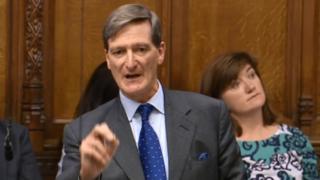
    Image copyright Getty Images

    The Dominic Grieve gang. Like most of his cohorts, who number about a dozen and include former minister Nicky Morgan (seated behind Mr Grieve in the picture above) who led an unsuccessful rebellion in the customs vote, the former attorney general is not a natural rebel.

    Mr Grieve and his supporters inflicted the government’s first Brexit defeat, in December, securing a “meaningful vote” for MPs on the final deal with Brussels, but some wonder whether his gang have the killer instinct of their pro-Brexit rivals when that final showdown happens in the autumn. Mr Grieve has said he will quit the party if Boris Johnson becomes prime minister, in reaction to a row over the former foreign secretary’s comments about the burka.

    Government survives key Brexit trade vote

    Cross-party crusaders
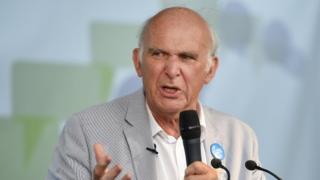
    Image copyright EPA

    Conservative MP Anna Soubry, a close ally of Labour’s Chuka Umunna in the People’s Vote campaign for another EU referendum (see below), has called in the past for the creation of a new centre-ground party.

    She also backed a call by fellow Conservative Sir Nicholas Soames – a longstanding pro-European and the grandson of Sir Winston Churchill – for a “government of national unity”, made up of senior figures from different parties to sort out Brexit, although that idea seems to have disappeared from the radar.

    But it is the leader of the Liberal Democrats, the UK’s traditional centre party, who has emerged as the biggest cheerleader for a new centre party.

    Sir Vince Cable is openly encouraging disaffected anti-Brexit Labour and Tory MPs to form new groups and work with the Lib Dems to colonise what he believes is the vast territory that has opened up in British politics as Labour moves to the left under Jeremy Corbyn and Tory Brexiteers push their party to the right.

    Sir Vince, who has said he will stand down as Lib Dem leader once Brexit has been “resolved or stopped”, admits his party, with just 12 MPs, has struggled to achieve the rapid growth in support it wanted despite being the only national party campaigning for a second referendum and has set out plans to transform into a “movement for moderates”.

    Cable to quit ‘once Brexit resolved’

    Tory second referendum group
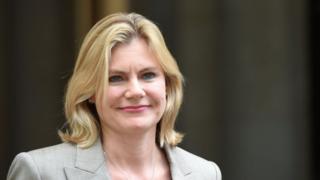
    Image copyright PA

    Former Education Secretary Justine Greening is the most senior Conservative to have called for a referendum on the final Brexit deal. She was backed by Heidi Allen and Anna Soubry, and another prominent backbencher, Sarah Wollaston, has also joined the People’s Vote campaign. along with Phillip Lee and Guto Bebb.

    No 10 rejects Greening’s referendum call

    The Corbynites

    Image copyright PA

    Jeremy Corbyn’s supporters insist the party has never been more united behind its leader – despite a bitter and divisive row about anti-Semitism that dragged on for months over the summer.

    The vast majority of the shadow cabinet – about 30 MPs – and most of the 47 new Labour MPs elected last year, in addition to a handful of long-serving left wing backbenchers, are fiercely loyal to the leader and back his Brexit stance.

    But many, maybe even the majority, of the 257 Labour MPs, including the self-styled “moderates” who served in government during the Blair/Brown era, remain unhappy with the direction the party is going in.

    Some Corbyn critics have faced no confidence votes from their local parties, a sign they could face de-selection before the next general election.

    Corbyn critics lose no-confidence votes Blair doubts Labour can be ‘taken back’ Why Corbyn allies want MP selection change

    Labour People’s Vote supporters
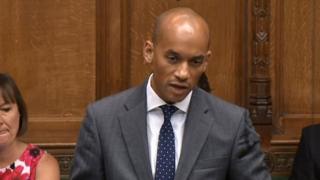
    Image copyright HOC

    Jeremy Corbyn’s backing for Brexit and refusal to throw his weight behind calls for a second referendum, after campaigning for Remain in the referendum, are a major sore point among “moderate” Labour MPs, who suspect he remains a Eurosceptic at heart.

    The cross-party People’s Vote campaign for a second referendum is backed by about 30 Labour MPs, including prominent figures such as Chuka Umunna (pictured above), Chris Leslie and Stephen Doughty.

    They outnumber members of other parties in the group, which also includes Lib Dems, Green MP Caroline Lucas, five Conservative MPs and Plaid Cymru’s four MPs.

    These MPs tend to eschew party labels when commenting on Brexit. The Labour members are in open revolt against their party leadership’s opposition to a second referendum – but they insist they are not operating as a party within a party.

    Chuka Umunna has written to members of his local party in Streatham, South London, to deny speculation he is involved in talks about the formation of a new party. The idea that the People’s Vote is the forerunner of a such a party is “patently absurd”, he writes.

    But he has also claimed Jeremy Corbyn’s supporters are trying to force “moderate” MPs like himself out of Labour, something the party leadership says is simply not the case.

    Call off the dogs, Umunna tells Corbyn Turn fire outwards, Corbyn urges MPs

    The SNP
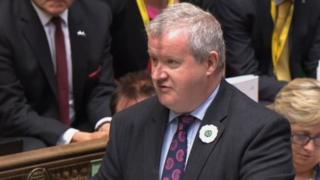
    Image copyright PA

    Like the members of the People’s Vote campaign, the SNP’s 35 MPs, led by Ian Blackford (pictured) are against Brexit and want the UK to stay in the EU single market and customs union.

    They have said they won’t stand in the way of a second referendum but have not committed to voting for one. One reason for this is that Scotland voted for Remain in 2016 and it did not make any difference to the result.

    They are likely to vote against anything resembling a “hard Brexit”.

    Labour Brexiteers

    Image copyright Labour Party

    Kate Hoey (pictured), John Mann, Frank Field and Graham Stringer – along with the currently independent Kelvin Hopkins – voted with the government in key Brexit votes, helping to ensure Theresa May’s survival.

    This is the core of a group who say they are standing up for the millions of Labour supporters who voted to Leave the EU.

    Mr Field has resigned the Labour whip in Parliament – and is fighting to remain a member of the party – after claiming it has become a “force for anti-Semitism in British politics”.

    The MP’s opponents say he jumped before he was pushed after losing a confidence vote organised by local activists in Birkenhead angry at his support for the government in Brexit votes, which they believe robbed Labour of the chance to force a general election it could have won.

    Ms Hoey is also facing calls to be expelled from Labour and has lost a confidence vote in her local Vauxhall Labour Party. Graham Stringer won a confidence vote in his Blackley and Broughton Labour branch.

    Field is not leading a Labour breakaway Field decides against calling by-election Labour needs seismic change – Blunkett