Blog

  • Why is Libya so lawless?

    Fighters loyal to Libya's Tobruk-based government celebrate as they come close to seizing the centre of Benghazi - 23 February 2016Symbol copyright AFP

    Libya has been beset through chaos seeing that Nato-sponsored forces overthrew long-serving ruler Col Muammar Gaddafi in October 2011.

    Western powers are now becoming more and more concerned that so-referred to as Islamic State (IS) has constructed a presence in the North African state and the us has answered by way of launching air strikes at the militant group.

    How bad is the situation in Libya?

    Simplest Libya’s myriad armed militias truly wield power – and it’s felt they generally dangle the politicians they supposedly back to ransom.

    During the rebellion, someone with a gun could command admire, and plenty of armed teams emerged – up to 1,SEVEN HUNDRED, in step with some estimates.
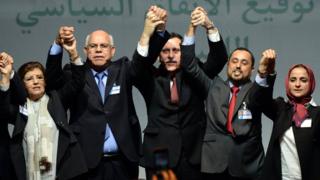
    Image copyright AFP Symbol caption Rival politicians have shaped a cohesion management but it has little actual energy over the entire u . s .

    There are two rival parliaments and 3 governments – the newest government was formed in UN-brokered talks with the purpose of changing the other . But this initiative is still at the rocks, partly on account of considerations that the new government is being imposed by Western powers.

    Symbol copyright AFP Symbol caption Libyan hands have ended up in the arms of armed teams across the region

    Then Again, professional-government forces subsidized by the West have now driven again the Islamists and retaken the town.

    Some security analysts describe Libya as an palms bazaar. it’s awash with weapons looted from Gaddafi’s arsenal – making a great playground for jihadists fleeing air moves in Syria and Iraq.

    IS has been attacking Libyan oil amenities, has kidnapped a number of international oil staff and in 2015 was in the back of high-profile attacks on Tunisia’s tourism industry – performed by gunmen skilled in Libya.

    Tunisia has built a partial security barrier and trench along its border with Libya aimed toward preventing additional atrocities.

    Beheadings and racial stress: Lifestyles beneath Islamic State

    How IS’s Libya foothold threatens UK

    The Libyans gaining ground on IS

    What is the West doing?

    the us has performed a minimum of four known air moves in Libya considering 2015. the newest one, in January, targeted an alleged coaching camp on the outskirts of Sirte the place some IS militants had fled after town fell.

    the united kingdom and France also have unique forces running within the North African state – the character and extent of these operations have in large part been secretive.

    Three French squaddies died in July 2016 while their helicopter used to be shot down by way of militiamen who recognized themselves as belonging to a new militant group referred to as Benghazi Defence Brigades (BDB).
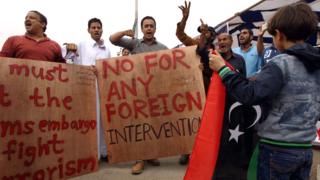
    Image copyright AFP Symbol caption The harmony executive’s call for foreign intervention has not been welcomed by way of a few

    Closing yr, plans have been unveiled to send 6,000 troops from a number of Nato countries, together with the united kingdom and France, to Libya to coach native troops to prevent IS-linked teams from gaining extra territory and to provide safety to diplomatic missions that were seeking to move back to the capital.

    On The Other Hand, the new team spirit govt was once reluctant to overtly permit or request this kind of presence and the plan has still not materialised.

    Former US President Barack Obama, in an interview revealed in April 2016, stated that the “worst mistake” of his presidency used to be the failure to arrange for the aftermath of Col Gaddafi’s overthrow.

    He partially blamed then-UK Top Minister David Cameron for “the mess”, saying he had not done sufficient to reinforce the North African nation whose instability was threatening its neighbours and was once a factor in Europe’s migrant crisis.

    How did Libya finally end up with rival governments?

    Parliamentary elections held in 2014 had been disputed. folks who held energy refused to give it up and remained in the capital, Tripoli.

    The newly elected parliament then moved to the port of Tobruk, 1,000km (620 miles) away and arrange a rival executive.

    This parliament still has the authentic backing of the UN as Libya’s professional legislative body – in spite of the fact that it’s opposed to the brand new unity administration. It wants Gen Khalifa Haftar, who’s leading the struggle against Islamist militias, to keep a senior function in a long run army, something the UN agreement doesn’t guarantee.

    The UN-mediated deal for a team spirit govt has seen the formation of a nine-member Presidency Council, led through High Minister Fayez Sarraj. He arrived in Tripoli in March 2016 to set up his management and has been seeking to win the give a boost to of among the militias and politicians, but it has little real energy over the whole united states.

    The council has additionally suffered from divisions. Two members boycotted it incessantly, ultimately transferring to the east, even as another member resigned.

    Mr Sarraj, an engineer by means of occupation, licensed the 1 August 2016 US air strike on suspected IS positions in Sirte, in the first co-ordinated army action between his executive and the united states.

    Has Libya pulled again from the brink?

    Were Not they all as soon as allies?

    Symbol copyright Reuters Image caption Col Gaddafi was in power for 42 years

    They had been united of their hatred for Gaddafi – but nothing more. there has been no unmarried workforce accountable of the rebellion. Militias were based in different towns, fighting their own battles.

    they are additionally ideologically divided – some of them are militant or reasonable Islamists, others are secessionists or monarchists and but others are liberals. Moreover, the militias are cut up alongside nearby, ethnic and native lines, making it a combustible combine.

    And after more than four a long time of authoritarian rule, that they had little understanding of democracy.

    in order that they have been unable to forge compromises and construct a brand new state based on the rule of law.

    My search for Gaddafi’s golden gun

    Which are the primary militias?
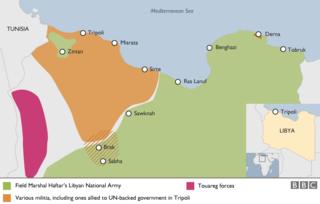
    Symbol copyright .

    East and principal:

    Gen Khalifa Haftar, crucial and divisive player in Libyan politics, leads the so-known as Libyan Nationwide Army (LNA), that is made up of former army units and militias loyal to them. He has cast himself as the primary opponent of the Islamist militias and has the backing of the Tobruk-primarily based government and is said to have co-ordinated military actions with Egypt and France. The Benghazi Modern Shura Council (BRSC) is an Islamist umbrella group that includes a posh make-up of radical warring parties, together with folks that pledged allegiance to IS. It has participants of Ansar al-Sharia, the gang that was once blamed for the 2012 killing of us Ambassador Christopher Stevens in Benghazi. It’s Going To also be linked to the Benghazi Defence Brigades (BDB), a new staff shaped of Islamist fighters principally pushed out of Benghazi. they all have found common floor in preventing towards Gen Haftar. Islamic State‘s presence in Libya is now in large part dispersed since the fall of its earlier stronghold of Sirte. Many combatants were killed in US bombings and it is believed some left the country or headed south. IS doesn’t keep watch over any city or the city however still has a presence in more than a few portions of the rustic. the crowd is made up of defectors from native jihadi teams and overseas warring parties. Its so much prominent affiliate in Libya was the Islamic Formative Years Shura Council (IYSC). In October 2014, the IYSC declared that Derna, a small town at the north-eastern coast and some 720km (450 miles) from Tripoli, had turn into the first Libyan the city to sign up for the worldwide caliphate that may be has vowed to create. Alternatively, it was driven out of town by way of the al-Qaeda-associated Mujahideen Shura Council of Derna.

    West:

    An umbrella crew referred to as Libya First Light, which controlled so much of the west, together with Misrata and Tripoli, has split up into more than a few brigades with differing loyalties. a few of them give a boost to the UN-subsidized solidarity executive, others stay unsure. the crowd seized Tripoli in August 2014 with the backing of a senior Islamic cleric and was led via combatants from Misrata, the city which took pleasure in striking up essentially the most fierce resistance in opposition to Col Gaddafi’s forces. a few of the militias from Misrata make up a large section of the anti-IS operation in Sirte. Symbol copyright AFP Image caption Libya Dawn was once a grouping of pro-Islamist militias
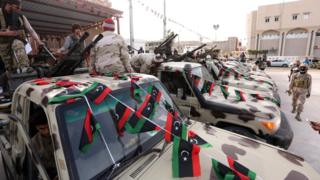
    Information to Libya’s militias

    Profile: Khalifa Haftar

    Rogue general divides Libyans

    What is way of life like?

    Oil manufacturing virtually ground to a halt for more than two years however has recovered a little in recent months. This took place after a siege used to be lifted via LNA forces after they took over the principle oil fields in vital Libya and expelled a rival armed workforce led by way of Ibrahim Jathran. Banks are nonetheless strapped for cash, on the other hand, and there’s little foreign currency to be had officially. The black market trade fee has sky-rocketed in latest months, and food prices have risen. Hospitals are in brief provide of medicine.

    An anticipated 400,000 Libyans are also internally displaced.
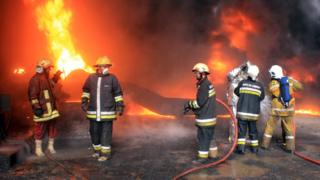
    Symbol copyright AFP Image caption IS has attacked oil facilities
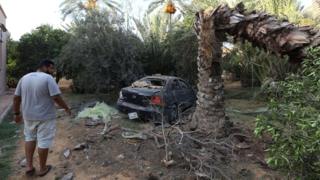
  • Hundreds break out Libya jail amid fatal clashes in Tripoli

    Libyans at the site of where a mortar shell landed in a market in the capital Tripoli, 30 August 2018 Symbol copyright Getty Photographs Symbol caption Civilians in Libya’s capital have been caught up within the fatal clashes between rival militias
    Some 400 prisoners have escaped from a facility near the Libyan capital Tripoli amid deadly violence between armed forces groups in the city, police say.

    “The detainees were capable of power open the doorways and go away” the Ain Zara jail, the police said.

    They delivered that guards, fearing for their lives, were unable to prevent the incident, AFP news company reviews.

    Clashes among militias within the city have led Libya’s UN-backed executive to declare a state of emergency.

    Many of the prisoners held at the Ain Zara facility in south-east Tripoli have been reportedly supporters of the late Libyan leader Muammar Gaddafi, and have been discovered guilty of killings through the rebellion towards his govt in 2011.

    Separately on Sunday, two people have been killed and several other others have been injured whilst rockets hit a camp in Libya’s capital housing loads of displaced other people, in keeping with emergency services and products and witnesses.

    At least 39 other folks, including civilians, have died in rival armed forces clashes in Tripoli in latest days.

    Why is Libya so lawless? Us Of A profile: Libya

    A UN-backed government is nominally in power in the capital, however militias occupy a lot of the remaining of the country.

    Why is there violence?

    The violence broke out remaining week when militias from a city to the south of Tripoli attacked southern areas, leading to preventing with local militias that toughen the the world over known executive, the government of Nationwide Accord (GNA).

    The GNA has described the clashes as “an attempt to derail peaceful political transition” in the country, adding that it “could not remain silent over the assaults on Tripoli and its suburbs, that’s a violation of safety within the capital and of citizens’ safety”.

    Human Rights Watch has additionally condemned the violence, adding that a minimum of 18 of the dead have been reportedly civilians, amongst them four children.

    Hundreds of migrants trapped through the combating were moved to different detention centres, even as the city’s airport was closed for two days on Friday.

    Libya has faced continuing chaos considering Nato-backed armed forces forces, some of them rivals, overthrew long-serving ruler Colonel Gaddafi in October 2011.

    What has the world community stated?

    UN Secretary Basic Antonio Guterres has mentioned the “indiscriminate use of power is a violation of international humanitarian and human rights law” and has advised “all events to supply humanitarian aid for those in need”.

    On Saturday, the us, UNITED KINGDOM, France and Italy known as for a right away finish to deadly violence in Libya’s capital.

    A joint statement said attempts “to weaken the reliable Libyan government and impede the continuing political process don’t seem to be appropriate”.

    “We Are calling at the armed groups to immediately prevent all military action and warn people who seek to undermine steadiness, in Tripoli or somewhere else in Libya, that they’re going to be made answerable for it,” the joint commentary read.

    However successive makes an attempt at a truce have so far didn’t stop the fierce combating between a few militias.

  • John McCain funeral: Senator laid to relax at US Naval Academy

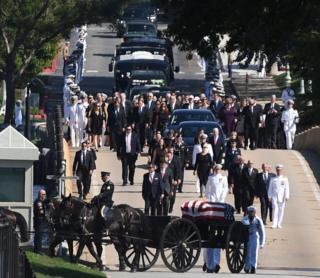
    The funeral procession of the late Senator John McCain heads to the cemetery for a private burial at the US Naval Academy in Annapolis Symbol copyright Reuters Symbol caption John McCain’s funeral procession heads to the cemetery at the US Naval Academy
    Senator John McCain has been buried on the US Naval Academy in Annapolis, Maryland, after a small personal rite.

    A army flypast was once performed with the squadron one plane brief, to symbolise the dead senator.

    Mr McCain graduated from the elite Naval Academy in 1958, later serving in Vietnam as a fighter jet pilot.

    Family and pals have been joined by his classmates and the current midshipmen for a service on the school’s chapel.

    It caps a week of memorials for Mr McCain, who died on 25 August, aged 81, from the results of brain cancer.

    Image copyright Reuters Symbol caption John McCain will likely be buried next to an antique friend, within the grounds of the united states Naval Academy
    On Saturday, heavyweights from around the political spectrum accrued at the Washington Nationwide Cathedral to remember the Arizona senator, who changed into one among America’s such a lot high-profile politicians.

    Two former presidents – George W Bush and Barack Obama – paid tribute to Mr McCain’s courage and experience of honour.

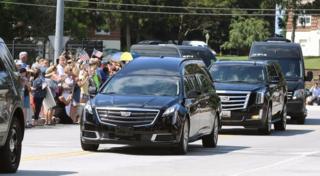
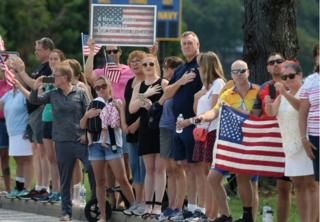
    Symbol copyright Reuters Image caption Mourners coated the route as Mr McCain’s hearse made its technique to his final resting place

    Mr McCain’s sons Jack and Don had been scheduled to pay tribute to him at the Sunday ceremony, along retired Army General David Petraeus and Senator Lindsey Graham, a long-time loved one.

    President Trump – who had best non-public and political variations with Mr McCain – has spent the weekend at his private golfing course in Virginia, and didn’t attend.

    Obituary: John McCain Why McCain picked these 15 pallbearers In footage: Presidents and loved ones gather for McCain The indignant politics of McCain’s loss of life

    Former US Senator Joseph Lieberman, a chum and colleague of Mr McCain who also gave a eulogy at Saturday’s provider, advised CNN on Sunday: “I say good-bye and my heart will probably be heavy. I’m Going To shed a tear and yet I’ll thank God that I knew a man like John McCain so smartly.”

    (more…)

  • Dutch police question suspect in stabbings of 2 Americans

    The U.S. State Department offered help Sunday to investigators in the Netherlands who are treating the stabbings of two American tourists at Amsterdam’s main railway station as a possible extremist at

    THE HAGUE, Netherlands (AP) – The U.S. State Department offered help Sunday to investigators in the Netherlands who are treating the stabbings of two American tourists at Amsterdam’s main railway station as a possible extremist attack.

    State Department spokeswoman Heather Nauert said the U.S. was “ready to assist Dutch authorities in their investigations as appropriate.”

    “Dutch authorities have announced that investigations are focused on a terrorist motive for this unprovoked, horrifying attack,” Nauert said in a statement. “The United States stands with our Dutch allies and others in our common fight against terrorism in all forms.”

    At a hospital on Sunday, detectives questioned the 19-year-old Afghan citizen who is a suspect in the Friday stabbings. Amsterdam police shot and wounded him.

    Amsterdam Police spokesman Ruben Sprong said the suspect, identified only as Jawed S. under Dutch privacy rules, was scheduled to appear at a closed hearing with an investigating judge on Monday.

    The Americans also remained hospitalized with “serious but non-life threatening injuries,” Sprong said. Their identities haven’t been made public.

    Dutch authorities said the suspect has a German residency permit and that his home in Germany was searched for the stabbing investigation.

    The city government in Amsterdam said Saturday that, based on the suspect’s first statements, “he had a terrorist motive.” It did not reveal what he said.

  • U.S. Navy seizes 1,000 smuggled rifles off war-torn Yemen

    The U.S. military said early Friday it seized over 1,000 Kalashnikov assault rifles being smuggled by small ships in the Gulf of Aden amid the ongoing war in nearby Yemen.

    DUBAI, United Arab Emirates (AP) — The U.S. military said early Friday it seized over 1,000 Kalashnikov assault rifles being smuggled by small ships in the Gulf of Aden amid the ongoing war in nearby Yemen.

    The seizure by the guided-missile destroyer USS Jason Dunham may mark the first such interdiction of weapons at sea bound for Yemen in years for American forces patrolling the region.

    However, the military did not say whom they suspected of smuggling the weapons.

    A short video released by the U.S. Navy it said was taken Monday appeared to show a skiff and a dhow, a traditional ship that commonly sails the waters of the Persian Gulf region. As the vessels bob in the high waves, people on the dhow toss large boxes into the skiff.

    The U.S. Navy’s 5th Fleet, based in Bahrain, said sailors boarded the boats Tuesday, uncovering the arms cache. Photos released by the Navy showed what appeared to be new Kalashnikov rifles wrapped in plastic.

    It said those aboard the vessels were handed over to Yemeni forces loyal to its exiled government in Saudi Arabia.

    The U.S. military did not offer a location for the seizure in the Gulf of Aden, which has Yemen to its north and Somalia to its south. Smuggling of drugs, weapons and charcoal into and out of Somalia by criminal gangs and militant groups remains common.

    The 5th Fleet repeatedly has accused Iran of smuggling arms via the sea to Yemen’s Shiite Houthi rebels, who have held Yemen’s capital, Sanaa, since September 2014. It points to seizures over a four-week period in early 2016, when coalition warships stopped three dhows in the Arabian Sea. The dhows carried thousands of Kalashnikov assault rifles as well as sniper rifles, machine guns, rocket-propelled grenade launchers, anti-tank missiles and other weapons.

    Iran denies arming the Houthis.

    One dhow carried 2,000 new assault rifles with serial numbers in sequential order, suggesting they came from a national stockpile, a report by the group Conflict Armament Research said. The rocket-propelled grenade launchers also bore hallmarks of being manufactured in Iran, the group said.

    The U.S. has supported a Saudi-led coalition fighting the Houthis since March 2015.

  • No deal yet in Canada-U.S. trade talks; time running out

    A deal to replace NAFTA still eluded U.S. and Canada on Friday with just hours before President Trump’s deadline for an agreement, the top Canadian negotiator said.

    A deal to replace NAFTA still eluded U.S. and Canada on Friday with just hours before President Trump’s deadline for an agreement, the top Canadian negotiator said.

    “We are not there yet,” Canadian Foreign Affairs Minister Chrystia Freeland told reporters in Washington.

    Ms. Freeland said they were “working hard” but that her negotiation team was not satisfied that the deal was good for Canada.

    Mr. Trump set a Friday deadline for Canada to agree to join the U.S.-Mexico deal to replace the three-way North American Free Trade Agreement. The replacement deal was announced Monday.

    If Canada is out, Mr. Trump threatened to submit the U.S.-Mexico deal with Congress and hit Canada with a 25 percent tariff on cars.

    Ms. Freeland’s remarks after the morning negotiation session threw cold water on early optimism voiced by both sides of the talks.

    She said the negotiation would continue.

    “As has been the case form the very beginning, Canada is a country that is good at finding win-win compromises. Having said that, in trade negotiations [and] in this negotiation, we always stand up for the national interest,” she said. “And that is what we are going to continue to do. We are looking for a good deal, not just any deal, and we will only agree to a deal that is a good deal for Canada. We are not there yet.”

  • Iran seeking to sidestep U.S. sanctions with rial-backed cryptocurrency

    Iran’s Central Bank has announced details regarding its effort to launch a digital currency backed by the national currency, the rial, in response to the re-imposition of harsh economic sanctions by t

    Iran’s Central Bank has announced details regarding its effort to launch a digital currency backed by the national currency, the rial, in response to the re-imposition of harsh economic sanctions by the U.S..

    The state-supported effort has been spearheaded by the Iranian National Cyberspace Center (NCC) per order of Iranian President Hassan Rouhani.

    It appears to have similarities to the shadowy cryptocurrency bitcoin, because transaction will occur via the blockchain, or distributed ledger technology, which stores information about all relevant transactions across a user network.

    Tehran’s cryptocurrency, however, differs in that the Central Bank will control the issuance of new tokens, which will be backed by Iranian rials.

    “The infrastructure is supposed to be as an ecosystem available for Iranian banks,” Ibena, the Central Bank of Iran’s news wire, reported earlier this week.

    Alireza Daliri, deputy for management and investment at the Iranian Directorate for Scientific and Technological Affairs, last month told state-sponsored media Press TV that the “currency would facilitate the transfer of money (to and from) anywhere in the world” and will help Iran “at the time of sanctions.”

    Analysts have called Tehran’s entrance into the murky, unregulated world of cryptocurrencies a desperate move driven by a mounting economic crisis in the wake of the Trump administration’s unilateral withdrawal from the 2015 Iranian nuclear deal. In the deal, Iran had agreed to curb its nuclear programs in exchange for the lifting of international economic sanctions.

    The withdrawal was in May. Since then, the White House has accelerated a campaign to pressure other countries to cut their commercial and financial ties to Tehran. In early August, Washington re-imposed sanctions targeting Iran’s automotive industry, debt sector and metals trade.

    The U.S. is poised to impose far more painful sanctions on Iran’s critical oil export sector starting Nov. 5, with a stated goal of driving Iran oil and gas sales to zero.

    The uncertainty has pushed Iran’s rial to its weakest level in decades, with recent months witnessing major protests over the rising cost of basic goods.

    Subverting dollar transactions

    On Wednesday, Iran’s Supreme Leader Ayatollah Ali Khamenei urged the Islamic Republic to do more to tackle its economic problems.

    “With regards to the economy, there is need for full force, large-scale and proficient work,” he was quoted as saying by Iran’s state-sponsored Press TV.

    According to analysts, Iranian officials believe a domestic digital currency could offer a solution to moving money around the globe as Tehran becomes further isolated form the global banking system.

    But Iranian bankers have also been skittish about cryptocurrencies and initially banned bitcoin and another leading digital currency, ethereum, earlier this year out of fear of money laundering within the country.

    Earlier this month Yaya Fanusie, director of analysis at the Foundation for Defense of Democracies’ Center on Sanctions and Illicit Finance, wrote that “Russia probably is influencing Iran’s push toward crypto.”

    In an article for Forbes, Mr. Fanusie noted that in May, Iranian and Russian press reported that senior economic official from both countries met in Moscow just before Tehran announced its central bank intended to develop a cryptocurrency aimed at subverting dollar transactions and the international SWIFT code banking system.

    Mr. Fanusie also noted that Russian entrepreneurs recently helped Venezuela’s Maduro regime launch a state cryptocurrency.

    Not long after the Venezuela digital currency was unveiled, Mr. Trump signed an executive order banning Americans from using it.

  • Donald Trump lashes out after report with off the record comments derails NAFTA talks with Canada

    President Trump railed against reports that off-the-record comments he made about Canada tanked new NAFTA negotiations on Friday.

    President Trump railed against reports that off-the-record comments he made about Canada tanked new NAFTA negotiations on Friday.

    Mr. Trump criticized Bloomberg for undermining the off-the-record agreement, saying “Oh well, just more dishonest reporting.”

    Wow, I made OFF THE RECORD COMMENTS to Bloomberg concerning Canada, and this powerful understanding was BLATANTLY VIOLATED. Oh well, just more dishonest reporting. I am used to it. At least Canada knows where I stand!

    — Donald J. Trump (@realDonaldTrump) August 31, 2018

    SEE ALSO: Trump’s off-the-record remarks roiled U.S.-Canada trade negotiations: ‘Totally on our terms’

    Mr. Trump’s tweet seemed to confirm the comments reported in the Toronto Star.

    “Here’s the problem. If I say no — the answer’s no. If I say no, then you’re going to put that, and it’s going to be so insulting they’re not going to be able to make a deal … I can’t kill these people,” Mr. Trump said about NAFTA talks with Canada.

    There was also a quote from the president that any new trade deal would be “totally on our terms.”

    The Canadian newspaper said it was not bound by Bloomberg’s agreement with the president and received the information from an anonymous source.

  • John Kerry, ex-secretary of state, says Trump ‘doesn’t know what he’s talking about’ on Iran deal

    Former Secretary of State John F. Kerry said Sunday that President Trump “doesn’t know what he’s talking about,” particularly when it comes to the Iran nuclear deal.

    Former Secretary of State John F. Kerry said Sunday that President Trump “doesn’t know what he’s talking about,” particularly when it comes to the Iran nuclear deal.

    Mr. Kerry insisted that Mr. Trump’s assertion that he “never walked away from the table” during the 2015 negotiations was false, saying, “I did walk away” during the talks.

    “Unfortunately, and I say this sadly, more often than not, he really just doesn’t know what he’s talking about,” Mr. Kerry told CBS’s “Face the Nation.” “He makes things up. And he’s making that up as he has other things.”

    .@JohnKerry comments on @realDonaldTrump ‘s criticisms of the Iran Nuclear Deal: More often than not, he really just doesn’t know what he’s talking about. He makes things up. pic.twitter.com/W4bip9A0iP

    — Face The Nation (@FaceTheNation) September 2, 2018

    Mr. Trump took a jab at the former Obama administration official in a May 4 speech before the National Rifle Association, saying that Mr. Kerry “never walked away from the table except to be in that bicycle race where he fell and broke his leg.”

    Mr. Kerry also defended his calls to world leaders in defense of the seven-nation Joint Comprehensive Plan of Action, the Obama administration’s signature foreign-policy achievement, after Mr. Trump moved to exit the agreement. The Trump administration ultimately withdrew from the deal in May.

    The former Democratic presidential candidate also defended his decision to make calls to world leaders behind the scenes as a private citizen to save the agreement, including Iranian Foreign Minister Javid Zarif.

    Mr. Trump to accused him of trying to undermine the administration with “possibly illegal Shadow Diplomacy,” but Mr. Kerry argued that he was defending the U.S. position, which at the time was the Iran deal.

    The United States does not need John Kerry’s possibly illegal Shadow Diplomacy on the very badly negotiated Iran Deal. He was the one that created this MESS in the first place!

    — Donald J. Trump (@realDonaldTrump) May 7, 2018

    “I spoke out,” Mr. Kerry said. “I will always exercise my right to speak out.”