Tag: Donald Trump

  • Kim Jong-un accepts Donald Trump’s invite to Washington, North Korea state media says

    North Korean leader Kim Jong-un has accepted President Trump’s invitation to visit Washington, North Korea’s Korean Central News Agency reported Tuesday night.

    North Korean leader Kim Jong-un has accepted President Trump’s invitation to visit Washington, North Korea’s Korean Central News Agency reported Tuesday night.

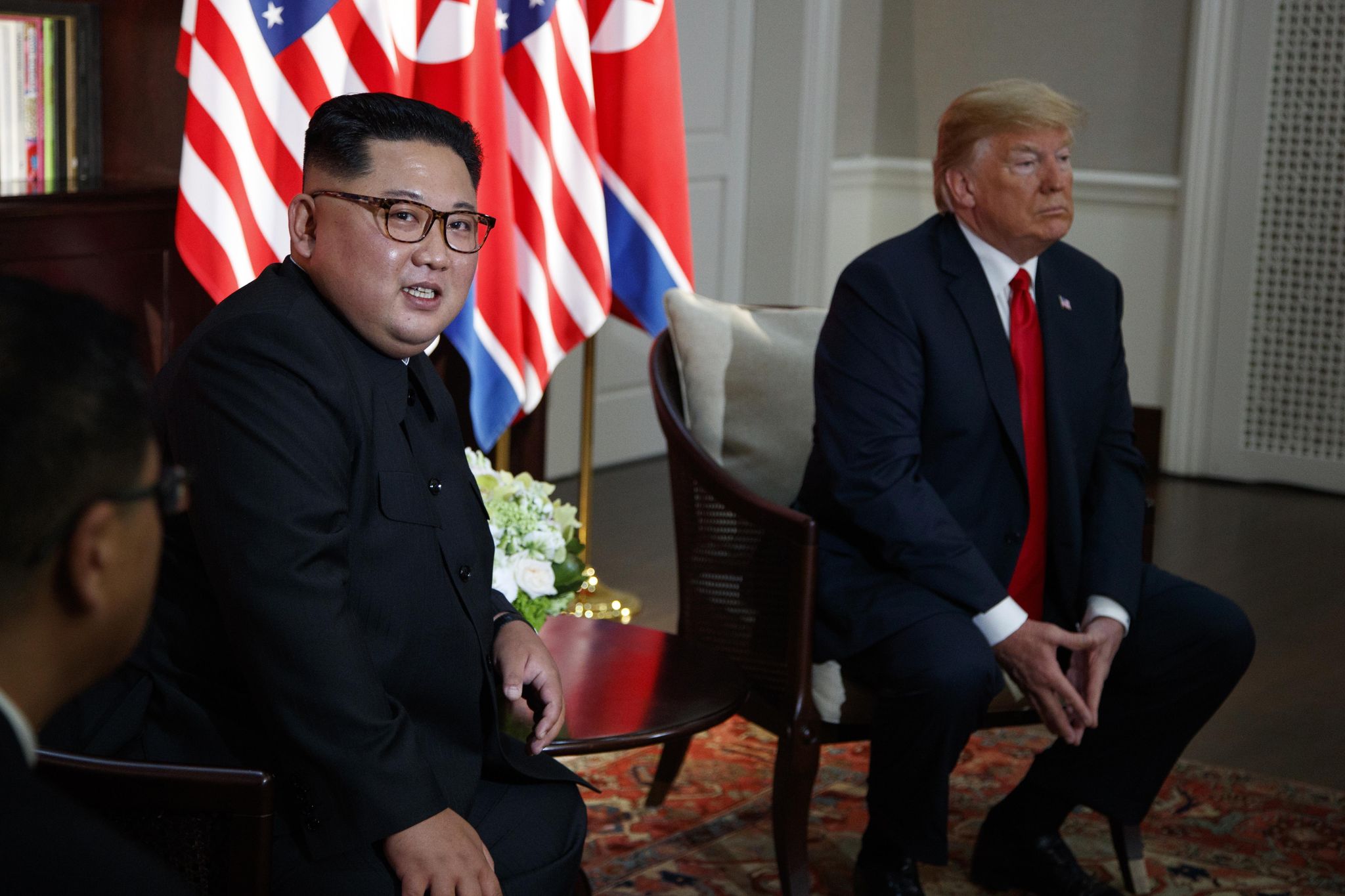
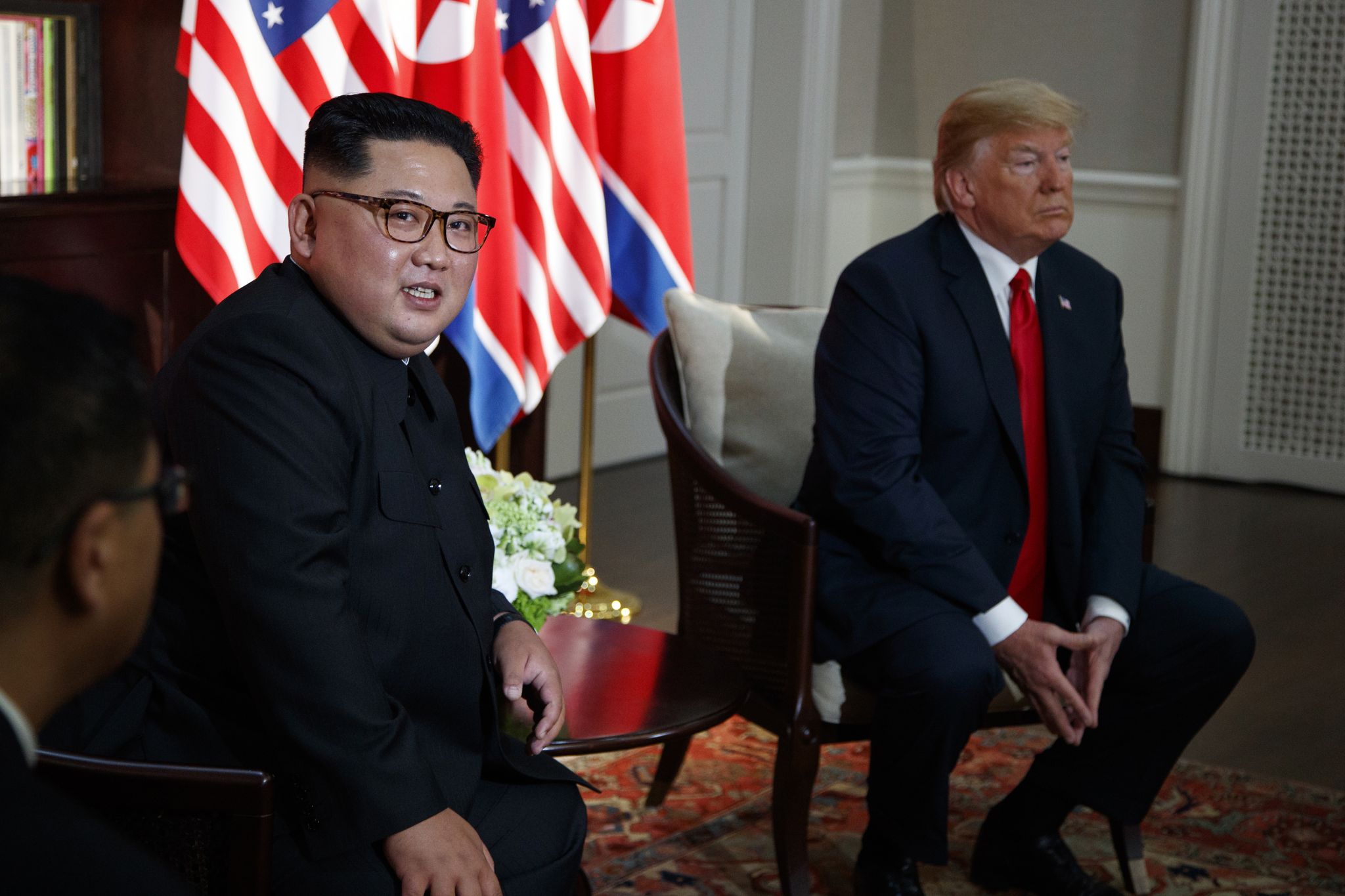
    The report came on the heels of the two leaders met for the first time in Singapore Tuesday for an historic summit on eliminating North Korea’s nuclear weapons. Mr. Trump had said he intended to invite Mr. Kim to visit the White House.

    At the summit, the two leaders signed a two-page document committing Mr. Kim to denuclearization, while Mr. Trump agreed to provide security guarantees for North Korea.

  • Trump tags US media as nation’s ‘biggest enemy’ after summit

    President Donald Trump challenged skeptical media coverage of his historic summit with North Korea’s Kim Jong Un on Wednesday, declaring that “Fake News” is the nation’s “biggest enemy.”

    WASHINGTON (AP) – President Donald Trump challenged skeptical media coverage of his historic summit with North Korea’s Kim Jong Un on Wednesday, declaring that “Fake News” is the nation’s “biggest enemy.”

    The president’s tweet, delivered a few hours after Air Force One touched down outside Washington, was reminiscent of his February 2017 Twitter rebuke in which he called several leading news outlets “the enemy of the American people.”

    Trump has sought to portray his unprecedented meeting with Kim as a significant accomplishment that has made the world less vulnerable to the North’s nuclear arsenal. Critics say that his agreement with the North lacks specific restraints on Kim’s government and that he offered to end joint military exercises with South Korea with little in return.

    The president tweeted after returning from his Singapore summit that “the Fake News, especially NBC and CNN,” are “fighting hard to downplay the deal with North Korea.” He added: “500 days ago they would have ‘begged’ for this deal-looked like war would break out.”

    “Our Country’s biggest enemy is the Fake News so easily promulgated by fools!” Trump tweeted.

    The president also asserted that after his initial round of talks with Kim, there is “no longer a Nuclear Threat from North Korea.” Trump’s claim is dubious given that independent experts estimate Pyongyang has enough fissile material for 20 to 60 bombs.

    The tweet followed a New York Times story on the Trump administration’s lack of scientific expertise, the president’s questioning of the honesty of the American media at an international summit in Canada and his dismissal of diplomatic expertise in favor of using a “touch” and “feel” approach in his talks with Kim.

    Trump has bristled against questions over his decision to meet with Kim, whose country is estimated to have 80,000 to 120,000 political prisoners. The president has dubbed his detractors “haters & losers.”

    “It’s a mistake to see attacks on the media as separate from those things,” said Jay Rosen, a New York University journalism professor. “It’s the erosion of the common world of fact. If we can’t agree on what the facts are, if there are no facts because they are in endless dispute, there is no accountability.”

    Rosen noted that international summits were often venues for the U.S. president and American journalists to insist on joint news conferences with autocratic leaders or strongmen and their accompanying press corps, a form of soft diplomacy that demonstrated America’s commitment to democratic institutions such as freedom of the press.

    While Trump held a news conference at the G-7 summit in Quebec last week, he told reporters during one exchange that he “came up with the term fake news” because many journalists who cover him are “very dishonest.” In response to a journalist representing CNN, Trump criticized the premise of the reporter’s question and then criticized “fake news CNN” as “the worst.”

    “Anybody who can exert a factual check on the president, saying ‘Wait a minute, that’s not what happened,’ is to be dismissed, attacked, delegitimized, pushed aside and turned into a hate object,” Rosen said.

    ___

    On Twitter, follow Ken Thomas at https://twitter.com/KThomasDC

  • Russia invites Donald Trump to World Cup

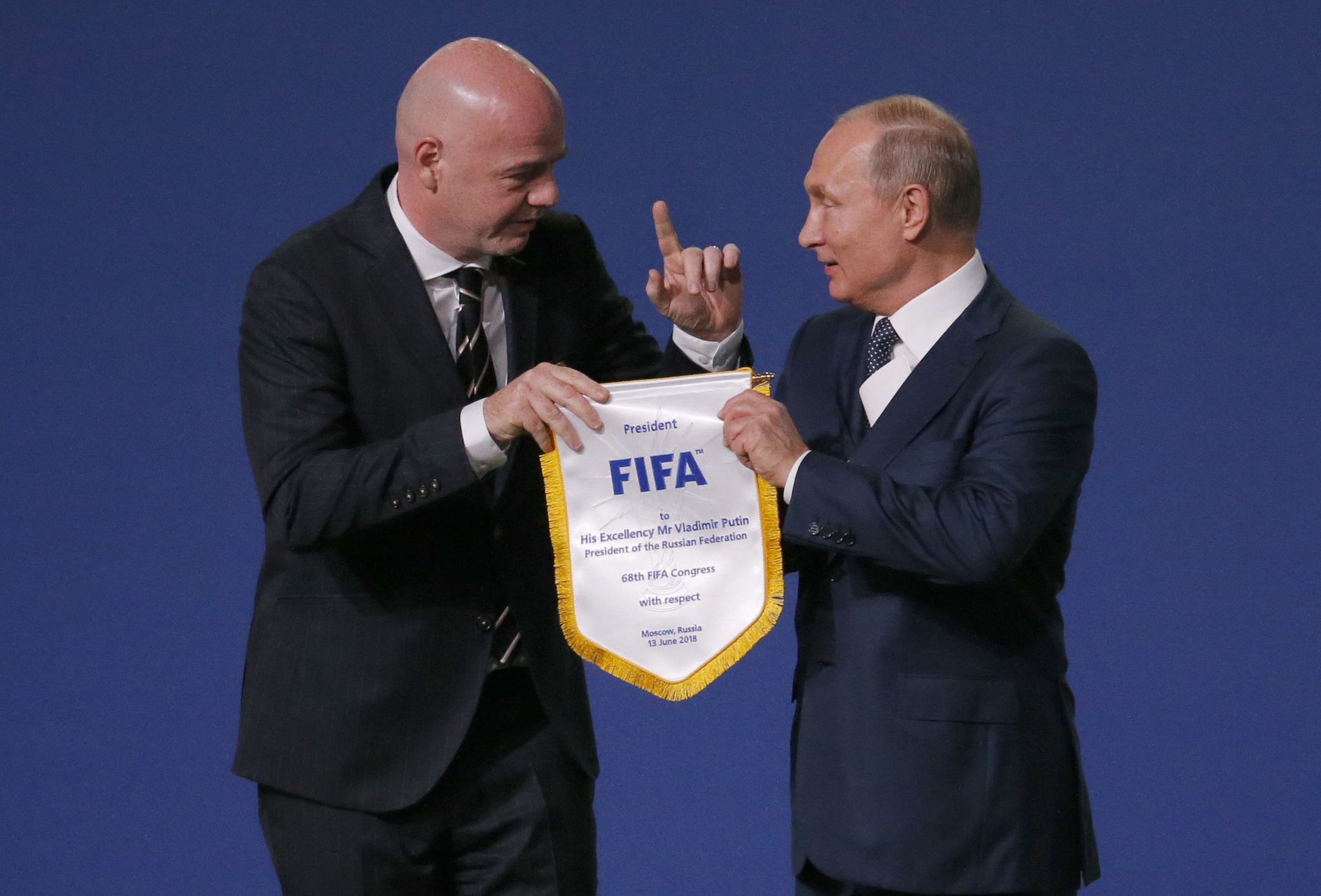
    President Trump is a welcome guest at the upcoming FIFA World Cup in Russia, Kremlin spokesman Dmitry Peskov told reporters on Wednesday.

    President Trump is a welcome guest at the upcoming FIFA World Cup in Russia, Kremlin spokesman Dmitry Peskov told reporters on Wednesday.

    “Russian President Vladimir Putin said he would be glad to see all guests here in Moscow and certainly this concerns the guests from the United States at the highest level,” Mr. Peskov told journalists when asked if Mr. Trump could be invited to attend a World Cup match, the official Russian state news wire TASS reported.

    Just a day before the 2018 competition kicks off with an opening match in Moscow between hosts Russia and Saudi Arabia, European media is feverishly debating which dignitaries will attend the monthlong tournament that concludes on July 15.

    Some world leaders face a quandary — attend and possibly be accused of playing into Mr. Putin’s hands during a time of global tension over Russian activities, or decline and be seen as not supporting their home team.

    According to German media, Chancellor Angela Merkel has yet to commit one way or anther.

    Ms. Merkel attended the 2006 World Cup in Germany, which helped raise her profile. In 2014, however, she also went to more mixed reviews. Images of her cheering a German goal were praised back home, but she received criticism for photos of her sitting alongside Mr. Putin and FIFA’s disgraced former president, Sepp Blatter.

    As for the U.K., no government ministers or royal family members will attend. British officials made that announcement earlier this year in response to the poisoning, allegedly by Russia, of a former Kremlin spy on English soil.

    French President Emmanuel Macron is keeping his options open. He has told French journalists he will attend but only if France reaches the semifinals. Saudi Arabia’s Crown Prince Mohammed Bin Salman will be present for the opening ceremony and the first game, which features his home team. South Korean President Moon Jae-in has also accepted Russia’s invitation.

    Foreign leaders are expected from a range of former Soviet states and also multiple South American countries.

    As for Mr. Trump, while the U.S. team is not in this year’s tournament, on Wednesday FIFA announced a joint North American bid will host the 2026 World Cup, returning to competition to the U.S. for the first time since 1994. The U.S-led effort, which includes Canada and Mexico, beat what was seen as a more risky Moroccan bid in a 134 to 65 vote.

    Afterwards, Mr. Trump tweeted his approval: “The U.S., together with Mexico and Canada, just got the World Cup. Congratulations – a great deal of hard work!”

    U.S. media also reported that some of the president’s behind-the-scenes actions could have helped sway key votes.

  • Trump-Kim summit raises new questions over South Korean role

    When South Korea’s president shuttled between North Korea and the United States to broker their first-ever summit, he faced both praise and criticism over whether he was a peace-making mediator or was

    SINGAPORE (AP) – When South Korea’s president shuttled between North Korea and the United States to broker their first-ever summit, he faced both praise and criticism over whether he was a peace-making mediator or was helping North Korea find ways to weaken U.S.-led economic sanctions.

    A day after President Donald Trump and North Korean leader Kim Jong Un held their summit in Singapore, is it clearer whether Moon Jae-in played a positive or negative role? A quick answer: Probably not.

    Assessments of Moon’s diplomacy have become more divisive and complex, with Trump criticized in both South Korea and the U.S. for the concessions he made to North Korea, while others believe the summit will successfully prolong the current mood of detente.

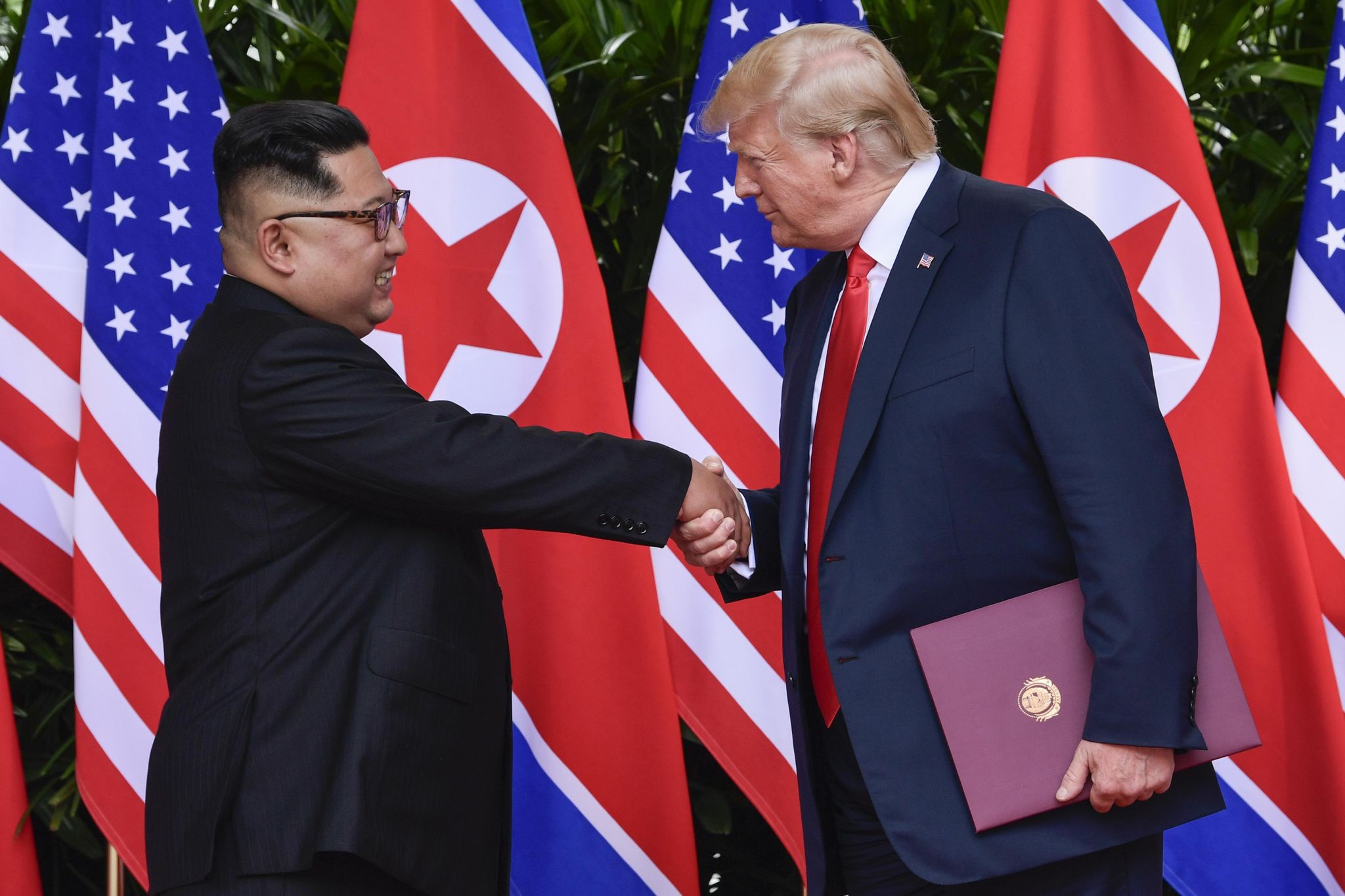
    Meeting for about five hours, Trump and Kim exchanged an historic handshake, took a short stroll together, patted each other’s backs and signed a summit agreement. Trump promised to provide security guarantees to the North and suspend joint military drills with the South as long as negotiations with the North continue in “good faith.” Kim, in return, agreed to work toward a vague “complete denuclearization of the Korean Peninsula.”

    Those moves were unthinkable even several months ago, when the two unpredictable leaders threatened to nuke each other and traded a series of harsh personal insults.

    Moon issued a statement after the summit calling it a “huge step forward” toward peace that “helped break down the last remaining Cold War legacy on Earth.”

    He acknowledged that many difficulties are likely to lie ahead but vowed to work together with the U.S., North Korea and others to bring lasting peace to the Korean Peninsula.

    “We will never go back to the past again and never give up on this bold journey. History is a record of people who take action and rise to a challenge,” he said.

    But conservatives in South Korea slammed the summit, saying it failed to curb North Korea’s nuclear ambitions. They said both Trump and Moon should be blamed for not specifying steps and deadlines for North Korea’s nuclear disarmament, allowing it time to perfect its weapons program.

    “High expectations were met by low results,” said Nam Sung-wook, a North Korea expert at Seoul’s Korea University. “Moon, and then Trump, were quick to bite on North Korea’s invitation for talks. When Trump realized there wasn’t going to be anything substantial in return, it was impossible for him to back out because he had already gone too far.”

    U.S. officials had worked hard to get North Korea to agree to “complete, verifiable and irreversible” disarmament, and said they would not offer any major concessions until it took meaningful steps. Despite those efforts, Trump announced after the summit that he had agreed to suspend U.S. military drills with South Korea, something North Korea has long demanded.

    On Wednesday, North Korean state media said Trump had also agreed to the North’s desire for a step-by-step disarmament process with corresponding U.S. concessions at each step, rather than immediate disarmament as the U.S. had initially sought.

    Trump’s agreement to suspend the military drills apparently came without prior consultation with South Korea, baffling many who believe the U.S.-South Korea alliance, forged in blood during the 1950-53 Korean War, should remain strong throughout the push for a negotiated end to the nuclear tensions.

    “Why did South Korea and the U.S. form an alliance and stage military drills before the nuclear crisis flared? It’s because North Korea has been belligerent,” said Kim Taewoo, former president of the Korea Institute for National Unification in Seoul. He said cancellation of the drills “is really a bad idea … and (Trump) betrayed our people.”

    Asked to respond to Trump’s decision, Moon spokesman Kim Eui-kyeom said the allies must consider a “variety of ways to further facilitate dialogue” during the nuclear negotiations. He said South Korea is still trying to figure out the exact meaning and intent of Trump’s comments.

    Since taking office in May last year, Moon, a son of North Korean refugees, has sought to take the lead in diplomatic efforts to end the North Korean nuclear standoff, which had been dominated by world powers including the U.S. and China.

    Provocative nuclear and missile tests by North Korea last year initially gave Moon little diplomatic room to maneuver. But he kept trying to reach out to North Korea, and eventually found a role as a mediator after Kim offered in January to send a delegation to the South Korean Winter Olympics.

    After successful cooperation at the Olympics, Moon sent special envoys to North Korea who later traveled to Washington with Kim’s proposal for a summit with Trump. Moon held talks with Kim in April at which Kim agreed to work toward “complete denuclearization.” He met Kim again in May when Trump said he was withdrawing from the planned summit with Kim – a decision Trump quickly reversed.

    Experts now expect a temporary peace to continue since North Korea has probably won what it wanted from Tuesday’s summit and Trump is unlikely to back down from summit deals that he wants to portray as a diplomatic triumph.

    Analyst Hong Min at Seoul’s Korea Institute for National Unification said critics of the joint statement signed by Trump and Kim are missing a bigger point.

    He said it’s meaningful in itself that the leaders of the United States and North Korea met, talked and signed an agreement that will carry more weight and significance than any pact previously made between the wartime foes. The agreement’s aspirational language on denuclearization was a “strategic decision” to reduce pressure on both sides and keep the process going, Hong said.

    Trump and Kim agreed that their countries will quickly engage in follow-up talks led by U.S. Secretary of State Mike Pompeo and a “relevant high-level” North Korean official.

    Bong Youngshik, a professor at Seoul’s Yonsei University, said it’s too early to predict how Trump’s cancellation of the military drills will play out in future nuclear negotiations. He said North Korea is likely to consider Trump’s decision a temporary measure while it remains in negotiations with Washington.

    Moon may not face any immediate serious political repercussions at home since North Korea will likely take gradual steps toward disarmament to prevent others from thinking it reneged on its pledge. But if Trump seeks re-election in 2020, his government is likely to apply more pressure on North Korea to make substantial progress in denuclearization, which could bring the nuclear issue to another critical point, said Shin Beomchul of Seoul’s Asan Institute for Policy Studies.

    ___

    Kim Tong-hyung reported from Seoul, South Korea.

  • The Latest: Trump’s claim of no nuke threat seen as dubious

    The Latest on the summit between President Donald Trump and North Korean leader Kim Jong Un (all times local):

    WASHINGTON (AP) – The Latest on the summit between President Donald Trump and North Korean leader Kim Jong Un (all times local):

    11:30 a.m.

    Secretary of State Mike Pompeo says he’s confident that U.S. talks with North Korea will resume “sometime in the next week.”

    Pompeo says he doesn’t know the exact timing. Speaking in Seoul, he says he expects it to happen fairly quickly after he and the North Koreans return to their nations. Pompeo returns late Thursday to the U.S.

    He says President Donald Trump is “in the lead” but that “I will be the person who takes the role of driving this process forward.”

    He says much more work has been done by the U.S. and North Korean that couldn’t be encapsulated in the Trump-Kim Jong Un statement. So he says teams will now work to make more progress on those items.

    ___

    11:20 a.m.

    Secretary of State Mike Pompeo says the United States wants North Korea to take major nuclear disarmament steps within the next two years.

    Pompeo is laying out an ambitious timeline for denuclearization following President Donald Trump’s meeting with Kim Jong Un. He says he won’t disclose specific timelines but that the administration is hopeful that “major, major disarmament” steps can occur before the end of Trump’s first term. The term ends in January 2021.

    Pompeo is also urging skepticism after North Korean official media said Trump had agreed to a step-by-step approach to denuclearization. Pompeo isn’t being specific but says that “one should heavily discount some things that are written in other places.”

    Pompeo spoke to reporters from Seoul, South Korea.

    ___

    11:15 a.m.

    Secretary of State Mike Pompeo says that North Korean leader Kim Jong Un understands that “there will be in-depth verification” of nuclear commitments in any deal with the U.S.

    Pompeo is pushing back on criticism that the joint agreement signed by Kim and President Donald Trump includes no mention of verifying North Korean nuclear disarmament. Ahead of Trump’s summit with Kim, the U.S. had said disarmament must be “complete, verifiable and irreversible.”

    But Pompeo tells reporters that it’s silly to focus on the lack of the word “verifiable.” He says that’s because the agreement does refer to “complete” denuclearization of the Korean Peninsula. Pompeo says that “in the minds of everyone concerned,” the word “complete” encompasses “verifiable.”

    Pompeo says: “I am equally confident they understand that there will be in-depth verification.”

    ___

    11:10 a.m.

    Secretary of State Mike Pompeo says joint U.S.-South Korea military exercises will resume if North Korea stops negotiating in good faith over its nuclear program.

    Pompeo is in South Korea a day after President Donald Trump met with Kim Jong Un and announced the U.S. would freeze what he called “war games” with North Korea.

    Pompeo says he was there when Trump talked about it with Kim. He says Trump “made very clear” that the condition for the freeze was that good-faith talks continue. He says if the U.S. concludes they no longer are in good faith, the freeze “will no longer be in effect.”

    Pompeo says Trump was “unambiguous” in conveying that to Kim.

    ___

    11 a.m.

    House Speaker Paul Ryan says President Donald Trump should be “applauded” for his meeting with North Korea leader Kim Jong Un. But Ryan is cautioning on Wednesday that the next steps toward an agreement won’t go fast.

    The Wisconsin Republican, who is retiring this year, told reporters that “The president needed to disrupt the status quo, and the president has disrupted the status quo” with the historic meeting in Singapore. He said “the president should be applauded….Now let’s go get an agreement.”

    Trump and Kim signed a joint statement that contained a repeat of past promises to work toward a denuclearized Korean Peninsula, but the details haven’t been nailed down.

    He cautioned that no one should expect that process to go quickly. “Time,” he said, “will tell how this ends.”

    ___

    10 a.m.

    President Donald Trump is challenging skeptical media coverage of his historic summit with North Korea’s Kim Jong Un. He says “Fake News” is the nation’s “biggest enemy.”

    Trump writes on Twitter that “the Fake News, especially NBC and CNN” are “fighting hard to downplay the deal with North Korea.”

    Trump says that “500 days ago they would have ‘begged’ for this deal-looked like war would break out.”

    The president says the country’s “biggest enemy is the Fake News so easily promulgated by fools!”

    Trump has been tweeting about his talks with Kim since Air Force One returned to the United States early Wednesday morning, arguing that the talks with North Korea have made the U.S. safer. Trump’s claim is dubious considering Pyongyang’s significant weapons arsenal.

    ___

    7:25 a.m.

    President Donald Trump is defending his calls to end military exercises with South Korea that allies have said is important to security in the Asia Pacific region.

    Trump says on Twitter after returning from his Singapore summit that “we save a fortune by not doing war games, as long as we are negotiating in good faith.”

    Trump has said the U.S. and South Korea should stop their joint military exercises as long as both sides are negotiating in good faith, which the president says is happening.

    Back in the United States, Trump is tweeting about his historic summit with North Korean leader Kim Jong Un. He says there is no longer a nuclear threat from North Korea even though experts estimate that Kim’s government has enough fissile material for 20 to 60 bombs.

    __

    6:15 a.m.

    President Donald Trump says on Twitter, “There is no longer a Nuclear Threat from North Korea,” as he returns to the United States after his historic summit with North Korea leader Kim Jong Un.

    Trump says on Twitter that “everybody can now feel much safer than the day I took office.”

    He says before he took office, “people were assuming that we were going to War with North Korea,” and President Barack Obama said North Korea was the nation’s biggest problem.

    Trump and Kim signed an agreement to work toward denuclearization, but it appears weaker than past deals that failed. Independent experts estimate North Korea now has enough fissile material for 20 to 60 bombs, and it has tested missiles that could potentially deliver a nuclear weapon to the U.S. mainland.

    ___

    5:37 a.m.

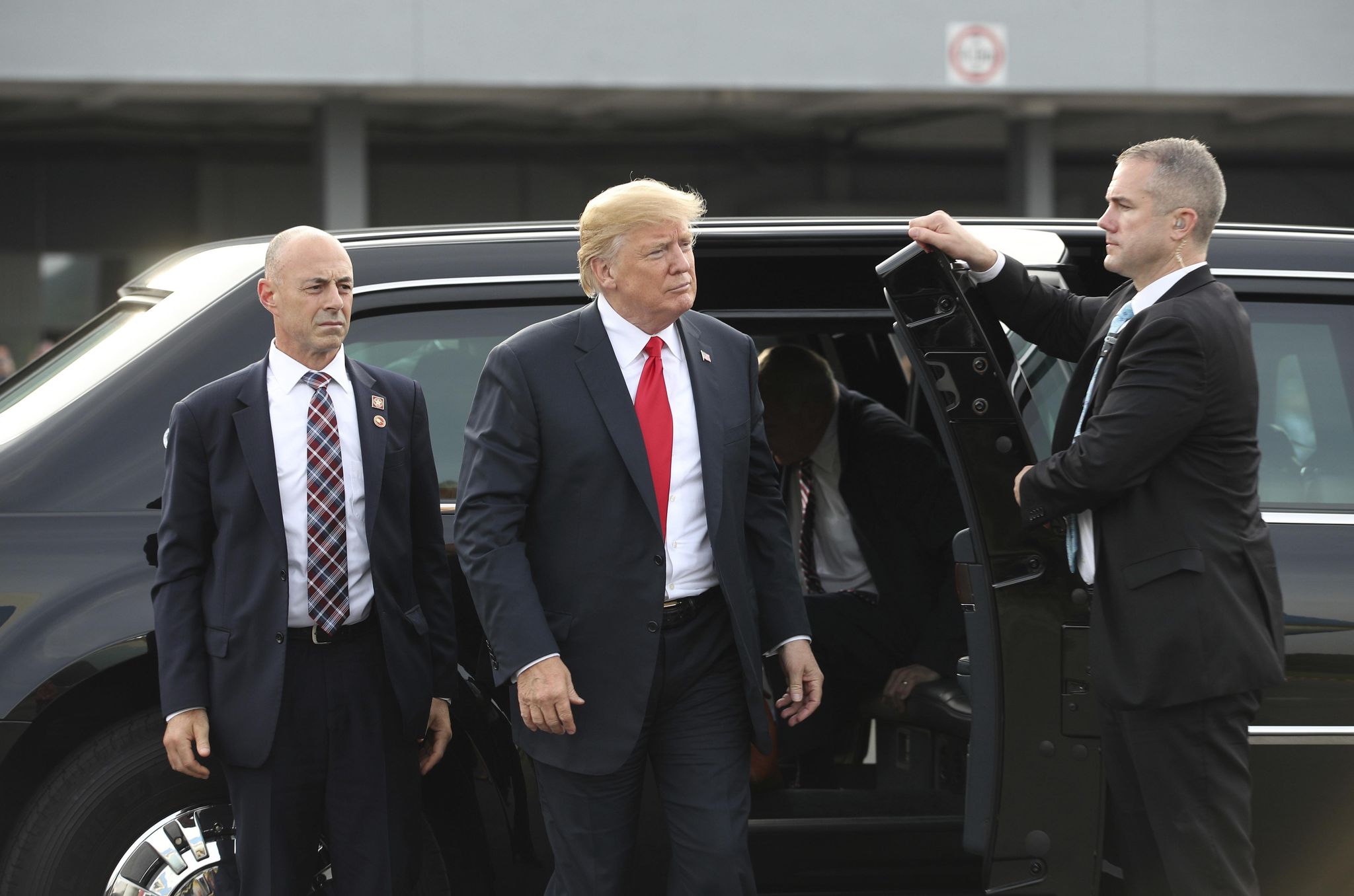
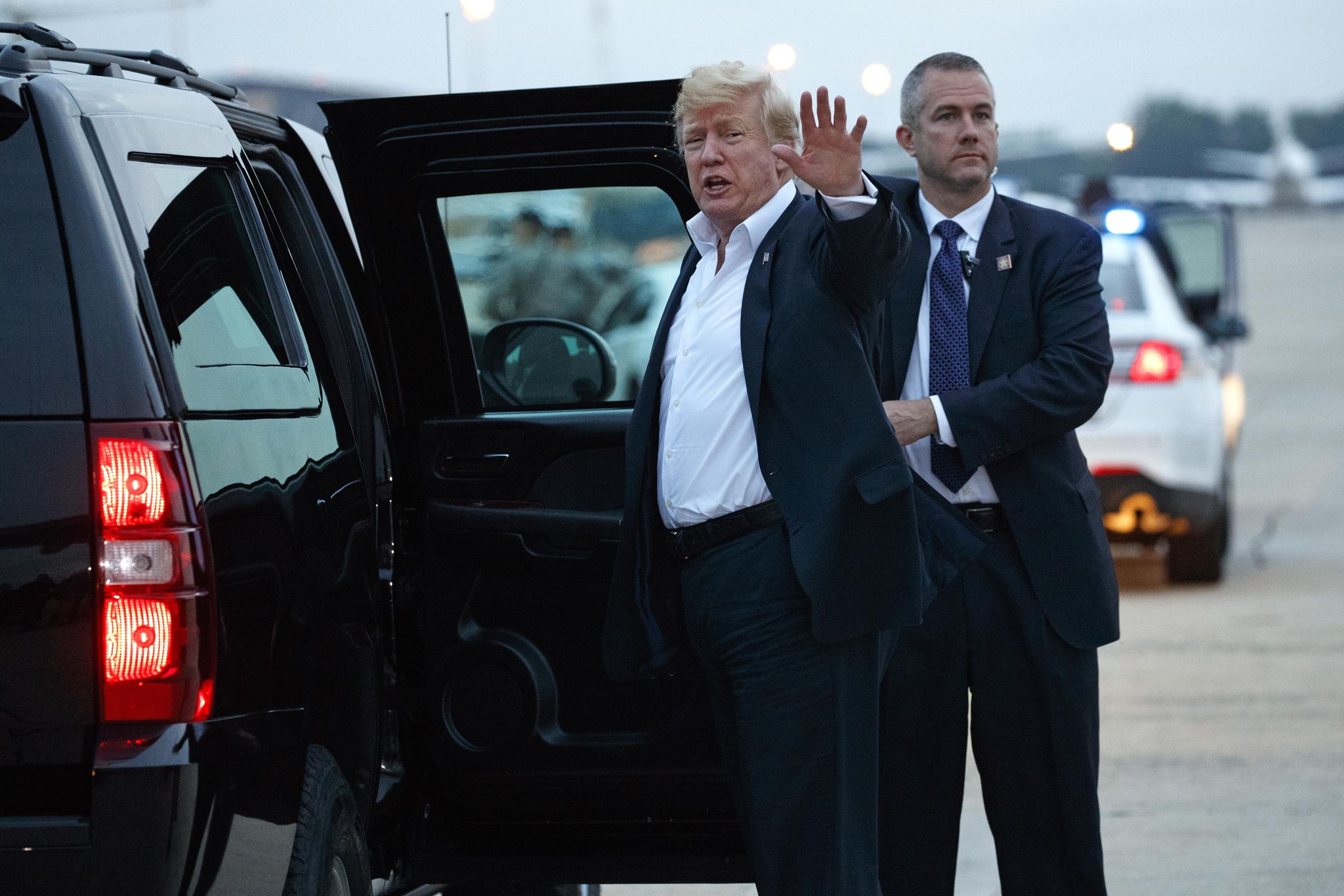
    President Donald Trump has arrived back in Washington from his historic nuclear summit with North Korea’s Kim Jong Un in Singapore.

    Air Force One touched down at Joint Base Andrews early Wednesday morning, completing the president’s marathon trip to Asia for talks with the North Korean leader. The president made refueling stops in Guam and Hawaii on his return to Washington.

    While his aircraft refueled in Hawaii, Trump thanked Kim for “taking the first bold step toward a bright new future for his people,” saying their summit on Tuesday “proves that real change is possible!”

    During his return, Trump spoke with South Korean Prime Minister Moon Jae-in and Japanese Prime Minister Shinzo Abe.

    ___

    6:25 p.m.

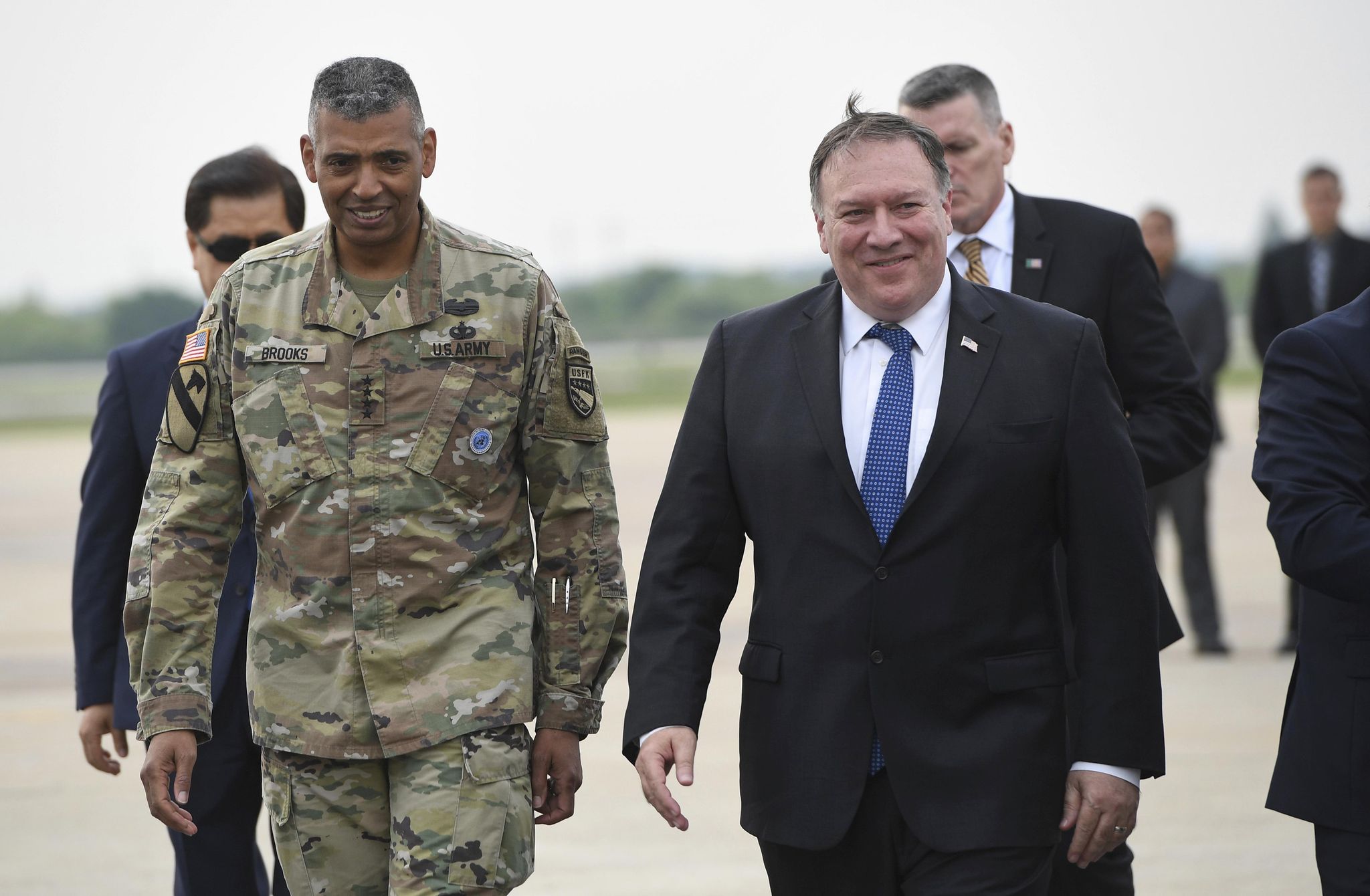
    U.S. Secretary of State Mike Pompeo has landed at Osan Air Base south of Seoul ahead of meetings with America’s allies in the aftermath of the summit between President Donald Trump and North Korean leader Kim Jong Un.

    He’s expected to meet privately in the evening with Gen. Vincent Brooks, commander of U.S. Forces Korea.

    Pompeo will meet President Moon Jae-in on Thursday morning to discuss the summit.

    Japanese Foreign Minister Taro Kono is also heading to Seoul and is due to meet with Pompeo and his South Korean counterpart. Pompeo, the former CIA director, then plans to fly to Beijing to update the Chinese government on the talks.

    ___

    5:05 p.m.

    Russia is welcoming the outcome of the summit between President Donald Trump and North Korean leader Kim Jong Un.

    Kremlin spokesman Dmitry Peskov says “one can only welcome the fact that such a meeting took place and that direct dialogue was begun.”

    Peskov tells reporters in Moscow on Wednesday that the meeting helps de-escalate tensions and push the situation away “from the critical point where it was just a few months ago.”

    Peskov says the meeting confirms Russian President Vladimir Putin’s view that “there is no alternative to political and diplomatic means in solving the problem of the Korean Peninsula.”

    Peskov adds, however, that given how complicated the situation is around North Korea, the Kremlin isn’t expecting a quick resolution.

    ___

    3:20 p.m.

    A spokesman of South Korean President Moon Jae-in says Washington and Seoul need to consider a “variety of ways to further facilitate dialogue” while they are engaged in nuclear negotiations with Pyongyang.

    Kim Eui-kyeom made the comments on Wednesday when asked to respond to President Donald Trump, who following his summit with North Korean leader Kim Jong Un said that the United States and South Korea should stop their joint military exercises “as long as we are negotiating in good faith.”

    Kim, Moon’s spokesman, says Seoul is still trying to figure out the exact meaning and intent of Trump’s comments.

    ___

    10:50 a.m.

    The U.S. top diplomat is jetting to South Korea to brief the country’s president as Asian allies try to parse the implications of the extraordinary nuclear summit in Singapore between President Donald Trump and North Korea’s Kim Jong Un.

    South Korea’s presidential office says U.S. Secretary of State Mike Pompeo will meet President Moon Jae-in Thursday morning to discuss the meeting, which made history as the first between sitting leaders of the U.S. and North Korea.

    Trump and Kim reached a broad agreement that offered few specifics but included promises of U.S. security guarantees and a reiteration from Kim of his country’s commitment to “complete denuclearization of the Korean Peninsula.”

    Trump however seems to have caught allies off guard by saying he would stop U.S.-South Korean war games.

  • The Latest: Trump arrives back in Washington

    The Latest on the summit between North Korean leader Kim Jong Un and President Donald Trump (all times local):

    WASHINGTON (AP) – The Latest on the summit between North Korean leader Kim Jong Un and President Donald Trump (all times local):

    5:37 a.m.

    President Donald Trump has arrived back in Washington from his historic nuclear summit with North Korea’s Kim Jong Un in Singapore.

    Air Force One touched down at Joint Base Andrews early Wednesday morning, completing the president’s marathon trip to Asia for talks with the North Korean leader. The president made refueling stops in Guam and Hawaii on his return to Washington.

    While his aircraft refueled in Hawaii, Trump thanked Kim for “taking the first bold step toward a bright new future for his people,” saying their summit on Tuesday “proves that real change is possible!”

    During his return, Trump spoke with South Korean Prime Minister Moon Jae-in and Japanese Prime Minister Shinzo Abe.

    ___

    8:20 a.m.

    President Donald Trump is thanking North Korean leader Kim Jong Un for “taking the first bold step toward a bright new future for his people,” saying their summit Tuesday “proves that real change is possible!”

    Tweeting from Air Force One, which just landed in Hawaii to refuel on the trip back from Singapore, Trump says, “There is no limit to what NoKo can achieve when it gives up its nuclear weapons and embraces commerce & engagement w/ the world.”

    Trump is celebrating Tuesday’s agreement to launch a process to denuclearize the Korean Peninsula, though experts and allies are still awaiting details on the broad accord the two sides say they’ve reached.

    ___

    Follow AP’s summit coverage here: http://apne.ws/MPbJ5Tv

  • In SC primary, ardent Trump backer defeats Rep. Mark Sanford

    President Donald Trump is crediting his Election-Day tweet in part for the defeat of a South Carolina Republican congressman who has been critical of his administration.

    COLUMBIA, S.C. (AP) – President Donald Trump is crediting his Election-Day tweet in part for the defeat of a South Carolina Republican congressman who has been critical of his administration.

    Trump tweeted Wednesday that his advisers didn’t want him to get involved in the Republican primary, thinking Rep. Mark Sanford “would easily win.”

    But Trump says Rep. Katie Arrington “was such a good candidate, and Sanford was so bad, I had to give it a shot.”

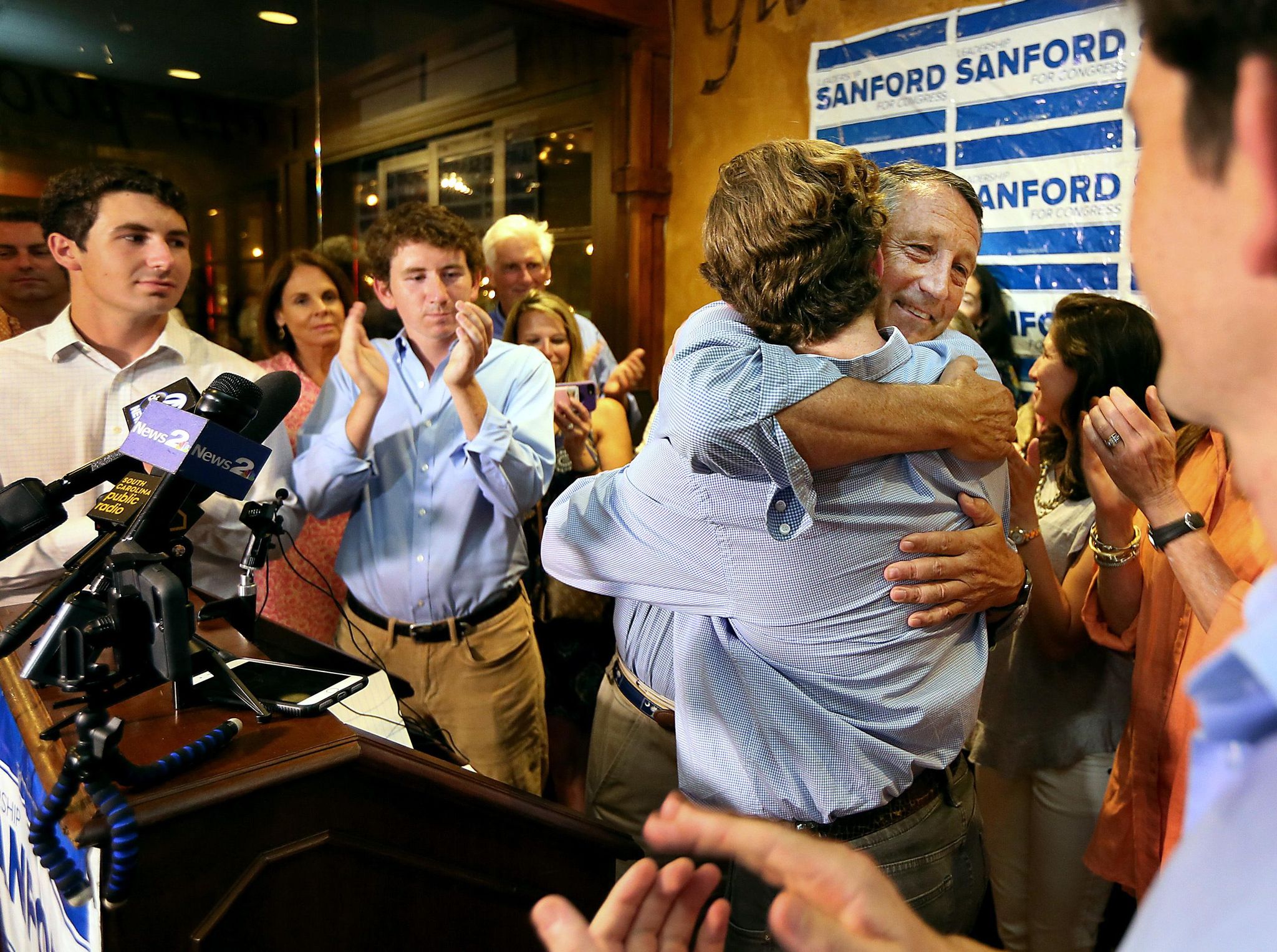
    Arrington narrowly defeated Sanford after Trump tweeted that Sanford had been unhelpful, adding, “He is better off in Argentina.”

    That was a reference to Sanford’s surprise disappearance from the state as governor, which he later revealed was to further his affair with an Argentine woman.

    Sanford’s loss was perhaps the most dramatic result in primaries across five states Tuesday.

    He becomes the second incumbent House Republican to lose a primary this year – the latest victim of intense divisions among the GOP in the Trump era.

    Sanford’s voting record is generally conservative, but his criticism of Trump as unworthy and culturally intolerant made him a target of dedicated Trump supporters who often elevate loyalty over policy.

    Arrington blasted Sanford as a “Never Trumper,” and Trump tweeted a startlingly personal attack hours before polls closed, calling Sanford “MIA and nothing but trouble … he’s better off in Argentina.”

    Even for a political figure with no shortage of confidence in challenging party decision-making, the attack was a bold case of going after a sitting member of Congress. It’s almost certain to make other Republicans even more reluctant to take him on, even as Trump stirs divisions on trade, foreign policy and the Russia investigation.

    Sanford said Tuesday night that “I stand by every one of those decisions to disagree with the president.”

    Sanford had never lost a political race in South Carolina, and his defeat Tuesday came amid a roller-coaster political career. Despite the scandal over the affair, he completed his second term as governor and voters sent him to Congress two years later.

    In her victory speech, Arrington asked Republicans to come together, saying “We are the party of President Donald J. Trump.”

    Four other states voted Tuesday, including several races that will be key to determining which party controls the House of Representatives next year.

    In other races:

    __

    IN SOUTH CAROLINA, INCUMBENT GOVERNOR FACES RUN-OFF

    Sanford was not the only establishment Republican to face a challenge Tuesday. South Carolina Gov. Henry McMaster, a close ally of Trump, was forced into a runoff after failing to muster the required 50 percent vote to win outright.

    McMaster, an early supporter of the president’s 2016 campaign, had Trump’s full endorsement, marked by a weekend tweet.

    But while Trump remains very popular in the state, McMaster has been shadowed by a corruption probe involving a longtime political consultant. McMaster received the most votes of the four Republicans running, but will face Greenville businessman John Warren in a second contest June 26.

    McMaster, the former lieutenant governor, assumed the governorship last year after Nikki Haley resigned to become U.S. ambassador to the United Nations.

    ___

    GOP‘S ‘VICIOUS’ VIRGINIA VICTOR

    Trump is tweeting that people shouldn’t underestimate his loyalist Corey Stewart, who won Virginia’s Republican primary to face Democratic Sen. Tim Kaine. The president tweeted Wednesday that Stewart has “a major chance of winning!”

    Stewart, known for his ardent defense of Trump and of Confederate symbols, said he plans a “vicious” campaign against Kaine, who has a huge fundraising advantage going into the general election.

    Kaine gives passionate campaign speeches, but Trump’s tweet calls him a “total stiff.”

    As Trump’s top campaign aide in Virginia, Stewart accused the Republican Party of inadequately defending the candidate after the release of a recording in which Trump bragged about groping women.

    Stewart also has called efforts to remove Confederate monuments “an attempt to destroy traditional America.”

    ___

    A HOUSE BELLWETHER IN VIRGINIA

    Democratic State Sen. Jennifer Wexton was the clear winner in a six-way primary in a northern Virginia district considered key to the House battleground map this fall, and will challenge Republican Rep. Barbara Comstock.

    Democrats in two other districts they hope to retake nominated women: Abigail Spanberger in central Virginia and Elaine Luria in the district that includes Virginia Beach.

    In Comstock’s district, Wexton was the best-known in the field, and was viewed as the Democratic Party’s establishment choice. She had the endorsement of Democratic Gov. Ralph Northam.

    Comstock, a moderate Republican who easily beat back a challenge from conservative Shak Hill, is one of the Democrats’ top targets in November. The second-term House member’s district leans Republican, though Democrat Hillary Clinton received more votes there than Trump did in 2016.

    Though Wexton favors a ban on the sale of assault weapons, she defied what has been the tendency in some swing districts to nominate Democrats with liberal profiles on other key issues. She has not called for a single-payer, government-run health insurance system, as some Democratic House primary winners in California, Nebraska and Pennsylvania have.

    Democrats need to gain 23 seats to win the majority in the House.

    __

    TURNING THE LePAGE

    Maine voters are deciding on a successor to term-limited, conservative Republican Gov. Paul LePage. But first they had to wrestle with a new balloting system. Maine on Tuesday debuted its statewide ranked-choice voting , which allows voters to rank candidates first to last on their ballot.

    The system insured that counting was slow and winners difficult to call. But businessman Shawn Moody won the GOP nomination after midnight. He maintained a wide lead through the night, but risked not winning the race outright under the new rules.

    The Associated Press did not call the Democratic primary as none of the seven candidates was close to the majority needed to be declared the outright winner, so more tabulations are required next week under ranked-choice voting. Last-place candidates will be eliminated and votes reallocated until there is a winner, a process that may take more than a week.

    __

    NEVADA, NORTH DAKOTA: SEE YOU IN NOVEMBER

    Nevada and North Dakota are home to two of the most pivotal Senate races this year. What they didn’t have were competitive Senate primaries.

    Nevada Sen. Dean Heller, the only Republican seeking re-election in a state that Hillary Clinton carried in 2016, and Democratic Rep. Jacky Rosen sailed through their primaries, and already have begun focusing their criticism on each other in what is expected to be among the most competitive Senate races this year.

    There was also the return of Sharron Angle , the conservative who once ominously threatened to “take out” then-Sen. Harry Reid. Angle, who lost to Reid in her 2010 bid for Senate, lost her primary challenge to Rep. Mark Amodei on Tuesday.

    Centrist Steve Sisolak won a bruising battle between Clark County commissioners vying to be Nevada’s first Democratic governor in two decades. Fellow board member Chris Giunchigliani ran as a progressive, knocking Sisolak for his positive rating from the National Rifle Association in light of the mass shooting in Las Vegas in October. Republican Attorney General Adam Laxalt easily cleared the GOP field.

    Nevada election officials blamed new touch-screen voting machines for glitches that affected a small number of voters and delayed the count of ballots in rural Pershing County. In no case were voters unable to successfully cast a ballot, the Nevada Secretary of State’s office said.

    In North Dakota, GOP Rep. Kevin Cramer will face moderate Democratic Sen. Heidi Heitkamp . She is seeking re-election in a state Trump carried by 36 percentage points in 2016.

    __

    BROTHELS ON THE BALLOT

    Pimp Dennis Hof, the owner of half a dozen legal brothels in Nevada and star of the HBO adult reality series “Cathouse,” won a Republican primary for state Legislature, ousting a three-term lawmaker.

    Voters in November will also be voting on closing down brothels in at least one of the seven Nevada counties where they’re legally operating, and activists are trying to get the measure on the ballot in another district.

    __

    This story has been corrected to reflect that Sanford completed his second term as South Carolina governor and did not resign.

    __

    Associated Press writers Meg Kinnard and Christina Myers in Columbia, S.C.; Marine Villeneuve in Augusta, Maine; Patrick Whittle in Portland, Maine; Alan Suderman in Richmond, Va.; Matthew Barakat in McLean, Va.; Scott Sonner in Reno, Nev.; Michelle Price in Las Vegas; and James MacPherson in Bismarck, N.D., contributed to this report.
  • Iran deal comparisons cloud Trump’s North Korea summit

    President Donald Trump’s triumphant assertions about the success of the unprecedented Singapore summit are being met with skepticism and outright derision from critics seizing on the contradiction bet

    WASHINGTON (AP) – President Donald Trump’s triumphant assertions about the success of the unprecedented Singapore summit are being met with skepticism and outright derision from critics seizing on the contradiction between his withdrawal from the Iran nuclear deal and his willingness to accept vague pledges from North Korean leader Kim Jong Un.

    White House officials have repeatedly stressed that this week’s meeting in Singapore is the beginning, not the end, of a process that Trump’s team argues could have only been jump-started with the face-to-face meeting. The Singapore summit set out broad goals to be met in the coming months while the Iran deal, signed by President Barack Obama in 2015 and approved by seven nations, was an imperfect end to 18 months of negotiations, they say. Criticism that Tuesday’s commitment does not include specifics on denuclearization and verification is too early, they argue.

    “While I am glad the president and Kim Jong Un were able to meet, it is difficult to determine what of concrete nature has occurred,” said Sen. Bob Corker, R-Tenn., the chairman of the Senate Foreign Relations Committee. He said he wanted Secretary of State Mike Pompeo, who will lead the follow-on negotiations, to explain details of what the administration has in mind.

    The top Democrat on that panel, Sen. Bob Menendez of New Jersey, who also opposed the Iran deal, took issue with Trump’s zeal as well as his announcement of the suspension of U.S.-South Korea military exercises.

    “In exchange for selfies in Singapore, we have undermined our maximum pressure policy and sanctions,” Menendez said.

    For Iran deal proponents, though, the Singapore summit was evidence of Trump’s lack of preparedness and poor negotiating skills. Iran deal opponents, meanwhile, seemed willing to wait and see.

    Sen. Tom Cotton, R-Ark., a Trump advocate and fervent Iran deal foe, urged patience and sought to dispel suggestions that the president had unwisely plunged into a meeting with a dictator after having withdrawn from the accord with Tehran. He noted, as did other Trump allies, that North Korea already had nuclear weapons and the capability to deliver them whereas Iran did not.

    “There is a school of thought that … the United States president should not sit down with two-bit dictators,” Cotton told conservative commentator Hugh Hewitt. “I think there’s some validity to that school of thought with the exception (of) once those dictators have nuclear weapons.”

    “You know, countries like Iran and Cuba and other two-bit rogue regimes don’t have nuclear weapons, yet,” he said. “They can’t threaten the United States in that way. Once they have missiles that can deliver them to use, I would liken it to past presidents sitting down with Soviet dictators.”

    Victor Cha, a Georgetown University professor and former National Security Council director for Asia in President George W. Bush’s administration, lamented that the summit results “left a lot to be desired.” But he also maintained that the Trump-Kim meeting had reduced the chance of conflict even if it was only a “modest start.”

    “Despite its many flaws, the Singapore summit represents the start of a diplomatic process that takes us away from the brink of war,” Cha wrote in The New York Times in the immediate aftermath of the summit. “Mr. Trump’s unconventional approach leaves a lot to be desired in the foreign policy of the United States, but there was no other path to this less-than-satisfying but digestible outcome.”

    Kelsey Davenport, the nonproliferation policy director at the Arms Control Association, which supported the Iran deal, called the summit result “mediocre.”

    “The vague language on denuclearization is not a breakthrough, it is a boilerplate reiteration of past statements,” she said, adding: “It is far too early in the process for Trump to declare success.”

    In the case of the Iran deal, even the most generous assessors of the Singapore summit sought to remind the White House that intense diplomacy preceded the agreement with Tehran.

    “Pompeo will now have to undertake the kind of arduous, multiyear negotiations with Pyongyang that former secretary of state John Kerry undertook with Tehran,” Cha and Koreas expert Sue Mi Terry said in a paper for the Center for Strategic and International Studies. “Trump has assailed Obama’s deal with Iran as the ‘worst ever,’ but he now faces substantial challenges to achieve as much as Obama did.”

    Iran itself cautioned North Korea against taking Trump at his word.

    “We are facing a man who revokes his signature while abroad,” the semi-official Fars news agency quoted government spokesman Mohammad Bagher Nobakht as saying on Tuesday.

  • Made-for-TV summit puts Trump the Showman in spotlight

    From the staged handshake before a watching world, to the debut of an infomercial about an imagined North Korea, the summit between President Donald Trump and Kim Jong Un was a made-for-the-cameras pr

    Andersen Air Force Base, GUAM (AP) – From the staged handshake before a watching world, to the debut of an infomercial about an imagined North Korea, the summit between President Donald Trump and Kim Jong Un was a made-for-the-cameras production.

    While the Singapore sit-down at a luxury resort purported to be a serious conversation about a rising nuclear standoff, it was as much an opportunity for two decidedly unorthodox leaders to put on a show. From its start, the men embraced the power of the image over the substance, both keenly aware that the eyes of the world were fixated right where they’d intended: on them.

    Each moment of the high-stakes summit at a luxury resort on a Singapore island appeared designed for the cameras. Just after its start, both men walked toward each other from opposite ends of a colonnade, pausing before a row of alternating U.S. and North Korean flags for a lengthy handshake as cameras flashed and video and photos were beamed around the world.

    The image alone had deep, historic import, and surreal quality that even the leaders couldn’t ignore. “I think the entire world is watching this moment,” Kim said through an interpreter, comparing it to fantasy and a “science fiction movie.”

    Others thought of a different genre.

    “There’s no question this was a television production,” said Robert Thompson, director of the Bleier Center for Television and Popular Culture at Syracuse University. “Its major purpose was to be a television production.”

    For Trump, the reality television star turned surprise commander in chief, it was a chance to show off his deal-making skills on a global stage to a skeptical world. To Kim, an autocratic leader reviled by most of the international community, it represented a play for international legitimacy though a public greeting with the leader of the free world.

    Both were aware that the once-unthinkable meeting between a sitting U.S. president and a North Korean leader was a media blockbuster, drawing journalists from around the world, international viewers and mobs of cellphone-waving onlookers in the Asian city-state chosen for their sit-down. The buildup was filled with cliffhangers, from the name-calling to Trump’s first shocking announcement they would meet, to its sudden cancellation and resurrection.

    Historians were quick to point out the joint statement the two leaders signed was actually far less detailed than those struck with North Korea in the past, the same ones that Trump has repeatedly derided for ending in failure and perpetuating the nuclear threat.

    Trump immediately sold the deal – on television. He appeared before hundreds of journalists at a news conference, the sort of free-wheeling media session that he’s determinedly avoided for most of his presidency. It wasn’t a surprise that he took his message to unabashed supporter Sean Hannity for a Fox News Channel interview, but he also sat down with ABC News’ George Stephanopoulos for his first interview with a broadcast network in more than a year.

    Stressing that he had tried to pitch Kim on possible economic gains, Trump played for reporters a video depicting a utopian North Korea-of the-future, where speedboats glide alongside opulent, modern skyscrapers. Then he disclosed that he’d screened the film, produced for the occasion, for Kim.

    “That was a tape that we gave to Chairman Kim and his people, his representatives. And it captures a lot. It captures what could be done,” Trump said Tuesday.

    Proving he was a worthy foil, Kim stole the show from Trump on Monday night. The autocrat left his hotel and took a tour of some popular night spots, surrounded by a horde of security officials and breathlessly carried on live television, with people watching a leader who rarely leaves his home, much less goes out in public.

    Before leaving Singapore, Trump suggested a sequel as he talked about hosting Kim at the White House.

    He told ABC in an interview, “I would love to have him at the White House, whatever it takes. And I would love to have him at the White House and I think he’d love to be there. And at a certain point, when it’s all complete, I’d love to” go to North Korea, he said.

    ___

    Bauder reported from New York. Associated Press writer Zeke Miller contributed to this report.

  • South Korea downplays North Korea’s threats to cancel talks

    South Korea said Friday it believes North Korea remains committed to improving relations despite strongly criticizing Seoul over ongoing U.S.-South Korean military drills and insisting it will not ret

    SEOUL, South Korea (AP) — South Korea said Friday it believes North Korea remains committed to improving relations despite strongly criticizing Seoul over ongoing U.S.-South Korean military drills and insisting it will not return to talks unless its grievances are resolved.

    South Korean Unification Ministry spokesman Baek Tae-hyun said Seoul expects North Korea to faithfully abide by the agreements between its leader, Kim Jong-un, and South Korean President Moon Jae-in at their summit last month. The leaders issued a vague vow on the “complete denuclearization” of the peninsula and pledged permanent peace.

    “We are just at the starting point and we will not stop or waver as we move forward for peace in the Korean Peninsula,” Baek said.

    North Korea has taken repeated verbal shots at Washington and Seoul since canceling a high-level meeting with South Korea on Wednesday and threatening to scrap next month’s planned summit between Kim and U.S. President Donald Trump, saying it won’t be unilaterally pressured into relinquishing its nuclear weapons.

    The North’s threat cooled what had been an unusual flurry of diplomatic moves from a country that last year conducted a provocative series of weapons tests that had many fearing the region was on the edge of war. It also underscored South Korea’s delicate role as an intermediary between the U.S. and North Korea and raised questions over Seoul’s claim that Kim has a genuine interest in dealing away his nukes.

    Analysts said it’s unlikely that North Korea intends to scuttle all diplomacy. More likely, they said, is that it wants to gain leverage ahead of the talks between Kim and Trump, scheduled for June 12 in Singapore.

    Kim has declared his nuclear force is complete and announced a halt to nuclear and intercontinental ballistic missile tests while inviting foreign journalists to witness the dismantling of his nuclear test site between May 23 and 25. North Korea invited journalists from the United States, South Korea, China, Russia and Britain to witness the dismantling process, but on Friday it did not respond after Seoul sent a list of South Korean journalists who were picked to go, the Unification Ministry said.

    Baek spoke hours after Ri Son Gwon, chairman of a North Korean agency that deals with inter-Korean affairs, accused South Korea’s government of being “an ignorant and incompetent group devoid of the elementary sense of the present situation, of any concrete picture of their dialogue partner and of the ability to discern the present trend of the times.”

    In comments published by the North’s Korean Central News Agency, Ri said the “extremely adventurous” U.S.-South Korean military drills were practicing strikes on strategic targets in North Korea, and accused the South of allowing “human scum to hurt the dignity” of the North’s supreme leadership.

    Ri was apparently referring to a news conference held at South Korea’s National Assembly on Monday by Thae Yong Ho, a former senior North Korean diplomat who defected to the South in 2016. Thae said it’s highly unlikely that Kim would ever fully relinquish his nuclear weapons or agree to a robust verification regime.

    Ri said it will be difficult to resume talks with South Korea “unless the serious situation which led to the suspension of the North-South high-level talks is settled.”

    Senior officials from the two Koreas were to sit down at a border village on Wednesday to discuss how to implement their leaders’ agreements to reduce military tensions along their heavily fortified border and improve overall ties, but the North canceled the meeting.

    In Washington, Trump said Thursday that nothing has changed with respect to North Korea after its warning. He said North Korean officials are discussing logistical details of the meeting with the U.S. “as if nothing happened.”

    Trying to address the North Korean concerns, Trump said if Kim were to agree to denuclearize, “he’ll get protections that would be very strong.”

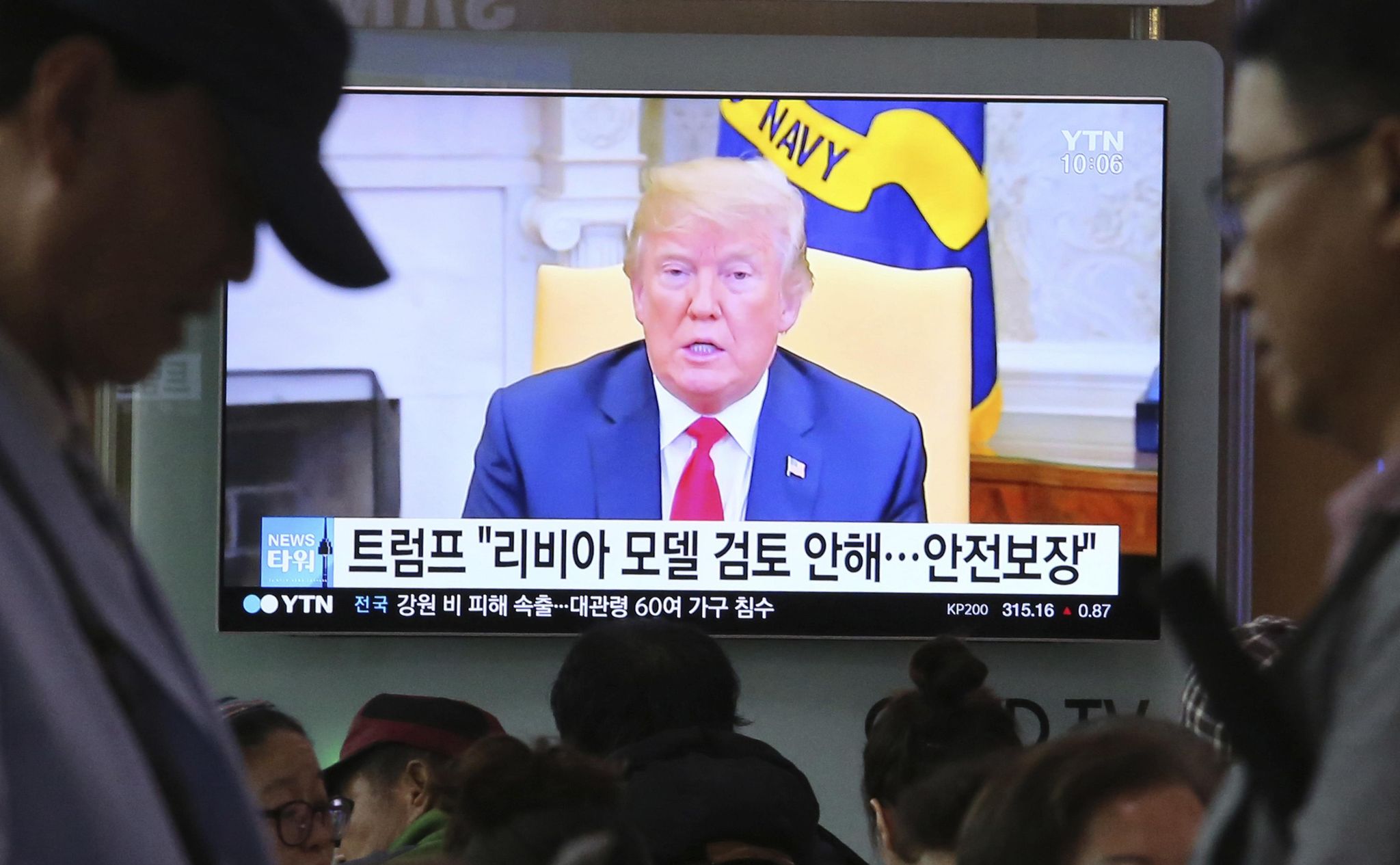
    But Trump warned that failure to make a deal could have grave consequences for Kim. Mentioning what happened in Libya when it gave up its nuclear program, Trump said, “That model would take place if we don’t make a deal.”

    “The Libyan model isn’t the model we have at all. In Libya we decimated that country.” Trump added. “There was no deal to keep Gadhafi.”

    Some analysts say bringing up Libya, which dismantled its rudimentary nuclear program in the 2000s in exchange for sanctions relief, jeopardizes progress in negotiations with the North.

    Kim took power weeks after former Libyan leader Moammar Gadhafi’s gruesome death at the hands of rebel forces amid a popular uprising in October 2011. North Korea has frequently used Gadhafi’s death to justify its own nuclear development in the face of perceived U.S. threats.