Blog

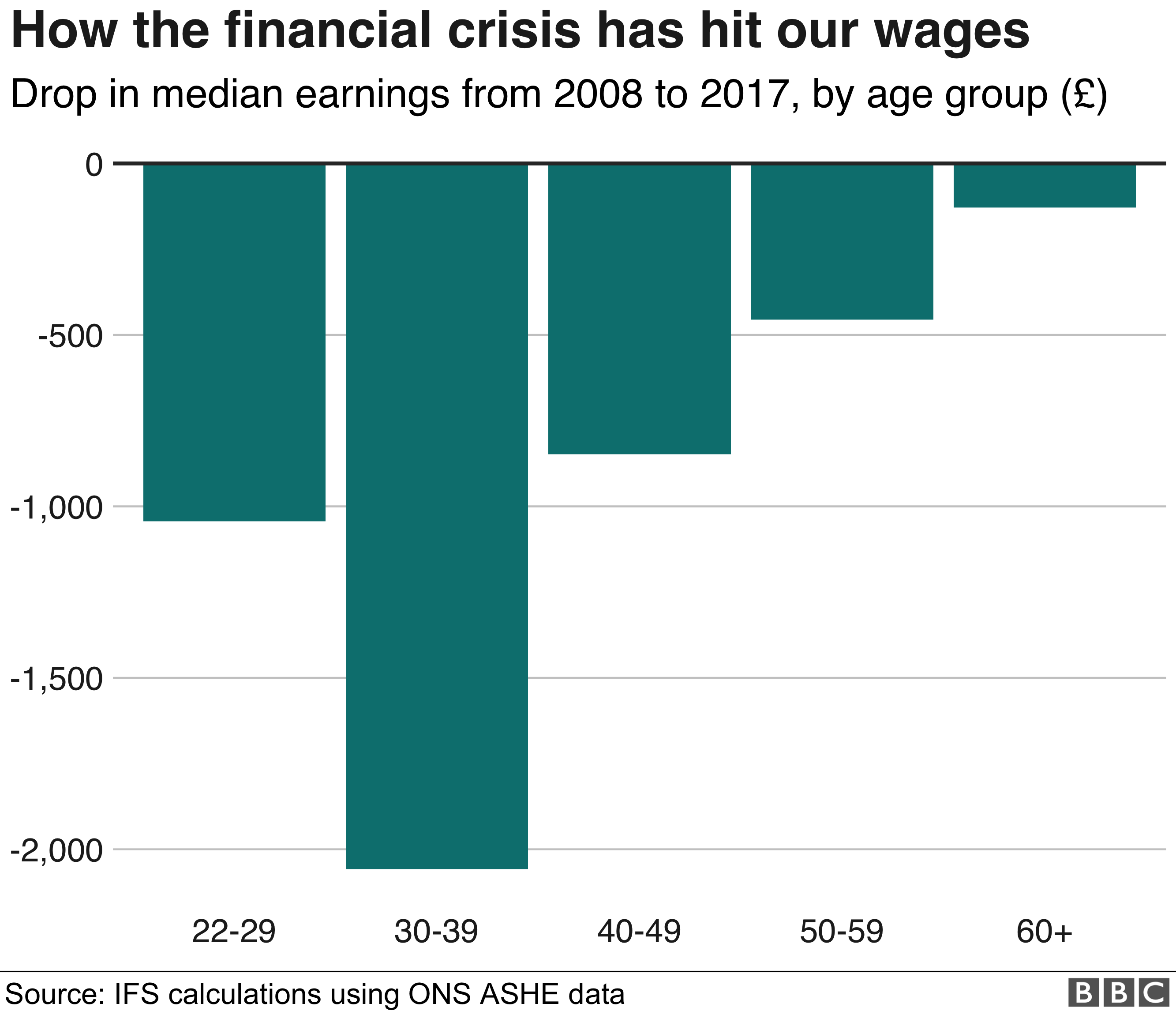
  • Workers are £800 a year poorer post-crisis

    Mr Johnson added: “Pensioners have done much better than younger people on average. In part this is because they are less reliant on earnings and so haven’t suffered from falls in earnings.”

    In addition, however, “government has chosen to protect the state pensions and other benefits received by pensioners,” Mr Johnson said.

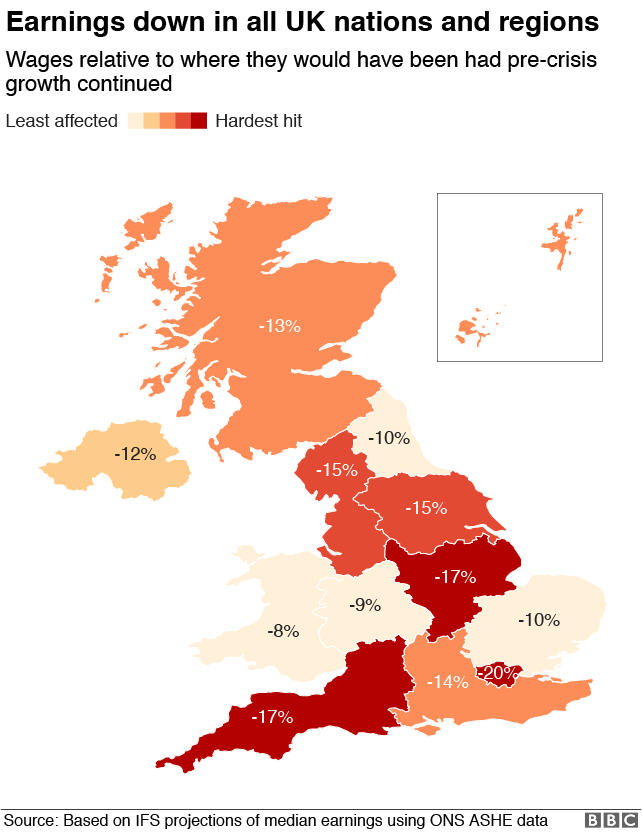
    Even more stark is the analysis from the IFS that, if wage growth trends between 1998 and 2008 had continued, people would on average be earning £3,500 more.

    That’s 15% higher than today’s average figure.

    How did the crisis affect your finances?

    Homes: House prices in London and the south east may have risen sharply in the decade since the crisis. But in large swathes of the UK prices have still not recovered to the levels seen in 2008.

    Savings: The last decade has been a disaster for Britain’s savers, especially many elderly people who rely on their savings income. Savers who once enjoyed rates of 5%-plus now get a fraction of that.

    Borrowing: Average household debt has climbed from less than £3,000 to £4,000 in the last decade. There are lots of reasons for this, not least the easy credit available through plastic cards.

    Banking: The way we bank has completely changed. Challenger banks have emerged, and mobile technology means we increasingly sort our finances using phones. But online banking has brought branch closures – and cyber-attacks.

    Read our report on a decade of changes

    “We should never stop reminding ourselves just what an astonishing decade we have just lived through, and continue to live through,” said Mr Johnson.

    “The UK economy has broken record after record, and not generally in a good way.

    “Record low earnings growth, record low interest rates, record public borrowing followed by record cuts in public spending.

    “On the upside employment levels are remarkably high and, in spite of how it may feel, the gap between rich and poor has actually narrowed somewhat, but the gap between old and young has grown and grown.”

    Low growth

    A regional breakdown of the effect of the financial crisis on wages shows that London, the East Midlands and the south-west of England have been worst hit.

    The IFS said that the financial crisis of a decade ago sparked the deepest recession since the Second World War and had been remarkable for the “persistence of its effects”.

    Economic growth is still low by historic standards and the total debts of the government have grown by £1tn.

    The public spending cuts pushed through by the governments of 2010 and 2015 were “historically unprecedented” the IFS said.

    The government has said that there are now record levels of employment and that the introduction of the National Living Wage and tax cuts had helped support many millions of working people.

    The deficit – that is the difference between what the government spends on services and receives in tax revenues – has also been substantially reduced.

    (more…)

  • Hurricane Florence threatens east coast US

    Video Hurricane Florence threatens east coast US
  • Hammond: ‘Shock’ of financial crisis still with us

    Philip Hammond Image copyright Reuters

    The “shock” of the financial crisis continues to impact the economy and peoples’ finances, UK chancellor Philip Hammond has said.

    Ten years after the financial system went into meltdown, he admitted “people are still suffering the effects”.

    But he said, in an interview with BBC economics editor Kamal Ahmed, there is “light at the end of the tunnel”.

    Rising wages and falling inflation were good news, he said, but uncertainty about Brexit was an economic dampener.

    A decade ago this week, the US investment bank Lehman Brothers collapsed, sending shockwaves through the global financial system.

    Research carried out for the BBC to mark the occasion showed that wages remain substantially below what they would have been with the crisis.

    Mr Hammond told the BBC: “We suffered a very big shock to our economy in 2008/09, and that’s a shock from which people are still suffering the effects today.”

    He was “acutely conscious” of the impact on wage stagnation and living. But he added: “We have got through this in much better shape than many of our neighbours.

    “We haven’t suffered catastrophic rises of unemployment, on the contrary, we’ve seen employment grow by three million jobs over this period.

    “We didn’t see widespread repossessions of homes, collapses of businesses, in the way we’ve done in previous recessions, so I think the way this has been managed has minimised the impact.”

    Independent analysis from the Office for Budget Responsibility projected real wage growth over the coming years, he added.

    Workers are £800 a year poorer post-crisisCarney warns against complacencyLehman gamble paid out for brave investors

    Mr Hammond also defended government efforts to cut debt, which many people argue led to austerity and worsened the impact on peoples’ incomes and the economy.

    “In the aftermath of the crisis, the urgent need was to reassure markets and investors about our intentions,” Mr Hammond said. “Government borrowing had grown to unprecedented levels – almost 10% of our total national income in the year after the crash – and the markets needed to know that we were going to be able to get that under control.”

    Debt burden

    He had, in fact, relaxed fiscal rules when becoming chancellor in 2016, Mr Hammond pointed out. That gave “more headroom” he said.

    But the challenge the economy faces “is not lack of demand, it’s poor productivity. It we want to see sustainable rises in living standards and real wages, we have to address the productivity challenge,” he said.

    He understood the calls for more spending on, say, the NHS and police. “We’ve made a huge commitment to the NHS, committing to spending £24bn across the UK by the end of this five-year period,” Mr Hammond said.

    But he added: “We do have to get our debt down. We have to do that for two reasons: Firstly the cost of our debt, is crippling – £50bn a year of money that we could be spending on schools and hospitals and police forces, being paid out in interest on the debt.

    “Secondly, having a debt that is this high, 85% of our GDP, reduces our ability to respond to another shock to the economy, another recession.”

  • Hurricane Florence: ‘Everybody’s frightened’

    Video Hurricane Florence: ‘Everybody’s frightened’

    (more…)

  • US plans crackdown on e-cigarette firms citing ‘epidemic’ teen use

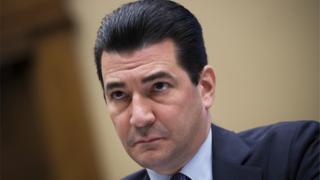
    Dr. Scott Gottlieb, commissioner of the Food and Drug Administration (FDA) Image copyright Getty Images Image caption FDA Chief Scott Gottlieb has warned of a crackdown on e-cigarette companies
    The US Food and Drug Administration is considering banning the sale of flavoured e-cigarettes, citing an “epidemic” of use among teens.

    The proposal, announced on Wednesday, is part of a broader effort to curb teen use of the nicotine devices.

    FDA chief Scott Gottlieb said: “The disturbing and accelerating trajectory of use we’re seeing in youth, and the resulting path to addiction, must end.”

    The toughened approach comes after firms ignored prior concerns, he added.

    “I’ve been warning the e-cigarette industry for more than a year that they needed to do much more to stem the youth trends,” he said.

    “In my view, they treated these issues like a public relations challenge rather than seriously considering their legal obligations, the public health mandate, and the existential threat to these products.

    “Well, I’m here to tell them that this prior approach is over.”

  • ‘Abhorrent’ Jacob Rees-Mogg protest condemned

    Media playback is unsupported on your device

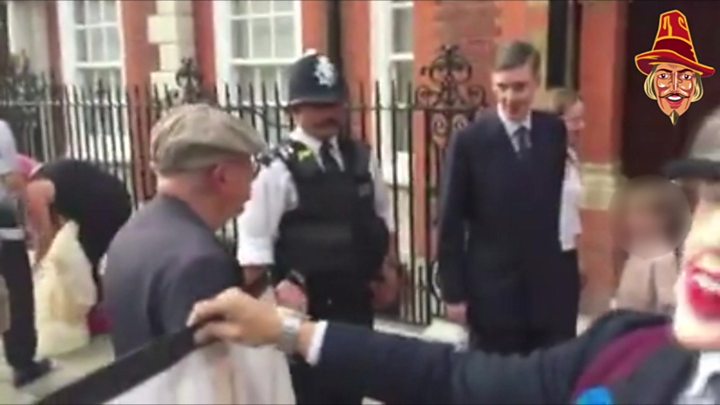
    Media captionProtesters shout at Jacob Rees-Mogg’s children during protest

    Protesters who targeted the home of Conservative Jacob Rees-Mogg and shouted at this children have been condemned by Downing Street and MPs.

    A video on the Facebook page of the Class War group shows a man telling one of the Tory MP’s children “your daddy is a horrible person”.

    Police officers stood between the protesters and the MP during the incident outside his Westminster home.

    Downing Street said the “intimidation” was “completely unacceptable”.

    “No elected member or their family should be subjected to intimidation or abuse in that way,” said the prime minister’s spokesman.

    Labour’s shadow Brexit minister Jenny Chapman said the protesters’ behaviour was “abhorrent”.

    She told the BBC’s Politics Live she was “ashamed if those people think they have anything to do with the Labour movement” and condemned the protest “without any reservation”, adding that the people in the video should “never be anywhere near someone’s children”.

    In the Class War video, a protester asked Mr Rees-Mogg how much he paid his family’s nanny, and when she too came out onto the street, demanded to know her salary and told her she had “Stockholm Syndrome”.

    A subsequent Class War Facebook post said people were getting their “knickers in a twist” over the footage, saying the MP’s family had come outside after the protesters arrived.

    The protest is believed to have been staged by veteran anarchist Ian Bone, who has taken part in similar stunts in the past.

    (more…)

  • Morocco country profile

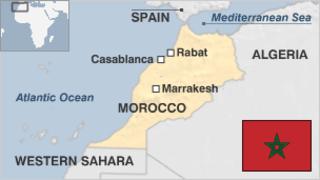
    Map of Morocco

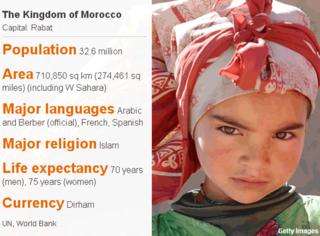
    The Kingdom of Morocco is the most westerly of the North African countries known as the Maghreb – the “Arab West”. It has Atlantic and Mediterranean coastlines, a rugged mountain interior and a history of independence not shared by its neighbours.

    Its rich culture is a blend of Arab, Berber, European and African influences.

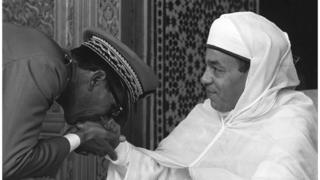
    Morocco was a French protectorate from 1912 to 1956, when Sultan Mohammed became king. He was succeeded in 1961 by his son, Hassan II, who ruled for 38 years and played a prominent role in the search for peace in the Middle East. He also ruthlessly suppressed domestic opposition.

    Read more country profiles – Profiles by BBC Monitoring

    FACTS

    LEADERS

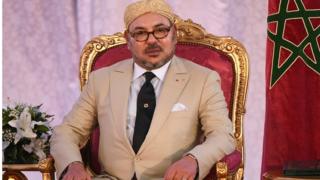
    King: Mohammed VI

    Image copyright Getty Images

    Groomed for “kingship”, as his late father King Hassan II referred to his upbringing, Mohammed VI became monarch in 1999.

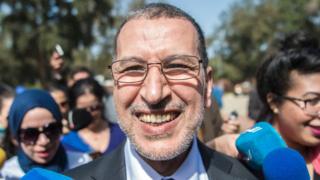
    Image copyright Getty Images

    Saad-Eddine El Othmani was appointed prime minister in March 2017 and asked to form a government by King Mohammed.

    A psychiatrist, Mr El Othmani was the Justice and Development Party’s secretary-general between 2004 and 2008, and the foreign minister in Abdelilah Benkirane’s first government between 2012 and 2013.

    He replaces Benkirane, who was dismissed by the king after failing to form a coalition government in the months following the 2016 elections.

    Benkirane had proposed rebuilding his outgoing coalition, but faced opposition from Aziz Akhannouch, a close ally of King Mohammed, and the resulting power struggle led to a political impasse.

    MEDIA

    Image copyright Getty Images

    The broadcast media are either dominated by the state or reflect the official line. However, the private press has succeeded in breaking taboos over some sensitive topics, including allegations of high-level corruption.

    Paris-based Reporters Without Borders notes that “religion, the king and the monarchy in general, the country and territorial integrity cannot be questioned.”

    The government owns, or has a stake in, RTM and 2M, Morocco’s main TV networks. Satellite dishes are widely used, giving access to French and pan-Arab stations.

    Read full media profile

    TIMELINE

    7th and 8th Centuries AD – Arab invasion; Idris founds the first major Muslim dynasty.

    Image copyright Getty Images Image caption A market in Marrakech
    10-17th Centuries – Dynasties and religious movements come and go, including the Almoravid movement which at its peak controlled Morocco and parts of present-day Algeria and Spain.

    1904 – France and Spain carve out zones of influence.

    1912 – Morocco becomes a French protectorate under the Treaty of Fez.

    1956 – End of French protectorate after unrest and strong nationalist sentiment. Spain keeps its two coastal enclaves. Sultan Mohammed becomes king in 1957.

    1961 – Death of King Mohammed; King Hassan II comes to power.

    1975-76 – Morocco annexes Western Sahara, but faces an ongoing guerrilla battle for independence from local Saharawi people.

    Image copyright Getty Images Image caption King Hassan II of Morocco
    1998 – Morocco’s first opposition-led government comes to power.

    1999 – King Hassan II is succeeded by his son, Mohammed VI.

    Read full timeline

  • Six held in France over vegan attacks on Lille shops

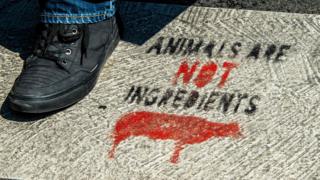
    Anti-meat graffiti in France Image copyright AFP/Getty Image caption There have been a spate of recent vegan activist incidents in France

    Six people have been held this week over a string of vegan activist attacks in the city of Lille, officials said.

    Nine businesses, including a butcher, fishmonger, cheese shop and a McDonald’s, have had windows smashed and fake blood thrown on their walls in recent months.

    Activists also spray-painted the slogan “Stop Speciesism”, a term denouncing unethical treatment of other species.

    Five of the six detained people have since been or will now be released.

    However, the Lille prosecutor’s office set a court date in December for a detained 21-year-old woman.

    Image copyright AFP/Getty Image caption The festival went ahead despite its initial cancellation
    The vast majority of French people eat meat, with vegans representing a tiny percentage of the population.

    According to a 2016 survey, only around 3% of French people are vegetarian.

    But a number of recent incidents have sparked debate in a country that has a long culinary tradition of eating meat.

    In March, a vegan activist received a suspended prison sentence for a Facebook post saying the killing of a butcher by an Islamist militant was “justice”.

    The French Federation of Butchers wrote to the government asking for protection against militant vegans, saying they aimed to “impose on the immense majority of people their lifestyle, or even their ideology”.

    The French government this year has introduced new regulations that ban vegetable-based food products in France from using words like “steak” and “sausage”.

    You may also be interested in:

    How a YouTube beef shook the vegan world ‘Vegans call me murderer and rapist’ The dad who feeds his son burgers almost every day

  • China: Car rams into Hunan square killing three

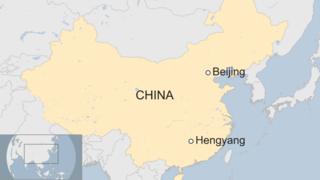
    Map of China showing Hengyang

    A man has driven a car into a busy square in southern China, killing at least three people and injuring 43, local government officials say.

    The car drove into the square in Hengyang city, Hunan province, at 19:40 local time (12:40 BST). Local media say that some victims appeared to have been stabbed.

    The driver, who has a criminal record, has been detained, officials say.

    Officials have not said whether the incident is terror related.

  • Morocco bans forced marriage and sexual violence

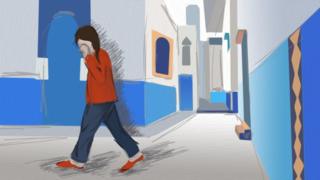
    An illustration Image caption The law was adopted in Morocco’s parliament in March
    Morocco’s law criminalising violence against women has come into force.

    The law includes a ban on forced marriage, sexual harassment in public places, and tougher penalties for certain forms of violence.

    It has been criticised by Human Rights Watch for not explicitly criminalising marital rape and lacking a precise definition of domestic violence.

    A government survey found that 63% of women between the ages of 18-65 had been victims of violence.

    Africa Live: Find out all the latest news from the continent Moroccan shock at ‘brutal rape ordeal’ Controversial Morocco rape law axed

    Samira Raiss, one of the main Moroccan campaigners for a law criminalising violence against women, said: “We will not stop here. This law is an asset but it has shortcomings that we have to work on.”

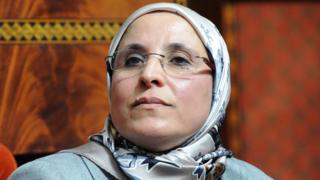
    Image copyright Getty Images Image caption Bassima Hakkaoui first drafted the law in 2013
    Human Rights Watch said the law has some positive aspects, “such as a definition of violence against women to mean ‘any act based on gender discrimination that entails physical, psychological, sexual, or economic harm to a woman’.”

    But it contains “major gaps and flaws that leave women at risk of domestic violence, including a lack of provisions to finance the reforms,” HRW says.

    Bouthaina Karouri, a member of the parliamentary committee that drafted the law, says these oversights can be fixed.

    “No law is perfect” Ms Karouri said.

    “Its effectiveness will depend on the approach adopted by the police and the judicial body. As it goes into effect, it is normal to discover some gaps but they can be amended in the future.”

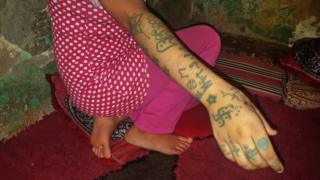
    Image copyright Getty Images Image caption Khadija said her captors forcibly tattooed her and burnt her with cigarettes

    The law comes into effect following last month’s massive outcry over the alleged rape, torture and kidnapping of a 17-year-old girl named as Khadija.

    Many went on social media, sharing the hashtag #JusticePourKhadija to describe their disgust and horror and calling on the authorities to take action.

    In 2014, Morocco’s parliament amended an article of the penal code that allowed rapists of underage girls to avoid prosecution by marrying their victims.