Blog

  • Karen Bradley comment taken ‘out of context’

    Karen Bradley Image caption Secretary of State Karen Bradley was appointed to the post in January

    The Secretary of State has said that her recent comments regarding Northern Ireland’s voting patterns were “taken out of context”.

    Karen Bradley said that she did not understand that nationalists did not vote for unionist parties during elections.

    The original comment was made during an interview with The House Magazine.

    Mrs Bradley said she did not comprehend that campaigns are generally fought within each part of the community.

    Karen Bradley ‘did not understand’ NI voting patternsJames Brokenshire to step down on medical reasons

    She told the magazine that it was “a very different world from the world I came from”

    She added: “I didn’t understand things like when elections are fought for example in Northern Ireland – people who are nationalists don’t vote for unionist parties and vice-versa.”

    Mrs Bradley was appointed in January to replace James Brokenshire.

    “I am here doing the job”

    Mrs Bradley defended her comment on Wednesday while taking a walk in Belfast City Centre to see the damage caused by the Primark fire.

    She said: “One thing from the interview was taken out of context.

    “The whole point is that I am here as the Secretary of State doing the job, here on the ground, meeting people, dealing with people, listening to businesses and individuals living in Northern Ireland and really focusing on getting that devolved government back up and running.”

    When asked about possible funding from the Treasury to help revitalise Belfast, Mrs Bradley said she was looking at the best way to deal with the situation and could make no commitments at this stage.

  • CBS’s Jeff Fager: 60 Minutes producer out amid #MeToo claims

    Jeff Fager of the TV show 60 Minutes Image copyright Getty Images Image caption CBS said producer Jeff Fager had “violated company policy” – while he claims he was fired for a text he sent

    The long-time producer of the CBS News show 60 minutes, Jeff Fager, is leaving his job “immediately” amid claims that he sexually harassed colleagues.

    In an internal memo, CBS News president David Rhodes said the departure was “not directly related to the allegations surfaced in press reports”.

    He said Mr Fager had “violated company policy”, without elaborating on how.

    Mr Fager himself denies harassment, and told reporters he had been fired over a “harsh” text he sent to a colleague.

    The news comes just three days after top CBS executive Les Moonves resigned with immediate effect after being accused of sexual misconduct, which he denies.

    Image copyright AFP Image caption Les Moonves is one of the most powerful men in US media

    CBS is currently the most-watched network in the US. The programme 60 Minutes, which airs on Sunday evenings, was first broadcast in 1968.

    Earlier this year, CBS fired veteran presenter Charlie Rose, who was accused of sexual harassment by a number of women, including several CBS employees.

  • Neanderthals were capable of making art

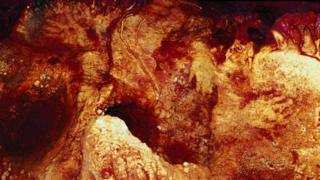
    Cave art Image caption In Maltravieso Cave, western Spain, Neanderthals stencilled their hands by blowing red paint over them

    Contrary to the traditional view of them as brutes, it turns out that Neanderthals were artists.

    A study in Science journal suggests they made cave drawings in Spain that pre-date the arrival of modern humans in Europe by 20,000 years.

    They also appear to have used painted sea shells as jewellery.

    Art was previously thought to be a behaviour unique to our species (Homo sapiens) and far beyond our evolutionary cousins.

    The cave paintings include stencilled impressions of Neanderthal hands, geometric patterns and red circles.

    Image copyright CD Standish, AWG. Pike, DL Hoffmann Image caption This ladder-shaped drawing from La Pasiega cave consists of red horizontal and vertical lines and is older than 64,000 years

    Prof Alistair Pike, from the University of Southampton, who is a co-author of the study, said: “Soon after the discovery of the first of their fossils in the 19th Century, Neanderthals were portrayed as brutish and uncultured, incapable of art and symbolic behaviour, and some of these views persist today.

    “The issue of just how human-like Neanderthals behaved is a hotly debated issue. Our findings will make a significant contribution to that debate.”

    Prof Chris Stringer, from London’s Natural History Museum, who was not involved in the study, commented: “Some previous claims for Neanderthal symbolic behaviour had dating uncertainties or lay within inferred overlaps between Neanderthals and Homo sapiens 40-60,000 years ago, meaning that they could still be attributed to modern humans, or to the influence of modern humans on Neanderthal behaviour.”

    He said the new work “seems to remove any doubts” that Neanderthals were capable of symbolic or artistic expression. Prof Stringer explained: “They further narrow any perceived behavioural gap between the Neanderthals and us.”

    But he said it could be argued there were still no clear examples of Neanderthal figurative art – artwork drawn from real sources, such as animals or people.

    Prof Pike told BBC News: “The next big question is: ‘did Neanderthals make figurative art? We’ve got hand stencils, we’ve got lots of red dots and we’ve got these lines. We want to know whether there are paintings of the kind of animals they were hunting.”

    ‘Meaningful’ expression

    In La Pasiega cave, in northern Spain, the researchers dated a ladder-shaped (scalariform) drawing to a minimum age of 64,800 years ago. However, the artwork from this cave has yielded dates of up to 80,000 years ago. There are animals painted within the rungs of the ladder, but the scientists haven’t yet dated these – and they could be younger.

    “Even different groups of modern humans were approaching art in different ways. So it’s really about the meaning of your symbols,” said Prof Pike. “Just because they didn’t paint animals, it doesn’t mean they couldn’t paint animals.”

    The early ages for the cave art are supported by the dating of sea shells that were perforated to be used on necklaces and are stained with pigments.

    Two of the four samples dated to about 115,000 years ago – again, much further back in time than the known presence of modern humans in the region.

    Commenting on the work, Prof Clive Finlayson, from the Gibraltar Museum, told BBC News: “The work is very good; there’s nothing to fault the dates.

    He added: “It suggests they’re much older than anything we know of from Europe or beyond the boundaries of Europe.”

    Image copyright STEWART FINLAYSON Image caption Ancient “hashtag”? This engraving, in Gorham’s Cave, Gibraltar, was reported in 2014. It may have been made by a Neanderthal

    In 2014, Prof Finlayson and colleagues reported the discovery of an engraving in Gorham’s Cave, Gibraltar, that may have been carved by a Neanderthal. But the recent finds add to mounting evidence we have underestimated the intellectual capabilities of our evolutionary cousins.

    But he said: “If we are going to be strict in our interpretations, that Neanderthals made these paintings is really inferred from the dates.” While there is no direct evidence of other human species in Iberia at this time, Prof Finlayson added: “To pin it on Neanderthals is highly likely… but from my knowledge I don’t think any of those three caves have Neanderthal remains.”

    Early symbolic artefacts, dating back 70,000 years, have been found in Africa but are associated with modern humans.

    Prof Pike said of the Spanish finds: “Some of these things are placed in the very darkest bits of caves, where you couldn’t do it by accident. You need a light source, you’ve got to wander through passages and you’ve got to prepare your pigments.”

    On the other hand, he said, “the panel in La Pasiega is on a really nice, smooth bit of wall framed by stalagmitic formations on either side. It looks like something you would stand in front of and look at”.

    He added: “As to the meaning, I don’t think we’ll ever know. But I think we’re pretty happy to say it’s meaningful.”

    Follow Paul on Twitter.

  • Why do people ignore hurricane warnings?

    Video Why do people ignore hurricane warnings?

    (more…)

  • ‘Miracle’ recovery for boy after meat skewer pierces head

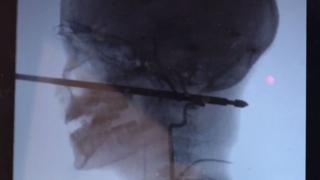
    X-ray showing meat skewer piercing through boys head Image copyright CBS Image caption Miraculously, the meat skewer missed major blood vessels and the boy’s brain and eyes.

    A 10-year-old boy in Missouri is recovering after he was attacked by wasps, fell from a tree house and impaled in the face by a meat skewer.

    The metal skewer that went through Xavier Cunningham’s head “miraculously” missed his eyes, brain, spinal cord and major blood vessels.

    He fell 4ft (1.2m) down from a tree house when the freak accident occurred on Saturday. He was taken to hospital.

    Kansas University Hospital told local media he is expected to recover fully.

    A team of Kansas University doctors successfully removed the square rod – which made for a trickier surgery than a rounded skewer due to the sharp edges – over several hours.

    Image copyright CBS Image caption The tree house from which 10-year-old Xavier fell

    He fell four feet from the tree house and landed directly on a foot-long (30cm) metal meat skewer. The skewer penetrated around six inches into the boys skull.

    Xavier’s mother Gabrielle Miller told Kansas City Star that she saw her son walk into the house, screaming, with the rod “just sticking out” of his head.

    “I’m dying Mom, I can feel it,” Mrs Miller recalled him telling her on the way to hospital.

    Xavier was taken to local hospital, transferred to hospital in Kansas City and again transferred to the University of Kansas hospital where he would eventually undergo surgery.

    His injury had no active bleeding and had avoided his eyes, brainstem, spinal cord and blood vessels, which enabled doctors to call in expert surgeons before attempting the removal surgery on Sunday morning.

    Image copyright CBS Image caption Xavier is recovering in hospital after being impaled by a meat skewer
    Koji Ebersole, director of endovascular neurosurgery at the University of Kansas Health System, told the Star: “You couldn’t draw it up any better. It was one in a million for it to pass 5 or 6 inches through the front of the face to the back and not have hit these things.”

    He said the biggest concern while removing the rod was the blood vessels in the boy’s neck.

    Dr Ebersole called the boy’s recovery “miraculous”.

    “I have not seen anything passed to that depth in a situation that was survivable, let alone one where we think the recovery will be near complete if not complete,” he told the Star.

  • Cave paintings change ideas about the origin of art

    Image copyright Maxime Aubert

    The artworks are in a rural area on the Indonesian Island of Sulawesi.

    Until now, paintings this old had been confirmed in caves only in Western Europe.

    Researchers tell the journal Nature that the Indonesian discovery transforms ideas about how humans first developed the ability to produce art.

    Image copyright Maxime Aubert

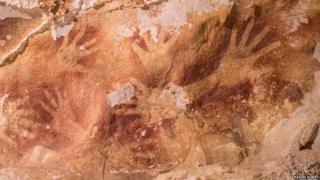
    Australian and Indonesian scientists have dated layers of stalactite-like growths that have formed over coloured outlines of human hands.

    Image copyright Maxime Aubert Image caption This painting, from Bone, is of a variety a wild endemic dwarfed bovid found only in Sulawesi, which the inhabitants probably hunted
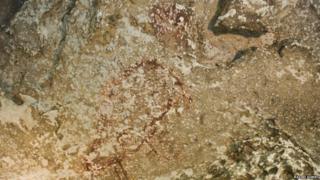
    There are also human figures, and pictures of wild hoofed animals that are found only on the island. Dr Maxime Aubert, of Griffith University in Queensland, Australia, who dated the paintings found in Maros in Southern Sulawesi, explained that one of them (shown immediately below) was probably the earliest of its type.

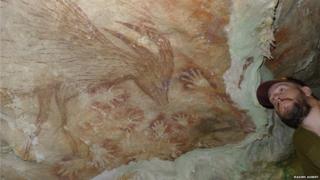
    Image copyright Maxime Aubert Image caption At the top of the worn painting is a faint outline of a human hand. Below it is possibly the earliest depiction of an animal

    “The minimum age for (the outline of the hand) is 39,900 years old, which makes it the oldest hand stencil in the world,” said Dr Aubert.

    This find enables us to get away from this Euro-centric view of a creative explosion that was special to EuropeProf Chris Stringer, Natural History Museum

    “Next to it is a pig that has a minimum age of 35,400 years old, and this is one of the oldest figurative depictions in the world, if not the oldest one,” he told BBC News.

    There are also paintings in the caves that are around 27,000 years old, which means that the inhabitants were painting for at least 13,000 years.

    In addition, there are paintings in a cave in the regency of Bone, 100 km north of Maros. These cannot be dated because the stalactite-like growths used to determine the age of the art do not occur. But the researchers believe that they are probably the same age as the paintings in Maros because they are stylistically identical.

    The discovery of the Indonesian cave art is important because it shows the beginnings of human intelligence as we understand it today.

    1. Click on links that appear in the video below to explore the story in more depth with Pallab on location in caves in Britain.

    2. Return to the main video by clicking on the box/image, bottom right.

  • ‘Oldest known drawing’ found on tiny rock in South Africa

    The oldest-known drawing, painted in ochre pigment on a small stone Image copyright Reuters Image caption The drawing dates back 73,000 years
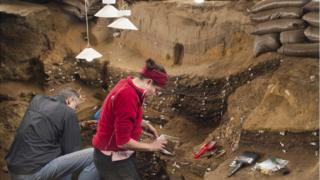
    Scientists say they have discovered humanity’s oldest known drawing on a small fragment of rock in South Africa.

    The drawing is about 73,000 years old, and shows cross-hatch lines sketched onto stone with red ochre pigment.

    Scientists discovered the small fragment of the drawing – which some say looks a bit like a hashtag – in Blombos Cave on the southern coast.

    The find is “a prime indicator of modern cognition” in our species, the report says.

    While scientists have found older engravings around the world, research published on Wednesday in the journal Nature says the lines on this stone mark the first abstract drawing.

    Image copyright Reuters Image caption Scientists found the stone fragment in Blombos Cave, 300 kilometres (185 miles) east of Cape Town

    Humanity has used ochre, a clay earth pigment, for at least 285,000 years.

    The drawing was “probably more complex” in its entirety, archaeologist Christopher Henshilwood told Reuters.

    “The abrupt termination of all lines on the fragment edges indicates that the pattern originally extended over a larger surface,” he said.

    You may also like:

    Ancient ‘paint factory’ unearthed Neanderthals were capable of making art Traces found of ‘world’s oldest cheese’ Egyptian mummification ‘recipe’ revealed

    Mr Henshilwood works at Norway’s University of Bergen and South Africa’s University of the Witwatersrand and led the research into the drawing.

    He told Reuters that while the team would be “hesitant to call it art”, it almost definitely had “some meaning to the maker”.

    There have been numerous other artefacts found in Blombos Cave, 300 kilometres (185 miles) east of Cape Town, including beads covered in red ochre, engraved ochre fragments, and a paint-making kit dating back around 100,000 years.

    Modern man, known as homo sapiens, is first known to have appeared more than 315,000 years ago in what is now Africa.

  • iPhone XR: Apple’s event in 90 seconds

    Video iPhone XR: Apple’s event in 90 seconds

    (more…)

  • Pope Francis faces twin battle in Church split over sexual abuse

    Image copyright Getty Images

    The crowds are quieter than they used to be.

    At the Pope’s weekly audience in St Peter’s Square, tourists and pilgrims barely filled half the piazza. It was easy to get to the front of the crowd to watch Francis go by in his Popemobile.

    In his address, he reflected on his recent trip to Ireland. “The meeting with eight survivors [of abuse by priests] left a deep impact,” he said.

    The audience was a sombre reminder that the novelty of this papacy has given way to two main battles, which are now tangled into one.

    Who is challenging the Pope?

    The first of these battles puts the Pope up against those who accuse him of not doing enough to tackle child abuse in the Church.

    Image copyright Reuters Image caption Pope Francis refused to respond to Archbishop Vigano’s 11-page letter as he returned from Ireland

    “They sense this especially now, with questionable innovative teachings coming from the Vatican and reports of abuse cover up at the highest levels. I believe these Catholics’ voices should be heard, and, as a Catholic journalist, I see it as my job to try to make sure they are.”

    Those voices include a number of cardinals.

    In 2016, four of them wrote to Francis calling on him to clarify his teaching. It was seen as a highly unusual act of protest or even disobedience. Their letter, openly questioning the Pope’s judgement, foreshadowed the statement released by Archbishop Vigano.

    Will Pope succeed?

    Francis did not reply to the cardinals’ letter. Nor has he replied to Carlo Maria Vigano’s accusations.

    The Pope has clearly decided that there is nothing to be gained by engaging in open battle with conservative critics.

    “He is no pushover,” says Robert Mickens. “He is standing his ground.”

    Popes can expect to find themselves taking on dissident factions within the Church.

    In 1988, Pope John Paul II took the dramatic step of excommunicating some members of a renegade religious society led by the French Archbishop Marcel Lefebvre which had rejected Vatican reforms.

    Benedict XVI took a strict line against priests who strayed from official teaching.

    The fight against doctrinal opponents may be the easier of Francis’s two battles.

    The Pope’s wider public fight to convince the other critics inside and outside the Church that he is capable of confronting the institution’s legacy of clerical sexual abuse may be much more difficult.

    (more…)