Blog

  • Catalonia crisis in 300 words

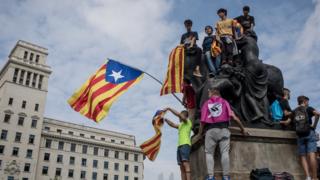
    Image shows supporters of Catalan independence gathering in Barcelona on 2 OctoberImage copyright Getty Images Image caption Supporters of Catalan independence in Barcelona

    The ongoing stand-off between Catalonia and the Spanish government in Madrid is complicated. Let’s break it down.

    What is Catalonia?

    Catalonia is a region in north-east Spain. It has its own language, parliament, flag and anthem. It even has its own police force and controls some of its own public services, such as schools and healthcare.

    It is one of Spain’s wealthiest and most productive regions and has a distinct history dating back almost 1,000 years.

    Why the controversy?

    The Catalan parliament approved an independence referendum which went ahead on 1 October despite being suspended by Spain’s Constitutional Court.

    The Spanish government tried to stop voting and hundreds of people were hurt in scuffles with police at polling stations.

    While Catalan authorities say just under 90% of voters backed independence, turnout was only 43%.

    Click to see content: Catalonia_vote

    What have both sides said?

    Catalan leaders declared an independent republic but immediately suspended its implementation.

    Catalan President Carles Puigdemont said he wanted negotiations on the region’s exit from Spain.

    Spain’s Prime Minister Mariano Rajoy has responded by asking the Catalan government to clarify whether or not it has declared actual independence.

    What happens next?

    Depending on the Catalan government’s answer, the government in Madrid could impose direct rule on the region.

    That would mean suspending Catalonia’s powers to make its own decisions on public services such as education and healthcare.

    Why does the crisis matter?

    There is no suggestion that the crisis could degenerate into an armed conflict but it could damage the region and Spain as a whole economically, bringing new instability to the eurozone.

    It could also set an example for other countries with secessionist movements in Europe.

    Want to know more?

    Catalan crisis: Six things you need to know What are the options for Spain now? Does Catalonia want to leave Spain? Could Catalonia make a success of independence? Spain’s distinctive north-eastern region

  • Thousands march in Barcelona streets

    Video Mass march in Barcelona streets

    (more…)

  • Controversial EU copyright change faces key vote

    A composite image shows the EU flag, with a copyright symbol embedded in the centre of its iconic ring of yellow stars Image copyright Getty Images Image caption The proposed reform has attracted enormous attention and fierce campaigning on both sides

    EU lawmakers are set to vote on a controversial copyright reform that could change how internet companies treat uploaded content from users.

    A version of the proposal was rejected in July after a grassroots campaign, and fierce campaigning on both sides.

    Critics fear the rules are too broad and could affect parodies, remixes, and even links to articles and websites.

    But many musicians, authors, and other creators back the reforms which they view as necessary to support artists.

    Hundreds of changes have been made since the July vote, but opponents say major issues remain.

    What is the controversy?

    The proposed copyright directive is supposed to protect creators by forcing payments to be made to them if their work is copied or linked to online.

    Most of it is not controversial, and the debate is centred around two sections: articles 11 and 13.

    Why Europe’s copyright plan was so controversial Copyright law could put end to net memes

    Article 13 has attracted the most attention, and been labelled an “upload filter” by critics.

    If a user tries to upload copyrighted music, photos, or anything else, it must be checked against a database – and filtered out if it contains copyrighted material.

    Effectively, it makes sites like Facebook and Youtube responsible for what its users upload.

    Skip Twitter post by @EDiMA_EU

    Did you know that memes containing copyrighted images will be blocked by automated filters under the copyright directive? #FixCopyrighthttps://t.co/p92ip1RPBd pic.twitter.com/BH6KzHrW9L

    — EDiMA (@EDiMA_EU) September 6, 2018

    Report

    End of Twitter post by @EDiMA_EU

    But with more than 400 hours of video uploaded to YouTube every minute, no human could do the job – filtering would need to be done automatically by computers.

    Such systems are both expensive and often criticised for being over-zealous and filtering anything that might be copyright-protected.

    For example, some people believe that background music playing in a family video could be filtered out, or that small samples of copyrighted content in a parody or internet meme image could be enough to trigger the automatic filter.

    The possibility has led to such systems being labelled “censorship machines” by some opponents. MEPs behind the directive say such claims are wrong, and have decried what they see as a misinformation campaign.

    The other debated section, article 11, seeks to grant new rights to news outlets and publishers, giving them a slice of revenue from aggregators like Google who link to their content.

    Skip Twitter post by @Senficon

    The amendment by @AxelVossMdEP proves this “mythbuster” wrong: If snippets were not affected, why would his new amendments only allow individual words to accompany a link? If you use more than that, like a headline, you have to pay. https://t.co/kZ7vUTur1A #SaveYourInternet

    — Julia Reda (@Senficon) September 10, 2018

    Report

    End of Twitter post by @Senficon

    But the broad nature of the rules led to fears that even simple hyperlinks or short “snippets” could be costly – potentially affecting a core part of how the world wide web functions.

    Who is for and against?

    Many creative industry associations continue to campaign for the directive to be implemented – including Britain’s record label group BPI and the Society of Authors.

    Supporters say the new rules will protect artists and creators, making it easier for them to earn a living – and that the amendments made since July should assuage concerns.

    Skip Twitter post by @Soc_of_Authors

    Nobody’s hearing about all the good things in the Directive – like the transparency triangle. Authors will get proper accounting of how well their work’s doing, and a proper share of the profits if they do well.

    — Society of Authors (@Soc_of_Authors) September 7, 2018

    Report

    End of Twitter post by @Soc_of_Authors

    Record labels have campaigned for the reform to go ahead, along with music titans like Sir Paul McCartney.

    Ahead of the July vote, some 1,300 musicians declared support for the changes, which would require websites like YouTube or Facebook to detect and delete user uploads of copyrighted music.

    But the divide between those for and against is not entirely clear-cut.

    Musician Wyclef Jean of the Fugees, for example, is in Strasbourg campaigning against the changes, which he believes will actually hurt musicians.

    And while some critics say the changes will hurt small businesses to the benefit of existing internet giants, those same giants – including Facebook and Google – also oppose the directive, which would make them liable for content uploaded by their users.

    What happens next?

    The July vote was defeated 318-278 after thousands of ordinary people contacted their European representatives following a grassroots campaign.

    But under European parliament rules, that meant it would be amended and debated before going for another vote, due on Wednesday.

    More than 250 changes to the original text have been proposed.

    “This vote is our best chance to prevent EU copyright reform from causing lasting harm to the open internet,” MEP Julia Reder said in a blog post criticising many of the proposed changes.

    Digital rights group the Electronic Frontier Foundation, meanwhile, said the proposal was “so terrible, it can only be called an extinction-level event for the internet as we know it”.

    French MEP Marc Joulaud told the AFP news agency, which also backs the measure: “The feeling of many in parliament is that on Wednesday we decide the life or death of the law.”

    “We can still finish on time if the text passes on Wednesday. This is the last slot,” he said.

  • Catalonia ‘National Day’ rally draws million

    Image copyright Reuters Image caption Red-shirted protesters blew whistles and banged drums in Barcelona

    Protesters formed human towers and demanded the release of separatist leaders who are in detention awaiting trial following the independence campaign.

    One elderly protester at the rally, Dolors Llauralo, told Reuters she would continue the battle.

    “I will demonstrate every year, as long as I can… I fight for [my children and grandchildren] so they will have a better life than the one we have had,” she said.

    Read more stories on the Catalonia crisis:

    Spanish direct rule ends in Catalonia Catalan crisis in 300 words Catalonia’s quarrel with Spain explained The man who wants to break up Spain

    More protests are planned on the key anniversary dates of the referendum and declaration of independence.

    However, opponents complained the Diada was being usurped as independence was not supported by all Catalans.

    Media playback is unsupported on your device

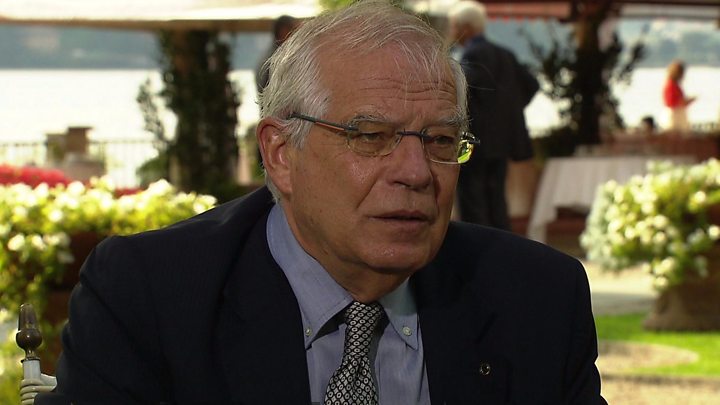
    Media captionCatalonia’s situation “not very serious”, says Josep Borrell

    Spanish Foreign Minister Josep Borrel, who is Catalan, said: “We Catalans should celebrate our national day and not just a call for independence that is shared by less than half of the population.”

    An opinion poll in July suggested 46.7% of Catalans favoured independence and 44.9% opposed it.

    (more…)

  • Trump’s claim of success in Puerto Rico hurricane response derided

    New York Democratic primary winner Alexandria Ocasio-Cortez, said: “Some of my [Puerto Rico] family just got power a few weeks ago. People are developing respiratory issues partly due to airborne fungal spores from lack of proper cleanup. The admin’s response to Puerto Rico has been a disaster.”

    Some Trump supporters on social media accepted there had been failures but said the president had done all he could and that it was Puerto Rican officials who were to blame.

    What happened in Hurricane Maria?

    Maria made landfall in mid-September last year having just been downgraded to a category four hurricane, with winds of 140 mph (225 km/h) and driving rain.

    It caused catastrophic damage to the north-eastern Caribbean and was the most intense cyclone worldwide in 2017.

    Six graphics that sum up Puerto Rico disaster

    Infrastructure was severely damaged in Puerto Rico and the territory struggled to make repairs to the power grid, only completing the work 11 months later.

    Maria was estimated to have caused $100bn (£77bn) in damage.

    For long the government there listed the death toll at only 64, although it acknowledged it was probably much higher.

    The island’s authorities finally accepted a revised toll of 2,975 after a government-commissioned report by experts from George Washington University.

    This counted those who died in the six months following the storm as a result of poor healthcare and a lack of electricity and clean water. Repeated power cuts also led to an increased number of deaths from diabetes and sepsis.

    The report said that those from poorer backgrounds in Puerto Rico were 45% more likely to have been killed in the aftermath of the hurricane.

    (more…)

  • Lula turns himself in after police stand-off

    Video Lula turns himself in after police stand-off

    (more…)

  • Brazil’s Lula still has power to influence politics

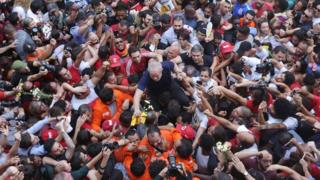
    Brazilian ex-president Luiz Inacio Lula da Silva is lifted by supporters after attending a Catholic Mass in memory of his late wife Marisa Leticia, at the metalworkers' union building in Sao Bernardo do Campo, in metropolitan Sao Paulo, Brazil, 7 April 2018 Image copyright Getty Images Image caption Lula is lifted by supporters at the steelworkers’ union building in Sao Paulo

    Brazil’s former President Luiz Inácio Lula da Silva’s surrender on Saturday capped a dramatic few days in Brazil. But the political spectacle is likely to continue as the country heads towards presidential elections in October.

    “We are going to return to the time where just a few people have a lot of money, and a lot of people have nothing,” Lula supporter Gisele Veloso says.

    She was on the verge of tears as she stood outside the steelworkers’ union in the early hours of Thursday morning. It was just after the Supreme Court ruled that Lula had to start serving his 12-year prison sentence for corruption and tensions were running high.

    Spectacular fall from grace

    For many, Lula still holds a special place. He was Brazil’s first working-class president and helped lift millions out of poverty. He promised change in a country known for its gaping inequalities.

    But it has been a stunning fall from grace for a man who was once the most popular leader in Brazilian history. Convicted and jailed for corruption and money laundering, he now has a less flattering claim to fame as the country’s most famous criminal.

    Media playback is unsupported on your device

    Media captionLula forced his way through crowds of his supporters to turn himself in

    For millions, including those who had voted for him in the past, he turned out to be just as corrupt as the politicians who came before him. There are now plenty of people who are eager to see him locked up.

    Messy months ahead

    Even so, it’s unlikely that this is the last we will hear of Lula. Leaders in the Workers’ Party (PT) have already said he remains their candidate for October’s elections.

    It is possible for Lula to campaign behind bars – for now. So the next few months will be messy and emotional.

    Parties have to put forward names of their preferred candidates by 15 August. The Electoral court then has until mid-September to analyse them.

    Lula: Only death will take me off streets A quick guide to Brazil’s scandals

    Because of what is known as the “Clean Sheet” law, which was introduced in 2010, anybody with a criminal conviction is banned from public office for eight years. At that point, Lula’s nomination is expected to be thrown out.

    But that means for several months, we could have a convicted criminal attempting to be the country’s next leader. This is Brazil and politics is nothing if not complicated – and at times unbelievable.

    An act of rejection

    For Thiago de Aragão, a partner at political consultancy Arko Advice, this is the end of an era – one that Lula’s Workers’ Party was warned about.

    “They knew that this would happen,” he says, adding that they have lined up possible candidates to replace him, including the former mayor of São Paulo, Fernando Haddad.

    “From within the Workers’ Party, breaking with Lula is not an option,” he says, adding that Lula has in the past few years become bigger than the party he founded.

    “Because of that, a candidate from the party that is not fully endorsed or linked to Lula does not stand a chance,” he adds.

    They have a strategy and that, according to Mr de Aragão, is to keep pushing Lula as a candidate until the last moment. When the electoral court throws his candidacy out, that’s when they’ll put forward another candidate.

    “They will make this an act of rejection,” he says. “The energy from that moment will then be transmitted to the candidate that will be chosen to run on Lula’s behalf.”

    From far-left to far-right

    Brazilian politics is increasingly polarised. Trailing behind leftist Lula in the presidential polls is far-right candidate Jair Bolsonaro. So could he become number one?

    Many experts doubt it.

    “The existence of a candidate like Bolsonaro is a product of the existence of Lula,” says Mr de Aragão.

    If that’s the case, then it throws the elections wide open. There is a great deal of uncertainty as to the political future of this country. Ask a Brazilian who to vote for and many just shrug their shoulders – they have no idea.

    One thing is certain though, Lula’s influence is here to stay.

    “He will still be able to do politics even through his silence,” says João Paulo Orsini Martinelli, a criminal lawyer in São Paulo. “His existence will still be there and he’s still a gravitational force within Brazilian politics. He’s a player.”

    Additional reporting by Anna Jean Kaiser

    (more…)

  • Brazil election: Jailed ex-leader Lula pulls out

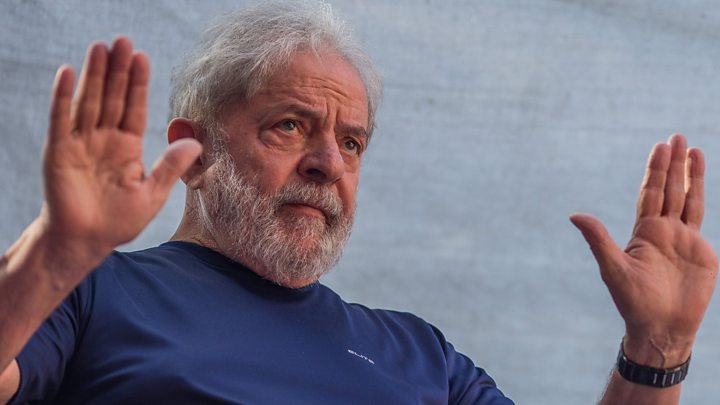
    Former Brazilian President Luiz Inacio Lula da Silva during a rally in Rio de Janeiro in April, 2018 Image copyright Reuters Image caption Lula had a huge lead over all other candidates

    Former Brazilian President Luiz Inácio Lula da Silva has pulled out of next month’s presidential election, allowing his running mate to stand in his place.

    Workers’ Party leader Gleisi Hoffman announced the decision outside the police headquarters where the 72-year-old is serving a 12-year sentence.

    Brazil’s top electoral court barred Lula’s candidacy less than two weeks ago due to his corruption conviction.

    Fernando Haddad will now be the party’s candidate.

    What happened?

    A letter written by Lula in his prison cell was read out to his supporters who have been camping outside the jail for five months demanding he be freed.
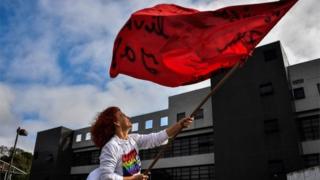
    Image copyright AFP Image caption Supporters of Lula have been camped outside the police headquarters where he is jailed

    In it, the former president, who governed from January 2003 until December 2010, said he would not run in the election scheduled for 7 October.

    He also named Mr Haddad as the man to step into the breach.

    Why did he finally give up?

    The decision comes after a lengthy legal battle which culminated on 31 August when the Superior Electoral Court (TSE) ruled that he was “ineligible” to run for the presidency.

    Lula’s legal team and the Workers’ Party have appealed against the decision and the Supreme Court is still due to rule on it.

    Up until Monday night, the Workers’ Party strategy had been to keep Lula’s name on the ticket for as long as possible.

    Lula left office with record approval ratings and despite being jailed almost 40% of people asked by polling firm Datafolha said they would vote for him.

    Fernando Haddad, on the other hand, is a former education minister who has little name recognition outside of São Paulo, where he served as mayor.

    Lula’s legal team asked the Supreme Court to extend the deadline for registering candidates for the presidency from end of business Tuesday to Monday 17 September to buy itself more time.

    Typical of the high drama which has characterised the election campaign, Lula and his party decided to change tack after the Supreme Court rejected their request to extend the deadline.

    Why was Lula barred?

    Lula was barred from running for the presidency under a 2010 law dubbed “Clean Slate”. It prohibits those who have a criminal conviction which has been upheld on appeal from running for public office.

    In July 2017, Lula was found guilty of accepting an upgrade to a beachfront flat as a bribe from an engineering firm involved in a major corruption scheme.

    Lula has always denied any wrongdoing and appealed against the verdict.
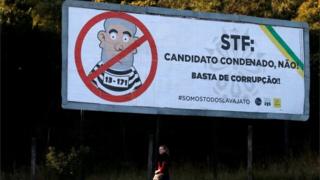
    Image copyright Reuters Image caption Lula was barred after being convicted on corruption and money laundering charges

    In January, an appeals court upheld the conviction and increased the sentence from the original nine-and-a-half years to 12 years.

    Lula and his legal team tried to argue he should stay out of jail while further appeals were under way.

    But in April, he was given 24 hours to turn himself in. After a tense, two-day stand-off he surrendered to police and was taken to the federal police headquarters in the city of Curitiba, where he has been held since.

    Why has he remained so popular?

    While he was in office, from January 2003 to December 2010, Brazil experienced its longest period of economic growth in three decades, allowing his administration to spend lavishly on social programmes.

    Tens of millions of people were lifted out of poverty thanks to the initiatives taken by his government and many of them remain loyal supporters.

    Many poor Brazilians could also relate to Lula in a way that they could not relate to other Brazilian politicians.
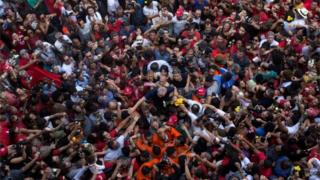
    Image copyright Reuters Image caption When Lula handed himself in to police, he had to wade through a sea of supporters

    Born in 1945 into a poor family in the north-east of Brazil, his family moved to São Paulo to find work by the time he was seven.

    He did not learn to read until he was 10 and started working in a car factory aged 14.

    A charismatic leader, he soon became the president of the metalworkers’ union and then founded the Workers’ Party.

    He served two consecutive terms as Brazil’s president before helping his protégé, Dilma Rousseff, be elected.

    Who will take over his mantle?

    The Workers’ Party has chosen Fernando Haddad to replace Lula as its presidential candidate. Mr Haddad was the minister of education during Lula’s presidency and is thought to enjoy his trust. He was Lula’s vice-presidential running mate until now.
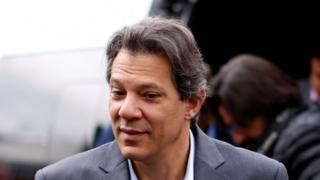
    Image copyright Reuters Image caption Fernando Haddad has not performed well in the polls so far

    From 2013 to 2017, the 55-year-old, who has degrees in economics and philosophy, also served as mayor of São Paulo, Brazil’s most populous city. He faced mass demonstrations against bus fare rises during his time as mayor.

    Mr Haddad, who has Lebanese roots, is not well known outside of São Paulo and has done poorly in the polls so far.

    Only 9% of those asked for a Datafolha poll on Monday said they would vote for him. But the Workers’ Party hopes people who had been planning on voting for Lula will switch their votes to Mr Haddad.

    The party hopes the boost he is expected to get will be enough to get him through to the run-off scheduled for 28 October.

    But Mr Haddad is facing legal problems of his own. Prosecutors allege that during his campaign for mayor his team received a loan from a construction firm which stood to benefit from contracts once he was elected. He has denied any wrongdoing.