Blog

  • U.S, Chinese officials spar over South China Sea engagements

    Top U.S. and Chinese defense officials and diplomats traded rhetorical barbs over ongoing American and allied military operations in the South China Sea, undercutting the message of cooperation and un

    Top U.S. and Chinese defense officials and diplomats traded rhetorical barbs over ongoing American and allied military operations in the South China Sea, undercutting the message of cooperation and unity between the two world powers during bilateral talks held in Washington on Friday.

    Defense Secretary James N. Mattis reiterated Washington’s stance that U.S. fighters, bombers and warships would “continue to fly and sail wherever international law allows” in the South China Sea and elsewhere in the Pacific.

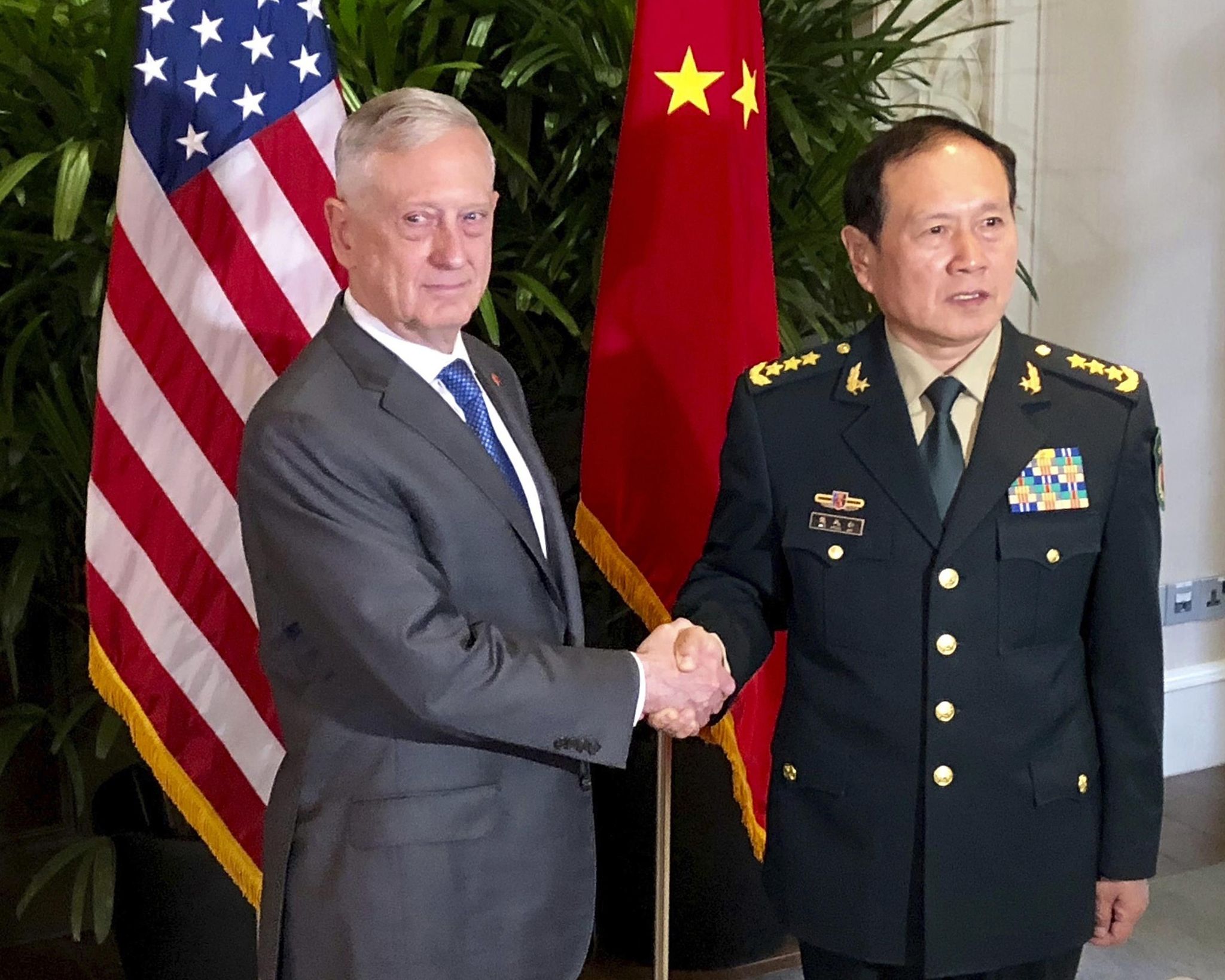
    “We continue to operate in international waters and airspace as all nations are entitled to,” Mr. Mattis said during a press conference at the State Department alongside Secretary of State Mike Pompeo, Director of the Office of Foreign Affairs of the Central Commission of the Communist Party of China Yang Jiechi and Chinese Defense Minister Wei Fenghe.

    His comments came after Mr. Yang claimed freedom of navigation through the contested waterways of the South China Sea, or or overflight across its airspace, is not being contested by Beijing, adding that any claim to the contrary and to use such claims as a reason for military action is “unacceptable”

    For his part, Mr. Wei said Washington and Beijing “stand to gain from cooperation and stand to lose from confrontation” in the South China Sea. “Confrontation and conflict … spells disaster for all,” he added.

    “The situation in the South China Sea is trending toward greater stability,” Mr. Wei noted, adding that Beijing continues to “urge the U.S. to play a constructive role” in maintaining that stability.

    Aside from Friday’s press conference at the State Department, Mr. Mattis and Mr. Wei are also scheduled to hold one-on-one talks Friday afternoon at the Pentagon.

    Discussions over a possible meeting between the two defense leaders had been percolating since October, when they held a sideline meeting during a regional national security conference in Singapore. But U.S.-China military relations quickly soured thereafter. Tensions reached a head when the White House nixed a previously scheduled visit by Mr. Mattis to Beijing that month.

    Friday’s meetings at the State Department and Pentagon were part of the second annual U.S.-China Diplomatic and Security Dialogue. Aside from the South China Sea, both sides sought to reinforce the notion of increasingly positive ties between the two countries.

    “The U.S. is not pursuing a Cold War or containment policy with China,” Mr. Pompeo said, adding “cooperation remains essential on many, many issues” ranging from a denuclearized North Korea to curbing Iranian influence across the globe.

    “The military-to-military relationship is moving forward and maintaining growth, despite some problems” between the U.S. and China, Mr. Wei said. China’s military buildup in the South China Sea “represents a growing force for world peace … and is transparent and for the protection of the Chinese people,” and is not a threat to the interests of the U.S. and its Pacific allies, he added.

  • Russian cybercrime suspect arrested in Bulgaria on U.S. hacking charges

    Bulgarian police have arrested a Russian citizen wanted by U.S. authorities in connection with a federal cybercrime case, spurring a new custody dispute between Moscow and Washington.

    Bulgarian police have arrested a Russian citizen wanted by U.S. authorities in connection with a federal cybercrime case, spurring a new custody dispute between Moscow and Washington.

    Identified by Russian media as Alexander Zh., 38, the suspected hacker is being held pending extradition to the U.S., where he has been charged with counts of computer fraud and conspiracy to commit computer fraud, the District Court of Varna, Bulgaria, said Thursday in a statement.

    The U.S. Department of Justice, as a matter of policy, “does not comment on extradition-related matters until a defendant is in the United States,” a DOJ spokesperson told The Washington Times Friday, adding: “There is nothing public at this time.”

    “We learnt about the arrest of the Russian citizen by the Bulgarian authorities from his wife,” said Vladimir Klimanov, Russia’s consular general in Varna, Bulgaria’s third largest city.

    “We haven’t received any official information,” Mr. Klimanov said Friday, Russian state media reported. “Under the circumstances, the Consulate General will take all the necessary measures.”

    Bulgarian authorities reported that the Russian is wanted in connection with allegedly causing at least $7 million in damages, and that he risks a maximum sentence of 20 years imprisonment if extradited to the U.S. and convicted.

    Russia does not have an extradition agreement with the U.S., meaning Moscow will not voluntarily surrender any citizens sought by Washington. Agreements exist between U.S. and other countries, however, and the Justice Department has more than once relied on authorities in allied countries apprehending Russian suspects traveling aboard.

    Yevgeny Nikulin, a Russian national accused of hacking U.S. companies including LinkedIn, was arrested in Prague in 2016 and was subsequently held by Czech authorities for 18 months while Washington and Moscow fought for custody. He was ultimately sent to the U.S. in April.

  • Australian police say stabbing attack linked to terrorism

    A knife-wielding man stabbed three people, one fatally, in Australia’s second-largest city on Friday in an attack police linked to terrorism.

    SYDNEY (AP) — A knife-wielding man stabbed three people, one fatally, in Australia’s second-largest city on Friday in an attack police linked to terrorism.

    The attack during the afternoon rush hour brought central Melbourne to a standstill. Hundreds of people watched from behind barricades as police tried to apprehend the attacker.

    Police said the man got out of a pickup truck, which then caught fire, and attacked three bystanders with a knife. He also attempted to attack police who arrived on the scene before being shot in the chest by an officer.

    The suspect died later at a hospital. One of the victims also died, while the two others were hospitalized.

    Police said the attacker’s vehicle contained several barbecue gas cylinders in the back. A bomb squad rendered them safe without any exploding.

    Victoria state police Commissioner Graham Ashton said the suspect, who was originally from Somalia, was known to police and the incident was being treated as terrorism.

    “From what we know of that individual we are treating this as a terrorism incident,” Ashton told reporters, adding that the police counterterrorism command was working on the case, as well as homicide detectives.

    “He’s known to police mainly in respect to relatives that he has which certainly are persons of interest to us, and he’s someone that accordingly is know to both Victorian police and the Federal intelligence authorities,” he said.

    The attack occurred on the eve of a busy weekend in Melbourne, with a major horse race scheduled for Saturday and a national league soccer match the following day. Sunday is also Remembrance Day, when memorial ceremonies for World War I are held.

    Ashton said police were “doing security reassessments of these events in light of what’s occurred,” but there was “no ongoing threat we’re currently aware of in relation to people surrounding this individual.”

    Prime Minister Scott Morrison condemned the “evil and cowardly attack.”

    “Australians will never be intimidated by these appalling attacks and we will continue to go about our lives and enjoy the freedoms that the terrorists detest,” he said in a statement.

    One witness said one of the stabbing victims, believed to be a man in his 60s who later died, was stabbed in the face, and that desperate efforts were made to save him.

    “Because he was on his stomach, they turned him over to see if he’s all right, he was still alive,” the witness, Markel Villasin, told Australian Associated Press.

    “He was breathing and he was bleeding out.”

    Video from the scene showed a man swinging a knife at two police officers near a burning car before he was shot.

  • White director who won minority theater grant defends decision to identify as black

    A white theater director defended Saturday his decision to identify as black, a case that has sparked an identity-politics debate in Great Britain after he received a publicly funded grant intended fo

    A white theater director defended Saturday his decision to identify as black, a case that has sparked an identity-politics debate in Great Britain after he received a publicly funded grant intended for minority artists.

    Anthony Ekundayo Lennon, a director for the black-led Talawa Theatre Company in London, said he had “no doubt that I have some African ancestry” after coming under fire for winning an Arts Council England award meant for “theatre practitioners of colour.”

    “I will not allow anyone who can’t accept or understand my life to be relevant to my existence,” said Mr. Lennon in an op-ed for the [U.K.] Guardian.

    His critics, including some British theater figures, accused him of misappropriating a racial identity and hijacking public funds meant to support minority thespians after the [U.K.] Sunday Times broke the story Sunday.

    Actress Kelechi Okafor tweeted Saturday that, “However ‘black’ you might ‘feel’ it is unethical and immoral to access funding that is specifically meant for actual black people,” adding that “I’m shocked that people are actually entertaining this nonsense.”

    “The leap to claiming blackness for himself is almost breathtaking,” said Paula Akban, an advocate for black women, in a Monday [U.K.] Independent column. “Not only has Lennon chosen to wear black identity like a costume, he has actively chosen to take up space and pilfer resources that were never meant for him.”

    Mr. Lennon, 53, who changed his middle name from David, said that he began identifying as “mixed heritage” as a boy after being frequently mistaken for black.

    He said he had to use an Afro comb growing up because “my mum couldn’t manage my hair.” One of his brothers has similar physical traits, he said, and neighbors would “arrive on the doorstep to gawp at us.”


    Yes, I have white parents. But I have African ancestry too | Anthony Ekundayo Lennon https://t.co/y3pnSwuPOm

    — The Guardian (@guardian) November 10, 2018

    Theatre director Anthony Ekundayo Lennon, who has won funds meant for ‘people of colour’, has admitted his parents and grandparents were all white https://t.co/gJNuWczvAg

    — The Sunday Times (@thesundaytimes) November 4, 2018

    That’s not what African ancestry means. I’m shocked that people are entertaining this nonsense.

    — Kelechi Okafor (@kelechnekoff) November 10, 2018


    Both the Arts Council and Talawa have defended the decision to award the minority-intended funding to Mr. Lennon, describing his case as exceptional. The two-year, full-time residential fellowship is reportedly worth 100,000 pounds, the equivalent of about $130,000.

    “Talawa raised their wish to support Anthony with us. In responding we took into account the law in relation to race and ethnicity,” said the Arts Council in a statement. “This is a very unusual case and we do not think it undermines the support we provide to black and minority ethnic people within the theatre sector.”

    Others have argued that adopting a different racial identity represents a logical extension of the transgender movement, which has celebrated men and women who portray themselves members of the opposite sex.

    “[T]his poses an interesting dilemma for the identitarian left,” said [U.K.] Spectator columnist Toby Young. “If it’s perfectly fine for someone born male to identify as female, why isn’t it OK for someone born white to identify as mixed heritage?”

    NewsOne.com, an online U.S. news site for and about African-Americans, compared Mr. Lennon to Rachel Dolezal, a white woman who headed an NAACP chapter after altering her hair and skin tone to look more black.

    “From Rachel Dolezal, who was showered with awards and praise while at the NAACP, to Anthony Ekundayo Lennon, these white folks who claim they are so Black are blatantly taking resources from Black communities,” said NewsOne in a Monday article.

    The brouhaha coincides with another high-profile European identity case involving a 69-year-old Dutch man, Emile Ratelband, who has filed in court to change his age to 49, saying being legally younger would boost his status with clients and on dating sites.

    The NewStatesman’s Dorothy Musariri said that despite Mr. Lennon’s “attempts at empathy, he has no real idea of the struggles black actors and directors experience in an industry obsessed with white characters and classic period (white) dramas.”

    “His award takes away from the little opportunities that people of colour have,” she said in a Tuesday column.

    Mr. Lennon has made no secret of parentage, appearing in a 1990 BBC documentary in which he discussed identifying as “African born-again” despite having white Irish parents.

    “Although I’m white, with white parents, I have gone through the struggles of a black man, a black actor,” he told a theater audience in 2012.

    He said Saturday he appreciated the support from friends and colleagues who have told him his case is part of a “wider conversation about identity and evolving consciousness,” while others have “tried to make me feel like a liar and a thief.”

    “It disappoints me that an attempt to reduce my life’s experience into a misleading headline can so easily lead to character assassination,” Mr. Lennon said.

  • Women winning election to more top offices in Massachusetts

    For all its liberal pretensions, Massachusetts hasn’t always been the most progressive of states when it comes to electing women to positions of political power.

    BOSTON (AP) – For all its liberal pretensions, Massachusetts hasn’t always been the most progressive of states when it comes to electing women to positions of political power.

    That’s changing.

    On Tuesday, Massachusetts voters elected four women to the state’s 11-member congressional delegation – the most ever. At the same time, voters elected twice as many women as men to statewide office on Beacon Hill.

    It wasn’t that long ago when women in high political office were still a relative rarity in Massachusetts

    Just a decade ago, in 2008, the only woman holding statewide office was then-Attorney General Martha Coakley, a Democrat. And the only woman on the state’s then 10-member congressional delegation was Democratic U.S. Rep. Niki Tsongas.

    The hard-fought shift didn’t go unnoticed Tuesday, when the election of women in Massachusetts and other states became a familiar theme.

    The highest-profile woman on the Massachusetts ballot – Democratic U.S. Sen. Elizabeth Warren – credited women with leading the fight against the Trump administration during her victory speech after winning a second, six-year term.

    “We’ve seen white women learning from black women how to organize and mobilize. Older women partnering with younger women to take to the streets. Married, single, straight, lesbian and transwomen, rich and poor women, building alliances with each other and, yes, building alliances with the men who also want to make real change in this country,” said Warren, who has promised to take “a hard look” at running for president in 2020.

    Boston City Councilor Ayanna Pressley – who defeated longtime incumbent U.S. Rep. Michael Capuano in the Democratic primary – ran unopposed Tuesday to become the first black woman elected to the U.S. House from Massachusetts. She will represent the 7th Congressional District.

    Pressley said black women face an added challenge running for office.

    “When it comes to women of color candidates, folks don’t just talk about a glass ceiling. What they describe is a concrete one,” Pressley said in her victory speech. “But you know what breaks through concrete? Seismic shifts.”

    In the state’s 3rd Congressional District, Lori Trahan emerged the winner. During her victory speech Trahan, who grew up in Lowell, gave a shout-out to Tsongas, whose decision not to seek re-election led to a mad scramble to replace her.

    Katherine Clark, who first won election to the U.S. House in 2012 to represent the 5th Congressional District, also pointed to the gains made by women seeking office in Massachusetts, saying she was thrilled to welcome Pressley and Trahan to the delegation.

    “For the first time in our history we will have a record number of women representing the commonwealth in Washington,” Clark said in a statement after winning re-election.

    At the Statehouse, voters re-elected Attorney General Maura Healey, Treasurer Deb Goldberg and Auditor Suzanne Bump – all Democrats – and Lt. Gov. Karyn Polito, a Republican. They also re-elected two men – Republican Gov. Charlie Baker and Democratic state Secretary William Galvin.

    The victories for women candidates weren’t limited to statewide and congressional races.

    In the Massachusetts House, Democrat Tram Nguyen defeated incumbent Republican state Rep. Jim Lyons from a district that includes Andover, while fellow first-time Democratic candidate Becca Rausch from Needham Heights defeated another Republican incumbent – state Sen. Richard Ross.

    And in Boston, Rachael Rollins, a former federal prosecutor, won election to become the city’s first female district attorney and the first woman of color to hold such a job anywhere in Massachusetts. Rollins ran on the promise to help curb mass incarceration and racial disparities in the criminal justice system while building trust between communities and law enforcement.

    In another sign of the growing political clout wielded by women on Beacon Hill, 2018 marked the first time in state history when an incumbent female Senate president (Harriette Chandler) passed the gavel to an incoming female Senate president (Karen Spilka).

  • How real is the threat of returning IS fighters?

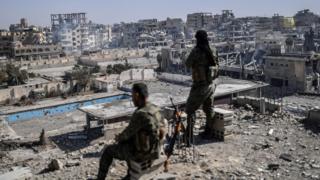
    Fighters of the Syrian Democratic Forces stand guard on a rooftop in Raqqa after retaking the city from Islamic StateImage copyright Getty Images

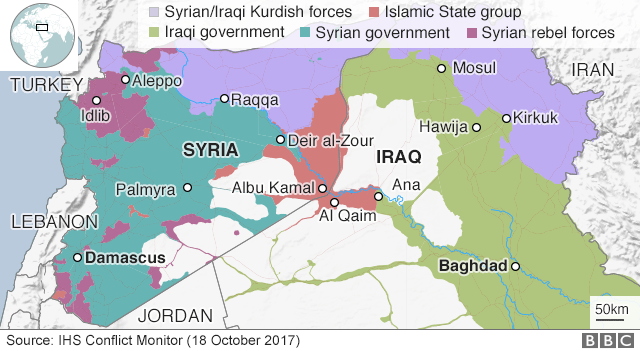
    Driven out of their de facto capital of Raqqa after three brutal years, IS fighters have lost much of the territory they once held. How real is the danger they will now travel to other countries to carry out attacks, asks Dr Lorenzo Vidino.

    As the self-declared Islamic State steadily crumbles in Iraq and Syria, security officials throughout the world are asking themselves a crucial question: what will happen to its fighters?

    Roughly 30,000 foreign fighters joined IS and there is concern that these battle-hardened individuals will return home, or move elsewhere, carrying out terrorist attacks to avenge the demise of the “caliphate”.

    While difficult to forecast, the changing fortunes of IS will undoubtedly have major implications for global security.

    Over the border

    There are indications, including an assessment by US counter-terrorism officials, that some foreign fighters will stay in Syria and Iraq.

    Image copyright Getty Images

    While Turkish authorities have been patrolling with significantly more zeal than in the past, mountainous terrain and the presence of sophisticated smuggling networks mean the border is quite permeable.

    IS has a long-established support network throughout Turkey, which is playing a key role in extracting foreign fighters from Syria.

    Given the scores of attacks that have bloodied the country over the last three years, Turkish authorities are understandably concerned about this influx.

    Neighbouring countries, such as Jordan and Lebanon, have similar fears.

    From battlefield to battlefield

    The potential end destinations for foreign fighters leaving Syria and Iraq are plentiful.

    There is evidence that some have joined the official wilayat, or “provinces”, IS has established in Yemen, the Sinai Peninsula, the North Caucasus and East Asia.

    The group also has a strong presence in Libya, where the US suggested last year that it had up to 6,500 fighters, and several hundred in Afghanistan, where the US reported killing at least 94 fighters in an attack on underground tunnels.
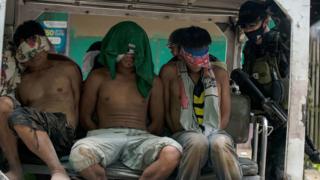
    Image copyright Getty Images Image caption Marawi in the Philippines has been partly held by fighters linked to IS since May

    There are also anecdotal indications of militants travelling to conflicts in far flung places such as the Democratic Republic of Congo, Myanmar and the Philippines.

    The arrival of foreign fighters to these regions could strengthen the capabilities of local jihadist groups and change the course of sometimes devastating conflicts.

    Vulnerable countries

    Many other foreign fighters are choosing to return to their countries of origin.

    While some returnees may no longer engage in militant activities, others are establishing clandestine networks seeking to carry out attacks and, according to local circumstances, destabilise the country’s political situation.

    North African countries are particularly vulnerable to the risk – nowhere more so than Tunisia, as about 6,000 of its citizens left to join IS – the highest per capita rate in the world.

    Arab Gulf countries may also suffer from this type of blowback.

    Russia, the Caucasus, and a number of Central Asian countries are also areas of concern, having seen large numbers join IS – many of whom went on to play a prominent role on the battlefield.

    The threat to Europe

    European authorities consider the return of some of the estimated 6,000 European foreign fighters a major security concern.

    To date, fewer than one in five individuals involved in attacks on the West since the “caliphate” was declared in 2014 had experience as foreign fighters, according to research by the Italian Institute for International Political Studies (ISPI) and the George Washington University’s Program on Extremism.
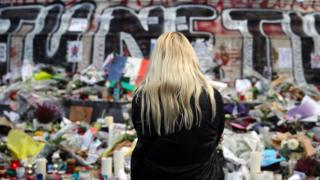
    Image copyright Getty Images Image caption The Paris attacks were carried out in part by former foreign fighters Who was behind the jihadist attacks on the West? Who are Britain’s jihadists? The archaeological treasures IS failed to destroy

    But this might change as the number of returnees – now estimated at roughly 1,000 – increases.

    Many may show no sign of wishing to engage in further violent activities, but there is a valid concern that some may make use of their combat skills.

    It is plausible that they could use their network of contacts and “celebrity status” among unaffiliated jihad enthusiasts to plan terrorist attacks.

    The territorial losses suffered by IS are not likely to affect the operational ability of these largely independent militants.

    A legal return

    While significant problems still exist, European authorities have improved intelligence sharing to better detect returning fighters.

    And thanks to improved co-operation with Turkey, many militants have been arrested before they get any further.

    A few do manage to reach Europe illegally, or by posing as refugees – as some of the November 2015 Paris attackers did.

    But most foreign fighters will come to Europe legally, often using their genuine European passports.

    If detecting them is a problem, working out what to do with them is equally fraught.

    Arresting them may be the obvious answer, but the reality is significantly more complicated.

    The UK Home Office, for example, disclosed last year that of the 400 British foreign fighters who had returned from Syria and Iraq, only 54 were convicted.

    Similar dynamics can be observed throughout the continent.
    Inside Raqqa after IS pushed out The city fit for no one Raqqa’s loss seals rapid rise and fall

    What is preventing authorities from arresting, prosecuting and convicting returning foreign fighters?

    It is mostly a legal matter, with lawmakers struggling to keep up with a constantly shifting threat environment.

    While legislations vary from country to country, they share some common problems.

    In some countries, joining a terrorist organisation or fighting in a foreign conflict were not criminal offences at the time when most individuals travelled to Syria.

    Several countries have since introduced new laws which, however, cannot be applied retrospectively.

    Even in countries where such actions have long constituted criminal offences, authorities struggle to gather the evidence needed to build a strong criminal case.

    Knowing that somebody joined IS or committed atrocities in Syria from an intelligence perspective is one thing.

    Being able to prove that beyond a reasonable doubt in a court of law is another.

    Even more complicated is the issue of children either born or raised in the “caliphate” by their foreign fighter parents.

    While most are not punishable under the law, they deserve attention because of the trauma they have suffered and, in some cases, because they present severe signs of radicalism despite their young age.

    The result is that authorities are overwhelmed, having to monitor hundreds of battle-hardened fighters, on top of the burgeoning number of home-grown IS sympathisers, in an attempt to determine which pose an immediate security threat.

    Instead, authorities throughout Europe have increasingly invested in programmes seeking to deradicalise returning foreign fighters.

    While it might be premature to definitively assess them, there are indications that some, like the one established in the Danish city of Aarhus – offering rehabilitation and inclusion in society, are effective.

    Others, like the French plan to set up 12 deradicalisation centres, have been shelved.

    Looking to the future

    The loss of much of its territory is a major blow to ISIS.

    Yet the group and its adherents are already surfacing in various parts of the world and are likely to do so with even more frequency and vehemence in the near future.

    IS will become a more decentralised, amorphous organisation operating in a more asymmetric fashion, but it will not disappear.

    Moreover, the IS brand and the emotional appeal of its “caliphate” are unlikely to vanish any time soon.

    And, despite critical challenges, the organisation’s remarkably strong digital presence, the so-called “virtual caliphate”, will survive in some form, potentially rekindling the commitment of sympathisers worldwide and prompting some to carry out terrorist attacks in its name.

    The fall of the “caliphate” closes a chapter, but a new one is about to be opened.

    About this piece

    This analysis piece was commissioned by the BBC from an expert working for an outside organisation.

    Dr Lorenzo Vidino is the director of the Program on Extremism at the George Washington University and of the Program on Radicalisation and International Terrorism at the Italian Institute for International Political Studies (ISPI) in Milan.

    Edited by Duncan Walker
  • Holocaust trial: Germany tries former SS guard at Stutthof camp

    Johann R in court in Muenster, 6 November Image copyright EPA Image caption The face of the defendant, seen here in court, has been obscured by court order

    A former SS guard has gone on trial in Germany accused of complicity in mass murder at a Nazi death camp during World War Two.

    Identified as Johann Rehbogen, the 94-year-old served in the Stutthof camp in what is now northern Poland from June 1942 to September 1944.

    He denies knowing anything about atrocities committed there.

    Because he was not yet aged 21, he is being tried in a juvenile court in Münster, western Germany.

    US deports Nazi camp guard to Germany The hidden graves of the Holocaust Auschwitz inmate’s notes from hell finally revealed The Holocaust year by year

    The former guard, who uses a wheelchair, faces a sentence of 15 years if convicted but is unlikely to serve any time in prison because of his advanced age.

    Image copyright AFP Image caption Stutthof has been preserved as a museum Image copyright AFP Image caption Crematorium at Stutthof Image copyright AFP Image caption Bunks for inmates at Stutthof

    The defendant is “accused in his capacity as a guard of participating in the killing operations”, said Mr Brendel.

    It has still to be determined whether the other former SS guard is fit to stand trial.

    What was Stutthof?

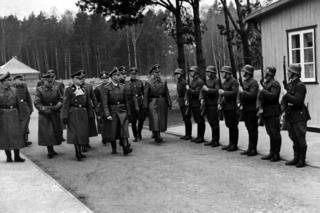
    Image copyright Stutthof Museum Image caption SS leader Heinrich Himmler (centre) visited Stutthof
    Located near the city of Danzig (now Gdansk), it was originally an internment camp before being officially designated a concentration camp in 1942.

    From June 1944, prisoners were murdered in a gas chamber.

    More than 65,000 people died in Stutthof before it was liberated by the Soviet Army on 9 May 1945.

    Who is the defendant?

    Johann Rehbogen was captured by the US Army after the war but returned to civilian life, working as a landscape architect for the North Rhine-Westphalia state authorities.

    Questioned by police last year, he denied knowing about atrocities in the camp. Although he was not named by the court in Münster, his name has been published by the Wiesenthal Center, which investigates Nazi war crimes.

    “If one looks at how many evil doings and crimes were perpetuated, one can understand why elderly people too have to face prosecution,” said Mr Brendel.

    “Germany owes it to the families and victims to prosecute these Nazi crimes even today. That is a legal and moral question.”

    How do survivors regard the trial?

    Relatives of those murdered at Stutthof are attending the trial. Among them is one of the plaintiffs, Ben Cohen, whose grandmother Judy Meisel is a survivor of the camp.

    He told the BBC it was good for her to see Germany pursue the case.

    “Her being able to witness even some of this process, even from afar, is a sense of closure,” he said.

    “To have Germany listening to her is very powerful for her.

    “I speak to her all the time and I can see a new perspective that this gives her on things, so that could maybe be considered a form of closure. But closure is a difficult word in this context.”

  • Matteo Salvini brushes off viral break-up with celebrity girlfriend

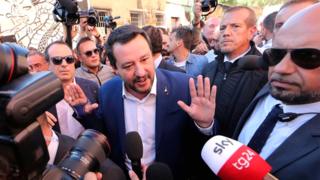
    Italian Interior Minister Matteo Salvini speaks to reporters in Rome on 24 October 2018 Image copyright Reuters Image caption Mr Salvini is both Italy’s interior and deputy prime minister
    Italy’s populist deputy PM Matteo Salvini has brushed off news of his break-up publicised by his former girlfriend on Instagram on Monday.

    Elisa Isoardi, a TV host who had been in a relationship with Mr Salvini for three years, made the announcement as he flew to Ghana to discuss migrants.

    He later dismissed it, saying Italians “did not care”.

    He was named interior and deputy prime minister in the new populist coalition government earlier this year.

    Skip Instagram post by elisaisoardi

    View this post on Instagram

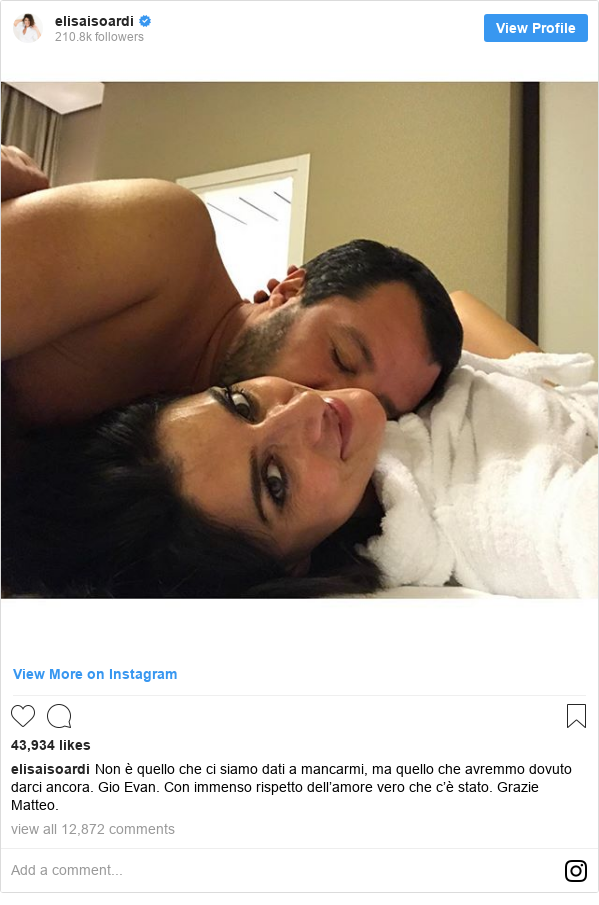
    Non è quello che ci siamo dati a mancarmi, ma quello che avremmo dovuto darci ancora. Gio Evan. Con immenso rispetto dell’amore vero che c’è stato. Grazie Matteo.

    A post shared by Elisa Isoardi (@elisaisoardi) on Nov 5, 2018 at 1:16am PST

    Report

    End of Instagram post by elisaisoardi

    Instagram post by elisaisoardi: Non è quello che ci siamo dati a mancarmi, ma quello che avremmo dovuto darci ancora. Gio Evan. Con immenso rispetto dell’amore vero che c’è stato. Grazie Matteo. Image Copyright elisaisoardi elisaisoardi

    Report

    Ms Isoardi’s post on Instagram features an intimate selfie of the couple.

    Quoting a line from contemporary poet Gio Evan, Ms Isoardi writes: “It’s not what we have given each that I miss, but what we still had to give to each other.”

    She adds: “With immense respect for the true love that was, thank you Matteo.”

    The relationship with Mr Salvini ended two and a half months ago, but Ms Isoardi, who hosts a cookery show on Italian television, had decided to go public now, she told Chi magazine in an interview.

    “Why did we break up? We were far apart due to the commitments we both have,” she said.

    Skip Facebook post by Matteo Salvini

    Impegnativa giornata di lavoro in Africa sul fronte immigrazione e sicurezza, ma il telefono dall’Italia mi squilla per…

    Posted by Matteo Salvini on Monday, 5 November 2018

    Report

    End of Facebook post by Matteo Salvini

    Mr Salvini, who is leader of the right-wing anti-migrant League, was on his way to Ghana to discuss the repatriation of migrants to Italy at the time Ms Isoardi posted her announcement.

    Later on Facebook, he wrote: “Busy working day in Africa on the immigration and security front, but the phone from Italy is ringing about other matters.”

    He himself is an avid user of social media, sharing details of his personal life with his 3.3 million Facebook followers and 900,000 followers on Twitter and Instagram.

    Italy coalition: What you should know What exactly is populism? Italy’s economy in charts

  • US mid-terms: The most surprising candidates

    Composite image showing candidates Christine Hallquist and Will Hurd in front of the Capitol building Image copyright Getty Images

    It can be tough to keep up with the deluge of information and analysis that comes with the US mid-term elections.

    Despite all the noise, the key question remains whether or not Republicans will be able to keep control of both chambers of Congress.

    But with so much to consider and thousands of races taking place, some interesting stories can be lost.

    That’s why we’ve picked out some candidates who have had memorable journeys to the ballot box on November 6.

    Plus, a politics professor explains how a compelling personal story can make a difference.

    Image copyright Getty Images / Sharice Davids

    Who?

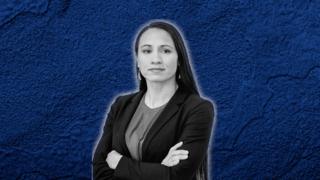
    Democrat Sharice Davids, a gay ex-mixed martial arts fighter, is running in Kansas’s third congressional district.

    What makes her interesting?

    Ms Davids could become the first Native-American woman elected to Congress.

    She is a member of the Ho-Chunk Nation, was raised by a single mother who worked as a drill sergeant, and has a law degree from a top US university.

    The 38-year-old won her first mixed martial arts fight in November 2013, but began to focus on politics after she was rejected by the Ultimate Fighting Championship.

    One quote: “I’ve been put down, pushed aside, knocked out. I’ve had to fight my whole life because of who I am and who I love.”

    The decorated female fighter pilot

    Image copyright Getty Images

    Who?

    Martha McSally, a two-term Republican representative from Arizona, is running for Senate in the state.

    What makes her interesting?

    Ms McSally is the first US female fighter pilot to fly in combat and the first to command a fighter squadron.

    She was deployed to Iraq and Afghanistan and earned six medals during her 26-year military career.

    If elected, she will become the first woman to represent Arizona in the Senate.

    One quote: “I’m a fighter pilot and I talk like one. That’s why I told Washington Republicans to grow a pair of ovaries and get the job done.”

    The ironworker with a viral ad

    Image copyright Getty Images

    Who?

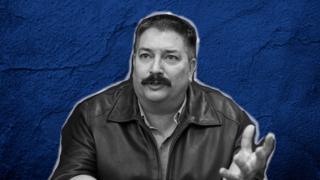
    Randy Bryce, a trade union activist and cancer survivor, is the Democratic candidate for Wisconsin’s first district.

    What makes him interesting?

    Mr Bryce – nicknamed Iron Stache – came to prominence when his biographical campaign video went viral earlier this year.

    He is an ironworker and former soldier who has emphasised his working-class roots, but he has drawn some notable opposition from close to home.

    His brother featured in a Republican attack ad and has said he is voting against him. Awkward.

    One quote: “I spent the last 20 years of my life building the district.”

    The outspoken Gays for Trump founder

    Image copyright Peter Boykin / Getty Images

    Who?

    Peter Boykin, founder of the Gays for Trump group, is running for North Carolina’s state legislature.

    What makes him interesting?

    He is a major outlier, because the vast majority of LGBT candidates running this year are Democrats.

    There are no gay Republican nominees for Congress or governor, according to the LGBT Victory Fund organisation.

    Mr Boykin has been forthright in addressing this issue, telling the New York Times that the Republican Party had “totally embraced” him.

    One quote: “The liberal gay community preaches peace, love, and tolerance but they only extend it to people who think like they do.”

    A really simple guide to the US mid-terms You choose what happens in the mid-terms Should Donald Trump be worried?

    The transgender former energy executive

    Image copyright Getty Images

    Who?

    Christine Hallquist, 62, who defeated three candidates to win the Democratic nomination for governor of Vermont.

    What makes her interesting?

    She could become the first ever transgender governor of a US state.

    Ms Hallquist transitioned in 2015 while working as the head of a state-wide energy company, a job she held for 12 years.

    Her nomination comes during an election year that has seen a record number of lesbian, gay and transgender candidates run for political office.

    One quote: “I just happen to be a leader who is transgender. Vermonters know that.”

    The ex-CIA agent and Trump critic

    Image copyright Getty Images

    Who?

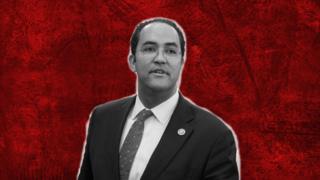
    Will Hurd, a 40-year-old former CIA officer and Republican representative, is contesting a close race for Texas’s 23rd district.

    What makes him interesting?

    He managed covert operations in Afghanistan during a nine-year career with the CIA, and has become a regular on political talk shows.

    His district covers an extensive part of the US-Mexico border, and he has been vocal in his opposition to President Trump’s immigration policies.

    Mr Hurd is a moderate in the party and his seat is high on the list of those the Democrats are hoping to take.

    One quote: “I’ve seen Russian intelligence manipulate many people over my professional career and I never would have thought that the US President would become one.”

    The newsreader and one-time Miss America

    Image copyright Getty Images

    Who?

    Democrat Mallory Hagan, 29, who has swapped beauty pageants for the ballot box in Alabama’s third district.

    What makes her interesting?

    She was crowned Miss America in 2013, having previously won the Miss New York and Miss Manhattan titles.

    Last year, top figures in the Miss America Organization resigned after leaked emails showed they had mocked a number of contestants including Ms Hagan.

    The experience prompted her to give politics a try. “It taught me a lot about the power of my voice,” she says on her website.

    But she faces a tough test in trying to unseat her Republican opponent, Mike Rogers, who has held the district for more than 15 years.

    One quote: “After looking at the numbers of women throwing their hats in the ring, I decided to do it.”

    The Trump-supporting underwear model

    Image copyright Getty Images

    Who?

    Antonio Sabato Jr, a TV actor and former Calvin Klein model, is the Republican candidate in California’s 26th district.

    What makes him interesting?

    Mr Sabato has been plastered on a 90ft [27m] billboard in Times Square and has shown off his ballroom skills on TV’s Dancing with the Stars.

    But in recent years it’s his political views that have been in the spotlight.

    He says he was blacklisted by Hollywood directors for his early support of Mr Trump’s presidential run.

    Mr Sabato has also repeatedly claimed – without evidence – that former President Barack Obama is Muslim.

    One quote: [On President Obama] “If he’s not a Muslim, we should call him President Barry.”

    What does this all mean?

    Image copyright AFP

    This year’s pool of candidates is a diverse one, with more women and LGBT people running than ever before.

    But will it make a difference? Yes, says Jennifer Lawless, a politics professor at the University of Virginia who specialises in campaigns and elections.

    “A lot of these more diverse candidates can generate levels of enthusiasm among voters that have traditionally not been part of the electoral environment,” she says.

    Prof Lawless also points out that most of the new, diverse, candidates are Democrats. Why is this?

    “A lot are running based on their concerns about the Trump administration,” she says. “Many have personal experience where they feel like they have been targeted themselves.”

    The women lining up to topple Trump The US state about to elect a woman

    There are also a number of candidates who have compelling personal stories to tell and Prof Lawless says this can be helpful – to an extent.

    “In a lot of cases these personal stories are a way for candidates to talk about themselves in a way that is genuinely authentic,” she says.

    “But there’s not much evidence to suggest that voters specifically look at individual life stories,” she adds.

    “The most important thing is the ability to convey that you have the background and the experience to be an effective representative of the people.”

  • US mid-terms latest: All you need to know Mid-terms: You choose what happens


    The US mid-term elections on Tuesday will help define the rest of Donald Trump’s presidency.

    Americans will vote for members of both chambers of Congress, as well as for governors in 36 out of 50 states.

    This is our last daily round-up ahead of the mid-terms, so we’ve pulled together all our material that matters.

    One question

    Wait…what are the mid-terms? (Don’t worry, it’s OK to ask.)

    It may feel like the US is always having elections, so what’s at stake on Tuesday? What are people voting for?

    Donald Trump’s name isn’t on the ballot this year, but it might as well be.

    One important thing to watch on Tuesday will be whether candidates who have embraced the president’s rhetoric and tactics end up doing well. This could shape the direction of the Republican party over the next two years.

    Either way, we can expect these mid-terms, like all others, to be a referendum on the president.

    The parties of presidents who have low approval ratings tend to do poorly in the mid-terms – and President Trump’s are very low indeed.

    This is one reason Democrats, with the House of Representatives in their sights, are optimistic this year.

    Here are other reasons Democrats are hopeful

    One race to watch

    Image copyright Reuters

    There are plenty we could have picked here – any of the close Senate races in Tennessee, Missouri or Arizona for example – but if there’s one race that sums up the 2018 mid-terms, it is the close race for governor in Georgia.

    Like in a number of other states this year, Georgia could see a significant first: Democratic candidate Stacey Abrams would become the first female African-American governor in the US if she won.

    Her Republican opponent Brian Kemp is Georgia’s secretary of state. His office has been behind the cancellation of 1.5m voter registration applications in four years, and has been accused of voter suppression, one of the hot-button issues this year.

    As with the divisive race for governor in neighbouring Florida, the Georgia contest has also been laced with racist undertones (or even overtones). Just last week, the Washington Post reported, voters in Georgia received a fake robocall purporting to be from Oprah Winfrey “asking you to make my fellow Negress Stacey Abrams the governor of Georgia”.

    Our correspondent Courtney Subramanian spent time in Georgia looking at how the bitter race has played out.

    You can read her piece here

    One guide

    The first polls will close at 23:00 GMT on Tuesday (that’s 18:00 on the east coast of the US).

    We’ll be bringing you coverage live online, on TV and on radio as the results come in.

    How can you find out where to read, watch and listen?

    See the schedule for our mid-terms coverage here

    One game

    There are plenty of possible outcomes on Tuesday, and therefore plenty of possible consequences.

    If you want to see what those consequences are, choose a scenario right here…

    Mid-terms: You choose what happens


    Share this chatbot

    (more…)