Sport Bolton Wanderers avoid administration
Blog
-
How did Coca-Cola put fizz into its World Cup sales?
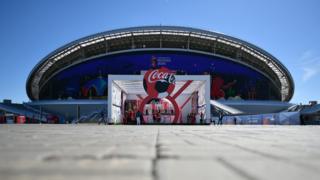 Image copyright Lukas Schulze/FIFA Image caption Coca-Cola was an official partner of the 2018 Fifa World Cup in Russia
Have you ever wondered why the products you see on supermarket shelves occupy the positions they do, and how retailers manage their stock levels? This is the science of shelf management and technology is playing an increasingly important part in it.
Following this year’s Fifa World Cup in Russia, Coca-Cola Hellenic Bottling Company (CCH), a major bottling partner for the global drinks brand, reported a 6.4% jump in revenues for the first half of 2018.
The football competition, warm weather and new product launches helped boost sales, the company said, but new technology also helped, in the form of sophisticated image recognition and data analytics.
CCH implemented a new system operated by tech firm Trax which digitised the previously manual stock-taking process.
When you have 200,000 retail customers across a geographically vast country like Russia, relying on pen and paper stock records that then had to be inputted into a computer was hardly ideal. It led to delays in replenishing empty shelves, which is not good for business.
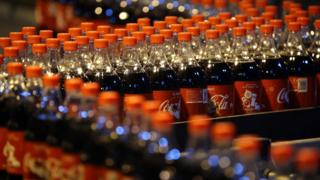 Image copyright Getty Images Image caption Coca-Cola Hellenic Bottling Company owns 10 bottling plants in Russia
 Running out of stock costs retailers more than $634bn (£494bn) a year in lost sales, according to a report by retail analysts IHL Group.
And with the summer’s World Cup attracting 4.5 million visitors, “it was highly important for us to get the right stocks in place,” says Aleksandr Makarov, project manager for CCH Russia.
Implementing the Trax system resulted in a 63% reduction in “out-of-stock” occurrences and audit times that fell from 20 minutes to two minutes, says Mr Makarov.
“We achieved 99.5% product availability in stores three hours before the games started.”
So how exactly did CCH achieve this?
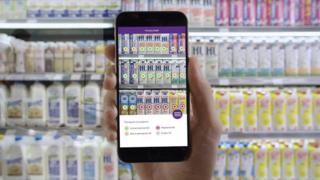 Image copyright Trax Image caption Trax uses on-shelf and smartphone cameras to analyse the position and availability of products
 Using shelf-mounted cameras and augmented reality on smartphones and tablets, Trax’s image recognition system monitors all the products on open shelves and in coolers, understanding how they differ in size, shape and colour.
A “panoramic stitching engine” pieces together the in-store images to recreate the full shelf, while analytic software recognises each product. The supermarket is instantly alerted if brands are out of place or missing from the shelves.
But, as Trax chief executive Joel Bar-El explains, “many products look the same but are in different sizes, like fizzy drinks, for example. So we’ve created an extra layer, understanding the physical layout of the store and looking at the price to help us work out the likely size of the product.”
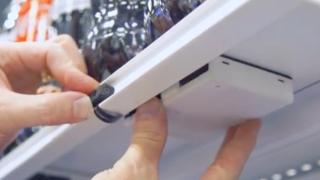 Image copyright Trax Image caption Shelf-mounted cameras monitor product position and stock levels in real time
 The firm is identifying 250 million products a month and providing real-time data to 170 retailers and brand manufacturers around the world, says Mr Bar-El.
As bricks-and-mortar retailers face the growing challenge of online, a number of tech companies are springing up offering digital stock management and data analytics services to retailers – Planorama, TransVoyant and MetaMind to name but a few.
Shelf science
Supermarkets devise planograms – organisational charts – of where their tens of thousands of brands should go on shelves or in fridges and freezers. This helps store workers put things in the right place, because when it comes to grocery retailing, position matters.
Broadly speaking, premium products go on the top shelves, cheaper items on the bottom shelves, leaving the middle shelves for the best-selling mid-range products.
According to consumer organisation Which?, it’s this “sandwich effect” that makes the profitable mid-shelf items seem more appealing. Clever packaging can subtly suggest that cheaper brands, placed near premium brands, are just as good.
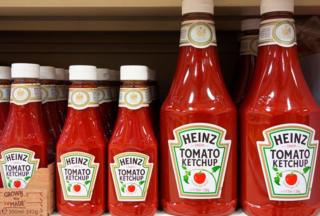 Image copyright Getty Images Image caption Image recognition must differentiate between products that look similar but are different sizes
 Brands pay handsomely for the right to occupy the best shelf positions, so they want to make sure retailers are doing what they promised to do. Sometimes they don’t, whether through human error or poor planning. So real-time monitoring helps address this.
And they also want to make sure there’s enough of their product in stock so there isn’t a yawning gap on the shelf for very long.
“Retailers are out of stock about 8% to 12% of the time at the moment,” says Mr Bar-El, “but systems like ours can reduce that to 3% or 4%.
“We alert them immediately. It normally takes three to four hours to replenish shelves today, but we’ve reduced that to 20 minutes in many cases,” he claims.
Toby Pickard, head of insight for innovation and futures at retail analysts IGD, says using technology to ensure real-time stock management is becoming crucial for companies.
“As retailers increasingly match each other on price and range, excellent in-store service and product availability will become more important in terms of enabling retailers to stand out from the crowd and drive footfall to their stores,” he says.
But, as Patrick O’Brien, UK retail research director at GlobalData, points out, “this is not exactly rocket science”.
“Existing technology and shop floor staff should be able to maintain shelf stock, so it comes down to whether or not these providers can actually prove a return on investment,” he says.

More Technology of Business
Bitcoin buster? The search for a more stable cryptocurrency The world’s first floating farm making waves in Rotterdam How electric vehicles are moving into the fast lane ‘There are boats floating above my head in Times Square’ Cyber-attack! Would your firm handle it better than this?
Data analytics is also revealing what’s actually happening. And some of the findings are surprising.
For example, one pet food maker assumed that having its product positioned next to its main competitor wouldn’t be good for sales. But it was. Why?
“We are not bothered by explaining why, we’re just following the data,” says Mr Bar-El. “It could be about colour, brain psychology, but we don’t know. Our conclusions are evidence-based.”
Online grocery shopping is growing quickly, with IGD forecasting 48% sales growth in the UK by 2022, 286% growth in China, and 129% growth in the US over the same period.
Won’t this be a threat to in-store tech providers?
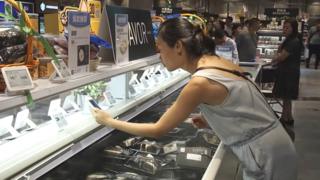 Image copyright Alibaba Image caption Chinese online retail giant Alibaba is integrating tech into supermarkets
 “There is no question that online grocery will continue to grow and will undoubtedly become a main focus of both retailers and brands,” says Mr Bar-El.
“But this increase in online sales is far from being the end of bricks-and-mortar stores. Online presents us with a far greater understanding of customer behaviour… the amount of data and insight that can be generated will help improve customer experiences, sales and overall understanding of every aspect of the business.”
He envisages a hybrid world – a blend of online and physical, as evidenced by Amazon’s bricks-and-mortar Amazon Go stores and Alibaba’s “new retail” concept, which aims to combine the convenience of online ordering and home delivery with the fun of in-store shopping and eating.
“The future of retail is all about data, and the companies of the future are the ones who are learning to use it across all platforms – both digital and physical,” he concludes.
So the next time you casually pluck that fizzy drink from the supermarket shelf, consider the science behind your decision.
Follow Technology of Business editor Matthew Wall on Twitter and Facebook Click here for more Technology of Business features
-
Coca-Cola to buy Costa coffee for £3.9bn
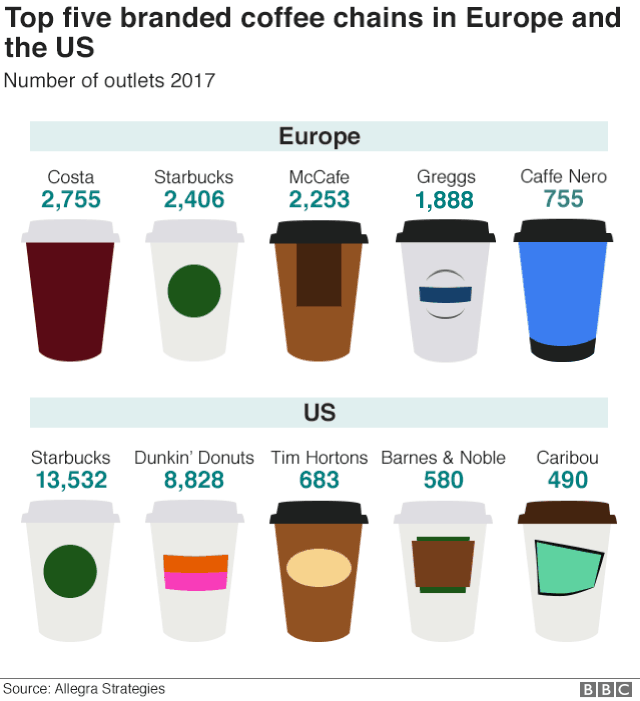

Describing the sale as a “win-win” for everyone, she said the price paid by Coca-Cola was far higher than if Costa had been demerged into a stand-alone company on the stock market.
She said she thought the beverage giant would use Costa to create “ready to drink, cold brew coffees”.
“You could see Costa absolutely everywhere, in vending machines, hotels, restaurants, pubs, cafes – in all the places you see Coke today,” she added.
Coca-Cola chief executive James Quincey told investors on a conference call that Costa was “a winning company that can go global”.
He acknowledged that retail sales were a new area for Coca-Cola, but said Costa already had “a strong management team” and that Coca-Cola intended to “make it attractive for them to stay”.
.news-vj-spw-wrapper ]]>

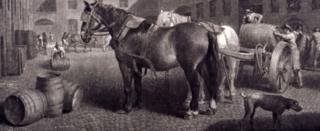 Image copyright Heritage Images
 From beer to beans to beds: Whitbread’s long history
1742 – Samuel Whitbread forms partnership with Godfrey and Thomas Shewell
1750 – Whitbread creates UK’s first mass-production brewery in London
1868 – Begins producing beer in bottles
1968 – Starts brewing Heineken under licence
1974 – Opens first Beefeater steakhouse
1990s – Buys David Lloyd Leisure, Marriott Hotels, TGI Fridays, Pizza Hut, Premier Lodge
1995 – Buys Costa Coffee from Sergio and Bruno Costa for £19m when it had 39 outlets
2000 – Sells brewing business to focus on Premier Inn and Costa
Whitbread also owns restaurants Beefeater and Brewers Fayre. Over the years, it has owned well-known brands such as TGI Fridays, Pizza Hut and Marriott Hotels.
The deal is subject to the agreement of Whitbread’s shareholders and various other approvals, including from anti-trust regulators.
It is expected to complete in the first half of next year.
Analysis: Dominic O’Connell, Today business presenter
For years, demerger was a dirty word at Whitbread. When asked, as they often were, about the logic of having a hotel chain and a coffee chain in the same company, executives would extol the benefits of having two leisure brands under one roof.
Shareholders were always less convinced, but were happy to go along with the idea while Whitbread grew its revenue, profits and share price at a steady clip over the last decade.
All that changed with the arrival of Alison Brittain as chief executive – and the appearance on the shareholder register of Elliott Management, an aggressive, deep-pocketed US hedge fund with a track record of shaking up big companies. It pushed hard for a demerger, and Ms Brittain, who judged that Costa and Premier had reached sufficient scale to stand on their own feet, opened the door.
The plan was that Costa would be spun off at some time in the next two years, but Coca-Cola pre-empted that with a knockout offer.
While this is a landmark deal for Whitbread, it is also a significant move for Coca-Cola, taking it into hot beverages for the first time and, it hopes, providing the growth for which its investors have been crying out.
Nicholas Hyett, equity analyst at Hargreaves Lansdown, described the deal as “a bitter-sweet moment for Whitbread investors”.
“On the one hand, £3.9bn is an undeniably rich valuation and likely far better than Costa could achieve as an independently listed company, valuing its earnings higher than those of the mighty Starbucks,” he said.
“On the other, Costa has long been the jewel in Whitbread’s crown and some will be sad to see it go at any price, especially given the growth potential in China and elsewhere.”
-
Premier League signs Coca-Cola as sponsor
 Image copyright Getty Images Image caption Coca-Cola is a sponsor of the World Cup
Drinks giant Coca-Cola has agreed its biggest UK sponsorship deal by becoming Premier League football’s seventh and final commercial partner.
It will become the official soft drink partner of the league, joining other sponsors Barclays, Carling, Cadbury, Nike, Tag Heuer and EA Sports.
The three-and-a-half-year agreement starts in January 2019. The financial details have not been revealed.
Coca-Cola also sponsors the football World Cup and the Olympic Games.
It also sponsored the EFL Championship for six years until 2010.
 Image copyright Coca-Cola Image caption Coca-Cola will use the deal to promote a number of its brands
 “They tailor different brands according to the different countries. The Premier League has a very similar reach in terms of popularity around the world, and Coca-Cola will be thinking they can do the same as Pepsi has done.
“Coca-Cola will have invested a significant outlay for this deal, and will want to use it to promote more than one brand.”
As well as digital initiatives, the drinks firm will also back a nationwide Premier League trophy tour.
Richard Masters, managing director of the Premier League, said: “We know from their previous campaigns in sport they are excellent at communicating to fans across the globe and they have some exciting ideas… that will see the league benefit from their huge reach in the UK and across the world.”
-
Kofi Annan’s funeral: World leaders bid farewell to ex-UN chief
 Image copyright AFP Image caption Funeral ceremonies in Ghana are usually elaborate affairs
World leaders and royalty have paid their respects to one of Africa’s most famous diplomats, Kofi Annan, at his funeral in his home country of Ghana.
It is the climax of three days of mourning which saw thousands of Ghanaians file past his coffin as it lay in state in the capital, Accra.
Annan died on 18 August in Switzerland at the age of 80.
He was UN secretary-general from 1997 to 2006, the first black African to hold the world’s top diplomatic post.
He was awarded the Nobel Peace Prize in 2001 for helping to revitalise the international body, during a period that coincided with the Iraq War and the HIV/Aids pandemic.
Africa Live: More updates on funeral The human side of a UN chief The lessons Annan learnt in boarding school
 Image copyright AFP Image caption Mr Annan’s body lay in state after it was brought from Switzerland
 Speaking at the funeral, current UN secretary-general Antonio Guterres said Annan was an exceptional leader who saw the UN as a force for good.
“As we face the headwinds of our troubled and turbulent times, let us always be inspired by the legacy of Kofi Annan,” Mr Guterres said.
“Our world needs it now more than ever,” he added.

‘Irresistible aura’
By Mayeni Jones, BBC News, Accra
 Media playback is unsupported on your device
Media captionBBC Africa looks back at the career of the former UN secretary-general Kofi Annan.
Mourners in traditional black and red attire filled the main hall of the Accra Conference Centre, which sits about 4,000 people. More are watching proceedings on a giant screen in an auditorium just outside the hall.
There have been hymns and a performance by soprano and human rights campaigner Barbara Hendricks.
Annan’s nephew Kojo Amoo-Gottfried read a eulogy, describing how he had led a hunger strike in his secondary school to protest against the quality of food in the dining hall.
There were also a moving tribute by his wife, Swedish lawyer and artist Nane Maria Annan. She described how her husband was always excited to return home, and thanked Ghana for giving the world such an extraordinary man.
She said her husband had an irresistible aura of radiant warmth.
“His legacy would live on through his foundation and through all of us,” she concluded.
 Image copyright EPA Image caption Drumming echoed through the funeral venue as Ghanaians celebrated Mr Annan’s life
 The former queen of the Netherlands, Princess Beatrix, and her daughter-in-law Princess Mabel, who were close friends of Annan, were among the mourners.
The king of Ghana’s Asante people, Otumfuo Nana Osei Tutu II, awarded Annan the title Busumuru in 2012 to honour his role as an international diplomat.
Busumuru is one of the swords attached to the monarch’s Golden Stool, or throne.
 Image copyright Ayo Bello/BBC Image caption Ghana’s traditional rulers came with magnificent ceremonial umbrellas to pay their respects
 The Anglican bishop of Annan’s home city of Kumasi in central Ghana, the Most Reverend Daniel Sarfo, said: “Today history is being made in Ghana. One of our illustrious sons is lying here.
“But we are grateful that God used him over the years to work for humanity, for peace. Today, as he lies here, he has finished his work.”
 Image copyright AFP Image caption Ghanaians were extremely proud of Mr Annan’s achievements
 All pictures subject to copyright
-
Skripal suspects interview: Key excerpts
 Image copyright Reuters Image caption Alexander Petrov and Ruslan Boshirov said they were tourists visiting Salisbury
The two men named as suspects in the poisoning of a Russian ex-spy in the UK – Alexander Petrov and Ruslan Boshirov – have been speaking to RT, Russia’s state-run international broadcaster. They claim they were merely tourists visiting the English town of Salisbury at the time the poisoning happened. Here are key excerpts of their interview.
“Well, we came there [to the UK] on 2 March, then went to a railway station to see the timetable. We arrived in Salisbury on 3 March and tried to walk through the town, but we lasted for only half an hour because it was covered in snow,” Mr Petrov said.
“Of course, we went there to see Stonehenge, Old Sarum, but we couldn’t do it because there was muddy slush everywhere. The town was covered by this slush. We got wet, took the nearest train and came back [to London].”
“We spent no more than an hour in Salisbury, mainly because of the lags between trains,” Mr Boshirov said. “Maybe we did [approach] Skripal’s house, but we don’t know where is it located.”
When the interviewer asked them whether they had Novichok or any poison with them, they emphatically said no.
What happened to the Skripals? The new Russian disinformation game Russian spy poisoning: What we know so far What is the GRU?
Then she asked whether they had the Nina Ricci perfume bottle that had been shown as evidence.
“Is it silly for decent lads to have women’s perfume? The customs are checking everything, they would have questions as to why men have women’s perfume in their luggage. We didn’t have it,” Mr Boshirov said.
Both men sounded distressed as they spoke about how their lives had changed since they were named in the UK as Russian intelligence agents who attempted to poison the Skripals.
“When your life [is] turned upside down, you don’t know what to do and where to go. We’re afraid of going out, we fear for ourselves, our lives and the lives of our loved ones,” Mr Boshirov said.
Asked whether they had recently been to any European state, the two said they had.
“Sure… In Switzerland, we were a couple of times… We spent New Year in Switzerland.”
The journey was part of their holiday, they said, though they had also been in Europe to do business related to sports nutrition.
“We examine the market, look if there is something new – some biologically active additives, amino acids, vitamins, microelements. We pick up the most necessary, come here and decide how to deliver the new products from this market here.”
-
Bank of England leaves rates on hold amid Brexit uncertainty
 Image copyright Getty Images
The Bank of England has left interest rates on hold at 0.75% as expected but flagged “greater uncertainty” around the Brexit negotiations.
The Bank’s Monetary Policy Committee (MPC) voted 9-0 to leave rates unchanged.
A quarter of a percentage point rise last month took rates to the highest level since March 2009.
The European Central Bank also kept eurozone interest rates unchanged at 0% on Thursday.
The MPC said in the minutes of its September meeting there were mounting fears about the UK leaving with the EU without a deal agreed.
 Image copyright PA Image caption England basked in record temperatures this summer, which boosted consumer spending
 The minutes showed recent rises in economic and wages growth had not affected the MPC’s commitment to “gradual” and “limited” rate rises in the coming years, said Samuel Tombs at Pantheon Macroeconomics.
Ruth Gregory at Capital Economics said expected two rate rises next year and another two in 2020, bringing rates to 1.75%, assuming a Brexit deal was struck and the economy held up well.
“That would be above the market expectation for just two hikes over the next three years – but still consistent with the MPC’s guidance,” she said.
Ben Brettell at Hargreaves Lansdown said: “Policymakers are firmly in ‘wait-and-see’ mode having raised rates last month, and will be reluctant to even consider another move until they have a clear idea of what Brexit will look like.
“Realistically May next year looks the first available opportunity to raise rates to 1%.”
Last month the Bank signalled that rates would need to rise by about 0.25 percentage points over the next two or three years to bring inflation, which stands at 2.5%, back to target.
September’s MPC minutes also revealed that the recent energy price cap announced by Ofgem would reduce inflation by more than expected over the course of 2019.
-
John Lewis boss rejects Dominic Raab Brexit jibe
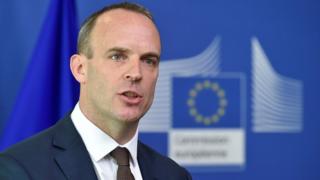 Image copyright Getty Images Image caption Dominic Raab says it is mistake for businesses that “aren’t doing so well” to blame Brexit
The boss of John Lewis has hit out at Brexit secretary Dominic Raab after he said companies should not blame Brexit for poor results.
Sir Charlie Mayfield said he “didn’t say Brexit was the reason” for a 99% slide in half-year profits.
“The fact is sterling is weaker, it’s more expensive to import goods… so we have to absorb that within our margin,” he said.
“I’m not going to get into some sort of ding-dong with the secretary of state.”
Dominic Raab told the BBC on Thursday it was a mistake for “business that aren’t doing so well to blame Brexit”.
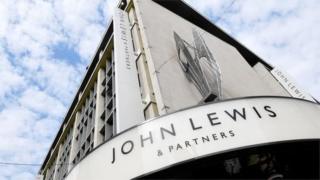 Image copyright Reuters
 Mr Raab also said the government was preparing for a no-deal Brexit despite being confident that eventuality would not come to pass: “Getting a deal with the European Union is still by far and away the most likely outcome.”
This week Ralf Speth, the boss of Jaguar Land Rover, warned the government needed to get “the right Brexit” or risk wiping out profits at the UK’s biggest carmaker and trigger big job cuts.
Meanwhile, the Brexit secretary welcomed a promise by two mobile operators, Vodafone and Three, not to impose Europe roaming charges for UK customers if Britain leaves the bloc with no deal.
“What we have said is we would like to see other companies following suit, but, in any event, we would legislate for a limit on roaming charges to make sure in a no-deal scenario that we protect British consumers,” Mr Raab said.
A new raft of technical papers is being released by the government on Thursday outlining the impact of a no-deal Brexit on business and consumers.
Mr Raab also accused those warning about shortages of food and medicines after a no-deal withdrawal of “scaremongering”, saying it was “nonsense” to claim UK supermarkets would run out of food.
-
Hurricane Florence: Your guide to the story
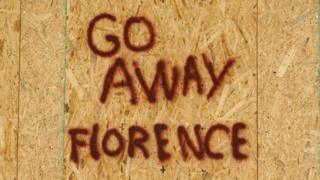 Image copyright Reuters
You may have heard about Hurricane Florence, the storm careering towards the US east coast prompting warnings of an impending disaster.
But what makes Florence so different from other storms this year? From Beryl, Chris, and Debby?
We’ve pulled together some of the key elements that explain why officials are so worried, and what damage Florence could cause.
One video to watch
The storm’s winds may have weakened in recent days – they are now at 110mph (175km/h) – but there are fears Florence’s slow-moving nature could bring different problems.
Forecasters say it could slow dramatically when it nears land and then linger until Saturday, moving unpredictably along the coast and bringing torrential rain.
 Image copyright Reuters Image caption Hurricane Florence seen off the US east coast in the Atlantic Ocean
 This satellite image of Florence hurtling towards the east coast on Wednesday gives a sense of its massive scale.
A National Weather Service forecaster has said it will be the “storm of a lifetime” for parts of the Carolina coast. One emergency official said it will be a “Mike Tyson punch” to the area.
There will be hurricane-force winds up to 80 miles from the centre of the storm, meteorologists say.
Some forecasters have predicted it could be the most powerful storm ever to hit the region.
One big number
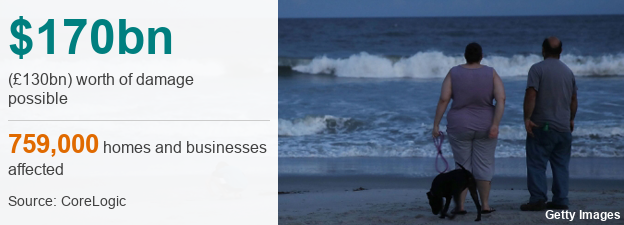
Florence could do more than $170bn (£130bn) of damage and affect nearly 759,000 homes and businesses, says analytics firm CoreLogic.
Energy companies have also warned that the storm could knock out power for the foreseeable future in some areas.
“This is no ordinary storm, and people could be without power for a very long time – not days but weeks,” a president of one energy company in North Carolina said on Wednesday.
One bit of context
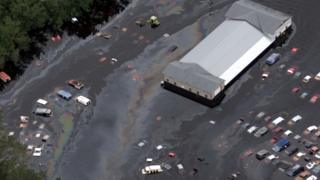 Image copyright Getty Images Image caption Hurricane Floyd hit North Carolina in 1999 and left floodwaters that were heavily polluted by agricultural waste
 If the storm lingers for a few days, the sheer amount of rainfall could lead to catastrophic flooding.
But the biggest danger could be life-threatening storm surges. These could be as high as 13ft (4m) along parts of the North Carolina coast.
All of this has led to fears that the state could face an environmental disaster if industrial waste – including hog manure and coal ash – is washed into people’s homes.
North Carolina has had this problem before. In 1999, Hurricane Floyd barrelled into the region and flooded vast areas with toxic water.
Dead hogs and chickens were pictured floating in the floodwaters, which had been polluted with agricultural waste and petrol.
One quote that tells a story
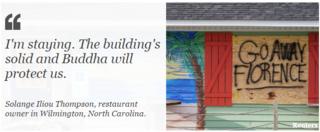
Many people in coastal communities have followed the mandatory evacuation orders, but some are vowing to stay put and ride it out.
Solange Iliou Thompson, a restaurant owner in the town of Wilmington, North Carolina, made her stance clear.
“I’m staying. The building’s solid and Buddha will protect us,” she told AFP news agency. “What can you do? You can’t stop Mother Nature.”
A delicatessen owner in the same town told Reuters that he was also going to stay.
“I’m not approaching Florence from fear or panic,” he said. “It’s going to happen. We just need to figure out how to make it through.”
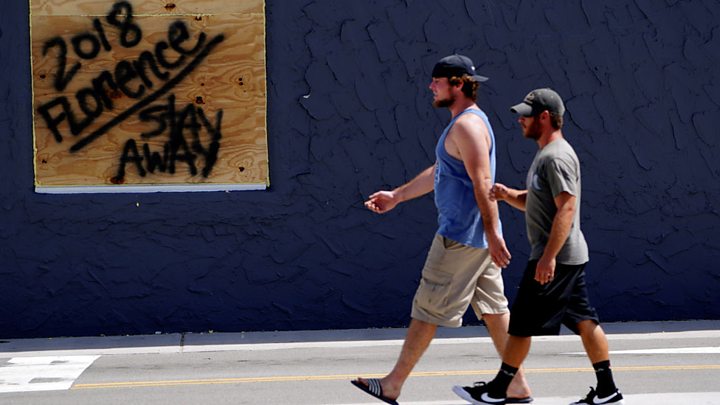 Media playback is unsupported on your device
Media captionWhy do people ignore hurricane warnings?
-
Chemnitz protests: Hitler salute wolves displayed
 Image copyright Getty Images Image caption Some of the statues were previously displayed in Dresden and other German cities
In a country where Nazi symbols are illegal, the sight of snarling wolves performing a Hitler salute is unusual.
But 10 bronze figures have now gone on display in the eastern German city of Chemnitz to protest against what organisers see as “growing hatred”.
Tensions have risen in the city in recent weeks after a German man was allegedly killed by two migrants.
Far-right protesters reportedly used the Hitler salute and chased migrants and journalists.
Germany’s far right march en masse
The organisers of the sculpture The Wolves are Back explain that the installation is based on the fact that both the Nazis and current-day right-wing radicals often describe themselves as “wolves”.
The wolves were created by artist Rainer Opolka and will be in front of Chemnitz’s iconic Karl Marx statue until Thursday evening, together with signs accusing right-wing groups of “exploiting our fears” and describing right-wing radicalism as “the mother of all problems”.
Some of the figures are ready to attack, while others are blindfolded.
The wolf statues were previously displayed outside a court in Munich during the sentencing of Beate Zschäpe, a member of a neo-Nazi gang who was found guilty of 10 racially-motivated murders in July, as well as in Berlin and Dresden.
It is not the first anti-racism event in Chemnitz. More than 60,000 attended a free concert in the city last week to protest against the far-right.