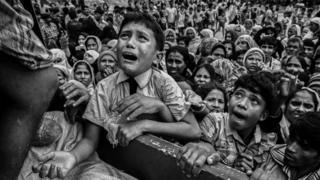
Blog

  • Roaming charges: What will happen after Brexit?

    Woman using smartphone in front of aeroplane Image copyright Getty Images

    In June 2017 the European Union scrapped additional charges for roaming on smartphones when you travel to another EU country.

    Roaming is when you use your mobile phone abroad. Since last year, UK consumers have, within reason, been able to use the minutes, texts and data included on their mobile phone tariffs when travelling in the EU.

    There are fair use limits, which mean you can use your mobile phone while travelling in another EU country, but you couldn’t get a mobile phone contract from Greece and then use it all year round in the UK.

    Before the rules changed, using a mobile phone in Europe was expensive, with stories of people returning from trips to find bills for hundreds or even thousands of pounds waiting for them.

    Will these charges return after Brexit?

    Image copyright Getty Images

    In March 2018, Prime Minister Theresa May announced: “The UK will not be part of the EU’s Digital Single Market, which will continue to develop after our withdrawal from the EU.”

    That means that the European regulation that prohibits roaming charges will not automatically be part of UK law, so UK mobile network operators, if they want to, might be able to reintroduce the charges.

    EU mobile phone roaming cost-cuts ‘a step closer’ Mobile phone roaming charge abolition plan rewritten Mobile phone roaming charges cut within EU

    A spokesperson for the Department for Digital, Culture, Media and Sport, which is responsible for this area, told Reality Check that the White Paper on leaving the EU had proposed “new arrangements for services and digital sectors, recognising that the UK and the EU will not have current levels of access to each other’s markets”.

    They continued: “That approach would not preclude discussions with the EU on arrangements for consumers, for example in the area of mobile roaming, if that would be in the mutual interests of both sides.”

    In other words, it would depend on a future UK-EU deal, which is yet to be negotiated.

    It is also possible that the UK government could create its own laws regulating roaming fees after Brexit, but it would be hard to impose that on UK network operators without a reciprocal agreement with their counterparts in the EU.

    Operators’ plans

    Of course, just because the operators might be allowed to reintroduce roaming charges, it does not necessarily mean that they will do so.

    Three has “committed to maintain the availability of roaming in the EU at no additional cost following Brexit”.

    Vodafone said it was too soon to assess the implications of Brexit on roaming regulation, but added it expected competition to continue to drive good value for customers and that it currently had no plans to change its roaming charges.

    EE also said it had no plans to introduce charging and called on the government “to put consumers at the top of their agenda in the Brexit negotiations to help ensure that UK operators can continue to offer low prices to our customers”.

    And O2 said: “We currently have no plans to change our roaming services across Europe. We’re engaged with the government with regards to what may happen once the UK officially leaves the EU.”

    What do you want BBC Reality Check to investigate? Get in touch

    Read more from Reality Check

    Follow us on Twitter

  • PM to discuss no-deal Brexit plans

    Theresa May leaves Downing st Image copyright PA

    The prime minister is to hold a special three-hour cabinet meeting to discuss preparations for a no-deal Brexit.

    The government is also due to publish guidance on issues such as mobile phone roaming charges, driving licences and passports in the event of the EU and the UK not reaching an agreement.

    The Brexit secretary has said the UK will not pay its financial settlement to the EU in a no-deal scenario.

    He said the government was “stepping up” its contingency planning.

    Theresa May’s proposals, set out after a Chequers summit in July, are fiercely opposed by some Tory MPs and the EU has also expressed reservations.

    Image copyright Getty Images Image caption Roaming charges in EU countries were scrapped in 2017

    Extra charges for people using their phones in another EU country were scrapped in June 2017. But the EU regulation banning them will not automatically be part of UK law after Brexit.

    Mrs May has said the UK will no longer be part of the EU’s “digital single market” after Brexit.

    In theory this means UK mobile operators, if they want to, could reintroduce the charges that could make it expensive to use a mobile phone in another EU country.

    However, last month major operators told the BBC they had no plans to raise charges.

    ‘Nonsense’ and ‘scaremongering’

    Mr Raab said the no-deal plans were “not something we want to have to implement”.

    “No one should pretend that no deal would be straightforward,” he said.

    “There would be risks and some short-term disruption. Extra checks at the EU border would bring delays for businesses.”

    And trading with the EU on World Trade Organization terms – an outcome backed by a group of Brexiteers in a report this week – would be “inferior” to the current arrangements, he said.

    But Mr Raab also criticised those he said were “scaremongering for political ends” about no deal being reached.

    “It’s nonsense to claim that UK supermarkets would run out of food,” he said, adding that people should not be scared by the government’s request to pharmaceutical companies to stockpile extra medicine supplies.

    More no-deal publications are expected in the coming weeks.

  • Gordon Brown in dire warning about the next financial crisis

    Media playback is unsupported on your device

    Media captionGordon Brown says we are sleepwalking into another financial crisis

    The world is not ready to deal with another financial crisis, former Prime Minister Gordon Brown has told the BBC.

    A breakdown in international co-operation means nations would be unable to act in a concerted way to tackle future threats – which are many.

    “I feel we’re sleepwalking into the next crisis”, said Mr Brown, speaking on the 10th anniversary of the start of the previous crisis.

    He added that some of the bankers involved should have gone to jail.

    Mr Brown, speaking from his living room, said: “This is a leaderless world and I think when the next crisis comes, and there will be a future crisis, we’ll find that we neither have the fiscal or monetary room for manoeuvre or the willingness to take that action.

    “But perhaps most worrying of all, we will not have the international co-operation necessary to get us out of a worldwide crisis.”

    In the immediate aftermath of the collapse of Wall Street banking giant Lehman Brothers, the UK government was one of the first to press the case for using public money to recapitalise failing banks and did exactly that – pumping taxpayer funds into Lloyds, HBOS and RBS.

    Mr Brown, UK prime minister as the crisis unfolded, said that it was possible to counteract the evaporation of trust in the markets by co-ordinated action between governments and regulators that trusted eachother.

    “But now with the trade wars, the disagreements over climate change, the nuclear deals that have fallen apart there is no spirit of co-operation – there is division and protectionism and I fear a new crisis would see nations trying to shift the blame to each other.”

    Bob Diamond defends risk-taking banks Hammond: Financial crisis ‘shock’ continues Carney warns against complacency

    He acknowledged that the use of public money to bail out high earning bankers was a difficult pill for the public to swallow and although he insists it was necessary, he says that he is frustrated that harsher penalties weren’t dished out to some of the bankers involved.

    “I’ll be honest with you. Some of these bankers should have gone to jail and until we have proper laws that can find the guilty and show there are clear penalties, then people will think the bankers have got away with it and will go back to doing the same thing again.”

    What blame does he bear himself? Former governor of the Bank of England, Mervyn (Lord) King has been critical of the way his government designed the regulatory regime – moving bank supervision away from the central bank to the Financial Services Authority.

    Mr Brown acknowledges that it didn’t work perfectly, but argues that the system was designed to look at isolated outbreaks of bank distress – not a contagion which consumed the entire global financial system.

    No national warning system, he says, was equipped to see the full picture and no individual country could have tackled the meltdown.

    A global problem needs global co-operation. Without that – and with most of the tools available already used (rock bottom interest rates, trillions pumped into the system through quantitative easing) – Mr Brown paints a grim picture of our ability to face the next crisis.

    (more…)

  • Restaurant loses $190m in value after dead rat found in soup

    Rat found in hotpot Image copyright Weibo Image caption The dead rat was fished out a pot of boiling broth

    A popular Chinese restaurant chain has lost around $190m (£145m) in market value after a pregnant woman found a dead rat in her soup.

    Hotpot restaurant Xiabu Xiabu’s stock hit its lowest level in almost a year, after photos of the dead rat being fished out of the broth with a pair of chopsticks quickly spread online.

    The outlet in Shandong province has now been temporarily suspended.

    The outlet reportedly offered her 5,000 yuan (£559, $729) as compensation.

    According to local news outlet Kankan News who spoke to her husband – identified as Mr Ma – he declined the offer, as he wanted his wife to undergo a full body check-up before deciding on a compensation amount.

    Image copyright Weibo Image caption The dead rat was lifted out and put on a plate

    “I feel like vomiting. I’m never going to eat hotpot outside again,” said one user.

    On 11 September, the company’s share price hit its lowest level since October last year. As of Wednesday, the hotpot restaurant’s market value is slowly recovering.

    “Xiabu Xiabu has always been one of my favourite restaurants, I thought they were quite clean as well… I can’t believe this,” another commented.

    “If something happens to her baby how are they going to compensate her? Is a life worth only 20,000 yuan?” one asked.

    Image copyright Getty Images Image caption Customers enjoying hotpot at Haidilao, one of Xiabu Xiabu’s rival competitors

    The restaurant initially put out a statement on Saturday saying that it had “ruled out” the possibility that a lack of hygiene had caused the rat to end up in the hotpot, but later deleted it.

    Authorities in Weifang city, the restaurant branch where the rat was found, said they would conduct investigations into Xiabu Xiabu’s restaurant.

    Hotpot is a common meal in China and across other parts of Asia.

    A simmering pot of hot soup is placed at a dining table and various vegetables and raw meats are then placed in the pot to cook.

  • BBC Trending

    A Rohingya refugee cries as he climbs on a truck distributing aid for a local NGO near the Balukali refugee camp Image copyright Getty Images Image caption More than 700,000 Rohingya Muslims have fled Myanmar

    Decades of ethnic and religious tensions, a sudden explosion of internet access, and a company that had trouble identifying and removing the most hateful posts.

    It all added up to a perfect storm in Myanmar, where the United Nations says Facebook had a “determining role” in whipping up anger against the Rohingya minority.

    “I’m afraid that Facebook has now turned into a beast, and not what it originally intended,” Yanghee Lee, UN special rapporteur on human rights in Myanmar, said in March.

    The company admits failures and has moved to address the problems. But how did Facebook’s dream of a more open and connected world go wrong in one south-east Asian country?

    Enter Facebook

    “Nowadays, everyone can use the internet,” says Thet Swei Win, director of Synergy, an organisation that works to promote social harmony between ethnic groups in Myanmar.

    That wasn’t the case in Myanmar five years ago.

    Outside influence had been kept to a minimum during the decades when the military dominated the country. But with the release of Aung San Suu Kyi, and her election as Myanmar’s de facto leader, the government began to liberalise business – including, crucially, the telecoms sector.

    The country where Facebook posts whipped up hate

    You may also be interested in:

    Is refugee crisis ‘textbook ethnic cleansing’? Genocide hate speech ‘persists on Facebook’ Blow by blow: How a ‘genocide’ was investigated

    The effect was dramatic, according to Elizabeth Mearns of BBC Media Action, the BBC’s international development charity.

    “A SIM card was about $200 [before the changes],” she says. “In 2013, they opened up access to other telecom companies and the SIM cards dropped to $2. Suddenly it became incredibly accessible.”
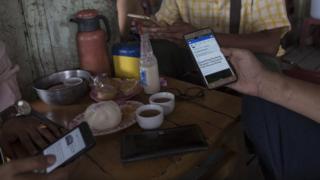
    Image copyright Getty Images Image caption For many in Myanmar, Facebook is synonymous with the internet

    And after they bought an inexpensive phone and a cheap SIM card, there was one app that everybody in Myanmar wanted: Facebook. The reason? Google and some of the other big online portals didn’t support Burmese text, but Facebook did.

    “People were immediately buying internet accessible smart phones and they wouldn’t leave the shop unless the Facebook app had been downloaded onto their phones,” Mearns says.

    Thet Swei Win believes that because the bulk of the population had little prior internet experience, they were especially vulnerable to propaganda and misinformation.

    “We have no internet literacy,” he told Trending. “We have no proper education on how to use the internet, how to filter the news, how to use the internet effectively. We did not have that kind of knowledge.”

    Ethnic tensions

    Out of a population of about 50 million, around 18 million in Myanmar are regular Facebook users.

    But Facebook and the telecoms companies which gave millions their first access to the internet do not appear to have been ready to grapple with the ethnic and religious tensions inside the country.

    The enmity goes deep. Rohingyas are denied Burmese citizenship. Many in the Buddhist ruling class do not even consider them a distinct ethnic group – instead they refer to them as “Bengalis”, a term that deliberately emphasises their separateness from the rest of the country.

    Last year’s military operation in the north-west Rakhine state was designed, the government says, to root out militants. It resulted in more than 700,000 people fleeing for neighbouring Bangladesh – something that the United Nations calls the world’s fastest growing refugee crisis.

    A UN report has said top military figures in Myanmar must be investigated for genocide in Rakhine state and crimes against humanity in other areas. But the government of Myanmar has rejected those allegations.

    Facebook ‘weaponised’

    The combination of ethnic tensions and a booming social media market was toxic. Since the beginning of mass internet use in Myanmar, inflammatory posts against Rohingya have regularly appeared on Facebook,

    Thet Swei Win said he was horrified by the anti-Rohingya material he has seen being shared. “Facebook is being weaponised,” he told BBC Trending.

    Image copyright Reuters

    Listen to more on this story

    The BBC Trending podcast, from the BBC World Service

    In August, a Reuters investigation found more than 1,000 Burmese posts, comments and pornographic images attacking the Rohingya and other Muslims.

    “To be honest I thought we might find at best a couple of hundred examples I thought that would make the point,” says Reuters investigative reporter Steve Stecklow, who worked with Burmese-speaking colleagues on the story.

    Stecklow says some of the material was extremely violent and graphic.

    “It was sickening to read and I had to keep saying to people ‘Are you OK? Do you want to take a break?’”
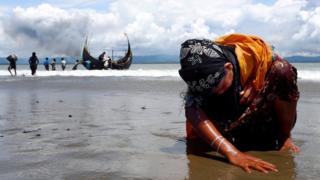
    Image copyright Reuters Image caption Some posts on Facebook expressed the hope that fleeing Rohingya refugees would drown at sea

    “When I sent it to Facebook, I put a warning on the email saying I just want you to know these are very disturbing things,” he says. “What was so remarkable was that [some of] this had been on Facebook for five years and it wasn’t until we notified them in August that it was removed.”

    Several of the posts catalogued by Stecklow and his team described Rohingyas as dogs or pigs.

    “This is a way of dehumanising a group,” Stecklow says. “Then when things like genocide happen, potentially there may not be a public uproar or outcry as people don’t even view these people as people.”

    Lack of staff

    The material that the Reuters team found clearly contravened Facebook’s community guidelines, the rules that dictate what is and is not allowed on the platform. All of the posts were removed after the investigation, although the BBC has since found similar material still live on the site.

    Has Aung San Suu Kyi turned her back on free press? Suu Kyi ‘should have resigned’ on Rohingya What will happen after UN’s ‘genocide’ report? ‘They problematic’: The view from Yangon

    So why did the social network fail to grasp how it was being used to spread propaganda?

    One reason, according to Mearns, Stecklow and others, was that the company had difficulty with interpreting certain words.

    For example, one particular racial slur – “kalar” – can be a highly derogatory term used against Muslims, or have a much more innocent meaning: “chickpea”.

    In 2017, Stecklow says, the company banned the term, but later revoked the ban because of the word’s dual meaning.

    There were also software problems which meant that many mobile phone users in Myanmar had difficulties reading Facebook’s instructions for how to report worrying material.

    But there was also a much more fundamental issue – the lack of Burmese-speaking content monitors. According to the Reuters report, the company had just one such employee in 2014, a number that had increased to four the following year.

    The company now has 60 and hopes to have around 100 Burmese speakers by the end of this year.

    Multiple warnings

    Following the explosion in Facebook use in Myanmar, the company did receive multiple warnings from individuals about how the platform was being used to spread anti-Rohingya hate speech.

    In 2013, Australian documentary maker Aela Callan raised concerns with a senior Facebook manager. The next year a doctoral student named Matt Schissler has a series of interactions with employees, which resulted in some content being removed.

    And in 2015, tech entrepreneur David Madden travelled to Facebook’s headquarters in California to give managers a presentation on how he had seen the platform used to stir up hate in Myanmar.

    “They were warned so many times,” Madden told Reuters. “It couldn’t have been presented to them more clearly, and they didn’t take the necessary steps.”

    Accounts removed

    A Facebook spokeswoman told Trending via email that the company was committed to hiring more content moderators but was also taking a number of other steps to tackle the problems in Myanmar.

    “In the last year, for example, we have established a team of product, policy and operations experts to roll out better reporting tools, a new policy to tackle misinformation that has the potential to contribute to offline harm, faster response times on reported content, and improved proactive detection of hate speech,” the spokeswoman said.

    Since last year, the company has taken some publicly visible action. In August, Facebook removed 18 accounts and 52 pages linked to Burmese officials. One account on Instagram, which Facebook owns, was also closed. The company said it “found evidence that many of these individuals and organizations committed or enabled serious human rights abuses in the country.”

    The spokeswoman said deleting the accounts was “not a decision we took lightly.”

    “Staying ahead of the bad means always looking for how people can misuse technology – and doing everything you can to prevent that misuse from happening in the first place. That’s our responsibility now and it’s something that weighs heavily on all of us.”
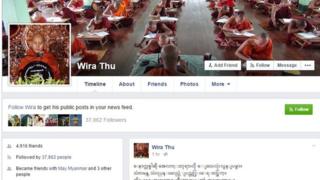
    Image copyright Facebook screengrab Image caption Radical Buddhist monk Wirathu’s Facebook page was removed earlier this year

    Between them, the accounts and pages were followed by almost 12 million people.

    In January this year, Facebook also removed the account of Ashin Wirathu, a radical monk famed for his angry speeches which stoking fears against Muslims.

    ‘Too slow’

    In a statement, Facebook has admitted that in Myanmar it was “too slow to prevent misinformation and hate”, and acknowledged that countries that are new to the internet and social media are susceptible to the spreading of hate.

    The subject of hate speech on the platform came up in early September, when Facebook’s chief operating officer, Sheryl Sandberg, testified in front of a US Senate committee.
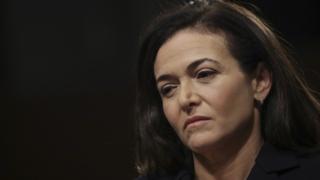
    Image copyright Drew Angerer Image caption Sheryl Sandberg says Facebook is committed to tackling hate speech

    “Hate is against our policies and we take strong measures to take it down. We also publish publicly what our hate-speech standards are,” she said. “We care tremendously about civil rights.”

    When Facebook chief executive Mark Zuckerberg appeared in front of Congress in April, he was asked specifically about events in Myanmar, and said that in addition to hiring more Burmese speakers, the company was also working with local groups to identify “specific hate figures” and creating a team that would help identify similar issues in Myanmar and other countries in the future.

    Elizabeth Mearns from BBC Media Action, believes that while it is Facebook’s role in Myanmar that is currently under scrutiny, the situation is just one example of a far wider issue.

    “We are definitely now in a situation where content on social media is directly affecting people’s real life. It’s affecting the way people vote. It’s affecting the way people behave towards each other, and it’s creating violence and conflict,” she says.

    “The international community understands now, I think, that it needs to step up and understand technology. And understand what’s happening on social media in their countries or in other countries.”

    An Egyptian man in Saudi Arabia has been arrested after a video of him having breakfast with a woman went viral on Twitter. READ NOW

    You can follow BBC Trending on Twitter @BBCtrending, and find us on Facebook. All our stories are at bbc.com/trending.

  • Myanmar: Jailed reporters’ wives speak out

    Video Jailed Myanmar reporters’ wives speak out

    (more…)

  • Myanmar’s jailed reporters and Suu Kyi’s silence

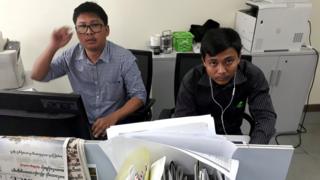
    Wa Lone (L) and Kyaw Soe Oo (R) Image copyright EPA Image caption The verdict against Wa Lone (L) and Kyaw Soe Oo (R) has been widely condemned
    The jailing of two Reuters reporters in Myanmar has left the journalism community asking whether their former rights champion has turned her back on a free press, writes the BBC’s Nick Beake in Yangon.

    For the journalists of Yangon this is personal.

    Many were close friends of Wa Lone and Kyaw Soe Oo. And many now feel one false move and they could be joining them in the notorious Insein prison here in Myanmar’s former capital.

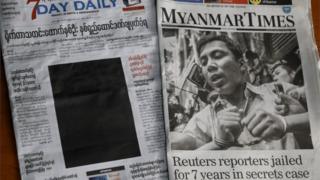
    “Insane” is how the jail is pronounced, and for many in the press, it reflects a chaotic legal farce which has played out over the past nine months – one that’s culminated in two young journalists being found to have been useful to “enemies of the state” and handed a seven year prison sentence.

    Reuters journalists jailed over secrets act

    Not that their wives regret their choice of careers. Not for one moment.

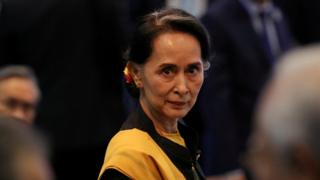
    Image copyright Reuters Image caption Aung San Suu Kyi has also been accused of ignoring violence against the Rohingya
    “I loved and respected her so much,” Pan Ei Mon said. “But she said our husbands were not reporters because they violated the nation’s secrets, and I am very devastated by that.”

    Reporters held ‘for investigating killings’ What next for Myanmar after damning report? Seeing through the official story in Myanmar

    Ms Suu Kyi used to champion the rights of journalists. She certainly benefited from their coverage of her long fight for democracy while she suffered years of house arrest.

    When it was time for my own question to the wives, I asked what their message to Ms Suu Kyi would be – as someone who the Burmese authorities had also kept apart from the man she loved (her late British husband Michael Aris).

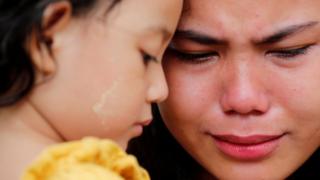
    Image copyright Reuters Image caption Chit Su Win fights back tears as she hugs her daughter, Moe Thin Wai Zan
    Chit Su Win told me she’d rather address her mother to mother.

    “My daughter asks me – doesn’t daddy love me anymore? Doesn’t daddy live with us anymore?”

    “As a mother, I feel devastated. I tell her daddy is working. I try to be strong for my daughter. I feel very depressed, but I steel myself, because if I am depressed, who will care for my daughter?”

    ‘All of you are at risk’

    As the mother of the nation, Ms Suu Kyi generated huge hope when her National League for Democracy (NLD) party triumphed in free elections in 2012, after five decades of brutal military rule.

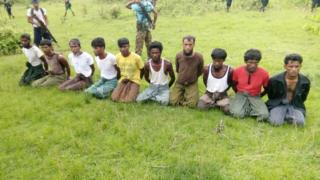
    Image copyright Reuters Image caption These are the men whose deaths the Reuters journalists were investigating
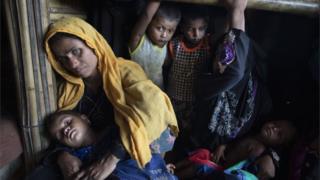
    One of the many painful ironies of this case is that the army later admitted its soldiers were culpable.

    The military’s wider crackdown on what it called Bengali “terrorists” last autumn – following attacks on security posts – forced three quarters of a million Rohingya into neighbouring Bangladesh. They remain there in the sprawling and depressing camps of Cox’s Bazaar.

    Who are the Rohingya? The story not being talked about in Myanmar Image copyright Getty Images Image caption More than 700,000 Rohingya have fled violence in Myanmar in the last year
    Last week in a blistering assessment, UN inspectors said the top generals should stand trial for genocide and accused Ms Suu Kyi of failing to use her “moral authority” to stop the violence.

    Myanmar rejects UN ‘genocide’ accusation Blow by blow: How a ‘genocide’ was investigated

    Now Ms Suu Kyi’s accused of failing to stand up for reporters, as well as the Rohingya.

    “All of you are at risk,” Khin Maung Zaw, the leading lawyer for the Reuters pair told the hushed room of journalists back at the press conference.

    He declared the verdict a black day for Myanmar and a major setback for a free press and the country’s transition to democracy.

    Image copyright EPA Image caption The 7Day Daily paper printed a black front page after the journalists verdict was announced
    Many wonder who will be next.

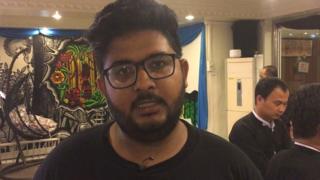
    Aung Naing Soe is one Burmese journalist who knows what it’s like to feel the heat of the regime in the new Suu Kyi era. Earlier this year he served a two month sentence for operating a drone near the parliament in the capital, Naypyidaw.

    Image caption Aung Naing Soe says the jailing of the Reuters journalist was “personal”
    “It’s really heartbreaking for us to come and cover this kind of event” he tells me.

    “I do not want to see tears from the wives of these journalists anymore. We have covered a lot of heartbreaking things but this is more personal. They are my colleagues, my friends.”

    Suu Kyi ‘should have resigned’ on Rohingya

    He’s worried that the public has been poisoned against journalists by online campaigns which characterise them as “betrayers of the state” and that there will be no popular backlash against any further attacks on the freedom of the press.

    In some countries, Wa Lone and Kyaw Soe Oo would have been given a prize for their investigative journalism. Not here. Not in Suu Kyi’s Myanmar.

    Image copyright Reuters Image caption Wa Lone (L) and Kyaw Soe Oo have continually maintained their innocence
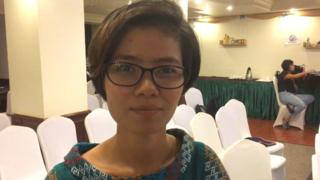
    As state counsellor, a role she created for herself because the 2008 Constitution denies her the presidency, Ms Suu Kyi runs Myanmar’s NLD civilian government.

    She has the power to issue a pardon and set these journalists free. If she’s even considering that, she certainly hasn’t shown it.

    Su Myat Mon is a reporter who focuses on women’s rights and social affairs.

    Image caption Su Myat Mon says being a journalist in today’s Myanmar does frighten her
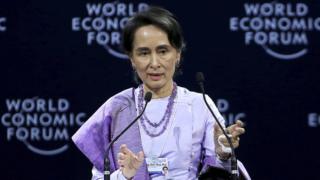
    “I was extremely disappointed with the verdict and with the NLD too. They’re a democratic government. They used to believe the media was for something, that it did something positive for democracy.”

    Is she scared to be a journalist in Myanmar now?

    “It does make me frightened,” she replies.

    “I can be arrested at any time if the government doesn’t like my reports. This verdict affects me: my emotions and the work I do.”

    Would she consider giving up the job, I venture? Su Myat Mon looks at me straight in the eye:.

    “I love this job. I may fear being arrested, but I still have my spirit. And, don’t forget, there’s nothing wrong with being a journalist. It is not a crime.”

    (more…)

  • Aung San Suu Kyi defends verdict against Reuters journalists

    Aung San Suu Kyi giving a speech Image copyright EPA

    Myanmar’s Aung San Suu Kyi has defended the jailing of two Reuters journalists, despite international condemnation.

    She said Wa Lone and Kyaw Soe Oo had broken the law and their conviction had “nothing to do with freedom of expression at all”.

    The two were sentenced for possession of police documents while investigating the killing of Rohingya Muslims.

    Ms Suu Kyi also said the army crackdown against the Rohingya could in hindsight have been handled differently.

    The Nobel Peace Prize laureate – who is not Myanmar’s elected president but is almost universally viewed as such – had been under intense pressure to comment on both the Rohingya crisis and more recently the journalists.

    Image copyright EPA Image caption The verdict against Wa Lone (L) and Kyaw Soe Oo (R) has been widely condemned

    The Rohingya have faced decades of discrimination in Myanmar, which considers them to be illegal and problematic migrants from Bangladesh.

    The latest crisis erupted when a brutal military crackdown was launched in response to a Rohingya militant group attacking several police posts.

    Since last year, at least 700,000 Rohingya have fled violence Myanmar, also known as Burma.

    In August, a UN report said top military figures in Myanmar must be investigated for genocide in Rakhine state and crimes against humanity in other areas.

    The report describes the army’s response – including murder, torture, rape, sexual slavery, persecution and enslavement – as “grossly disproportionate to actual security threats”.

    (more…)