Blog

  • Desperation explodes to anger as Indonesia quake toll rises beyond 1,200

    Desperation exploded into anger four days after an earthquake and tsunami decimated parts of the central Indonesian island of Sulawesi, leaving hungry residents grabbing food from damaged stores on Tu

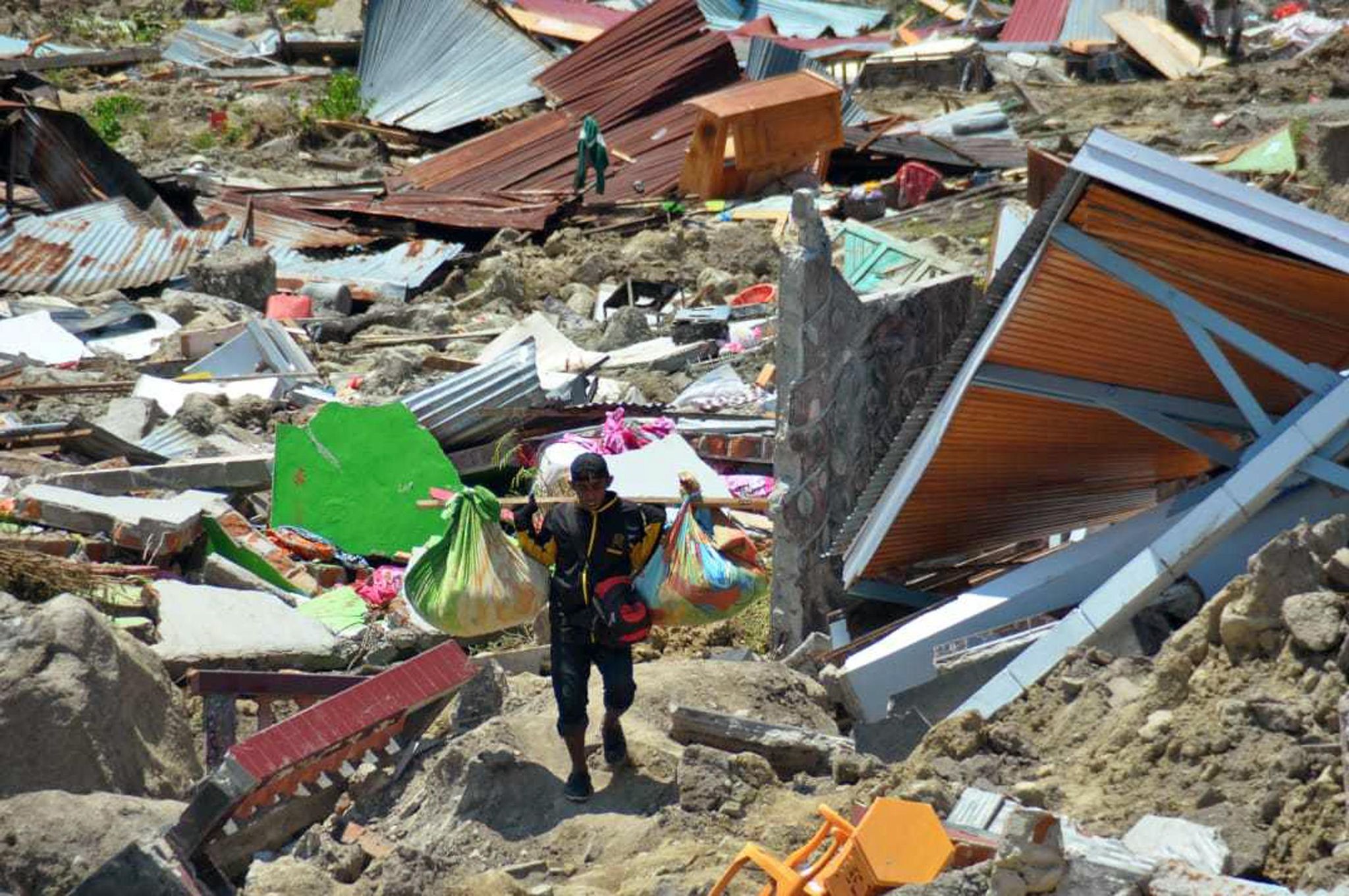
    PALU, Indonesia (AP) — Desperation exploded into anger four days after an earthquake and tsunami decimated parts of the central Indonesian island of Sulawesi, leaving hungry residents grabbing food from damaged stores on Tuesday and begging the president for help. The confirmed toll exceeded 1,200 dead with hundreds severely injured and still more trapped in debris.

    Most of the attention of rescuers so far has focused on the biggest affected city, Palu, which has 380,000 people and suffered considerable damage. Other hard-hit areas have been largely cut off due to impassable roads and downed power and phone lines after the magnitude 7.5 earthquake struck Friday and generated a tsunami said to have been as high as 6 meters (nearly 20 feet) in places.

    “We feel like we are stepchildren here because all the help is going to Palu,” said Mohamad Taufik, 38, from the area of Donggala, who said five of his relatives are still missing. “There are many young children here who are hungry and sick, but there is no milk or medicine.”

    The death toll for all affected areas reached 1,234, national disaster agency spokesman Sutopo Purwo Nugroho said in Jakarta. More people remain trapped in Sigi and Balaroa, meaning the toll is likely to rise.

    “With all the logistical aid coming in, the service to the refugees is better,” Nugroho said. “We still need more time to take care of all the problems.”

    He said 153 bodies were buried Monday in a mass grave and the operation continued Tuesday.

    A special aircraft carrying 12,000 liters (3,170 gallons) of fuel had arrived and trucks with food were on the way with police escorts to guard against looters. Nugroho said many gas stations were inoperable either because of quake damage or from people stealing fuel.

    In Donggala, the frustration of waiting for days without help boiled over for some.

    “Pay attention to Donggala, Mr. Jokowi. Pay attention to Donggala,” yelled one resident in a video broadcast on local television, referring to President Joko “Jokowi” Widodo and the lack of aid reaching his town. “There are still a lot of unattended villages here.”

    The town’s administrative head, Kasman Lassa, all but gave residents permission to take food – but nothing else – from shops.

    “Everyone is hungry and they want to eat after several days of not eating,” Lassa said on local TV. “We have anticipated it by providing food, rice, but it was not enough. There are many people here. So, on this issue, we cannot pressure them to hold much longer.”

    Desperation was visible in Palu as well. Signs propped along roads read “We Need Food” and “We Need Support,” while children begged for cash in the streets and long lines of cars snarled traffic as people waited for gas.

    Teams were searching for trapped survivors under destroyed homes and buildings, including a collapsed eight-story hotel in the city, but they needed more heavy equipment to clear the rubble. Nearly 62,000 people have been displaced from their homes, Nugroho said.

    Many people were believed trapped under shattered houses in Balaroa, where the earthquake caused the ground to heave up and down violently.

    “I and about 50 other people in Balaroa were able to save ourselves by riding on a mound of soil which was getting higher and higher,” resident Siti Hajat told MetroTV, adding her house was destroyed.

    In Palu’s Petobo neighborhood, the quake caused loose, wet soil to liquefy, creating a thick, heavy mud that resulted in massive damage. “In Petobo, it is estimated that there are still hundreds of victims buried in mud,” Nugroho said.

    Residents who found loved ones – alive and dead – over the weekend there also expressed disgust that it took rescue teams until Monday to reach the area.

    President Jokowi authorized the acceptance of international help, Nugroho said Monday, adding that generators, heavy equipment and tents were among the most-needed items. The European Union and about 10 countries have offered assistance, including the United States and China, he said.

    Australian Prime Minister Scott Morrison said Tuesday that his government has given $360,000 to help victims and is in talks with Indonesian authorities about a second round of aid. The initial funds are to go to the Indonesian Red Cross for the most obvious emergency aid needs, such as tarpaulins.

    Nugroho said only two of the 122 foreigners in the area remained unaccounted for – one from South Korea and the other from Belgium.

    The coastline at Palu was strewn with rubble and a few brightly colored cargo containers poking out of the water. Buildings near the water were ruined shells. The arches of a large yellow bridge rested in the water and eerie drone video showed a Ferris wheel, untouched, on a beach scraped bare by the waves.

    In Petobo, Edi Setiawan said he and his neighbors rescued children and adults, including a pregnant woman. His sister and father, however, did not survive.

    “My sister was found embracing her father,” he said. “My mother was able to survive after struggling against the mud and being rescued by villagers.”

    Indonesia is frequently struck by earthquakes, volcanic eruptions and tsunamis because of its location on the “Ring of Fire,” an arc of volcanoes and fault lines in the Pacific Basin. A powerful quake on the island of Lombok killed 505 people in August, and two moderate quakes near an eastern island on Tuesday reportedly damaged a bridge.

    The vast archipelago is home to 260 million people on more than 17,000 islands that stretch a distance similar to that between New York and London. Roads and infrastructure are poor in many areas, making access difficult in the best of conditions.

    ___

    Associated Press writers Margie Mason and Ali Kotarumalos in Jakarta, Indonesia, contributed to this report.

  • Mexico, Canada trade deal gives Trump China leverage

    President Trump’s ability to wangle a new deal from NAFTA partners Mexico and Canada will give the White House leverage to take a harder line in the escalating trade war with China, administration bac

    President Trump’s ability to wangle a new deal from NAFTA partners Mexico and Canada will give the White House leverage to take a harder line in the escalating trade war with China, administration backers said Monday.

    “Now the focus turns to China, where President Trump can resume his negotiations from a position of strength,” said Chris Garcia, a former Commerce Department deputy director.

    He said Monday that the United States-Mexico-Canada Agreement is a blow to Beijing because it will create more hurdles for Chinese-made auto parts to enter the U.S. market and undercut Beijing’s divide-and-conquer strategy.

    Trade analysts said a provision in the agreement dealing with currency manipulation gives Mr. Trump a template to attack Beijing for what critics say is a long pattern of driving down the yuan to benefit Chinese exporters.

    Although it’s unclear when the next round of U.S.-Chinese trade talks will occur — Beijing halted negotiations last week after Mr. Trump ordered tariffs on a fresh $200 billion in Chinese imports — Mr. Trump clearly signaled that he is ready to play hardball.

    “It’s a privilege for China to do business with us,” Mr. Trump told reporters at the White House while announcing the deal with Canada and Mexico.

    “China wants to talk very badly,” said Mr. Trump, crediting his willingness to use tariffs and other measures to rebalance the trading relationship between the globe’s two biggest economies. “Frankly, it’s too early to talk. Can’t talk now because they’re not ready, because they’ve been ripping us for so many years.”

    Some administration officials argued that the president now has momentum on his side as he ramps up talks with China and Japan on new trade deals.

    “The dominoes are falling, and it is good news for U.S. farmers,” Agriculture Secretary Sonny Perdue said in a statement.

    But some analysts predicted that, as tumultuous as the USMCA negotiations were over recent months, a breakthrough on trade with China is likely to be even more elusive.

    “Unfortunately, the China story is a lot more complicated,” said Luis Costa, a top strategy analyst with Citibank.

    Mr. Costa argued in an interview on CNBC that the Trump administration’s immediate goals for the trade talks with China are not entirely clear.

    “What does the U.S. really want to achieve in the short term so we can finalize and mute the noise? We don’t quite know,” he said. “So I think that the story will probably be with us for years, not months.”

    Chinese officials had no immediate response to the Canada deal, and stock markets in Hong Kong and on the mainland were closed Monday. Other Asian stock markets were mixed as traders struggled to understand the deal.

    Complex problem

    China poses a problem of far greater magnitude and complexity for U.S. trade negotiators. In addition to breaking down traditional trade and tariff barriers, Washington is demanding changes to China’s rules on such matters as technology-sharing and intellectual property rights.

    Although Mr. Trump likes to highlight China’s recent economic and financial woes, Chinese President Xi Jinping faces far fewer domestic pressures to cut a deal than do the democratically elected leaders of Canada and Mexico.

    The U.S. is China’s largest single export market, taking in just under a fifth of all Chinese exports. The U.S. is the third-largest importer into China, trailing South Korea and Japan.

    The planned U.S.-Mexico-Canada Agreement, assuming the three countries ratify it, takes off the table any hopes China may have had of enlisting Mexico City and Ottawa in a broad alliance against Mr. Trump’s trade agenda. The breakthrough over the weekend could strengthen Mr. Trump’s hand by aligning the U.S., Mexico and Canada as three-way trade partners, with China on the outside looking in.

    One area of the agreement that may have an immediate impact for China is the export of car and auto parts to the U.S. The agreement effectively caps imports from Canada and Mexico at 2.4 million vehicles and $90 billion worth of auto parts annually. Anything above that triggers a 25 percent tariff.

    The agreement also requires 75 percent of the value of vehicles sold in the U.S. to be produced within the NAFTA market and stipulates that 40 percent to 45 percent of a vehicle’s value be made in areas paying at least $16 an hour.

    A report Monday by Investors Business Daily maintained that “China is a prime target of the new auto part restrictions” that aim to “curb the use of components produced outside North America.”

    “This is a major victory for the U.S. in re-orienting the supply chain away from Southeast Asia and back to North America …,” Mr. Garcia said. “China was using Mexico to game the system.”

    Other parts of the accord also appear to have China clearly in mind. Alexandre Moreau, a public policy analyst at the Montreal Economic Institute, pointed to a provision in the agreement that may effectively block Canada and Mexico from cutting their own bilateral trade deals with China and other major trading powers.

    “That’s something that really worries me,” Mr. Moreau said in an interview on CNBC.

    Others expressed hope that the USMCA will result in such a boon for North America that such concerns are irrelevant.

    Mr. Garcia, the former U.S. Commerce Department official, argued in remarks circulated to reporters that the deal is “an effort to reorient the supply chain to North America.”

    “The de-industrialization of the United States ended last night,” he said. “This is a major victory for the U.S. in re-orienting the supply chain away from Southeast Asia and back to North America.”

  • Arthur Ashkin, Donna Strickland, Gerard Mourou win Nobel for work with lasers

    Three scientists from the United States, Canada and France won the Nobel Prize in Physics on Tuesday for work with lasers described as revolutionary and bringing science fiction into reality.

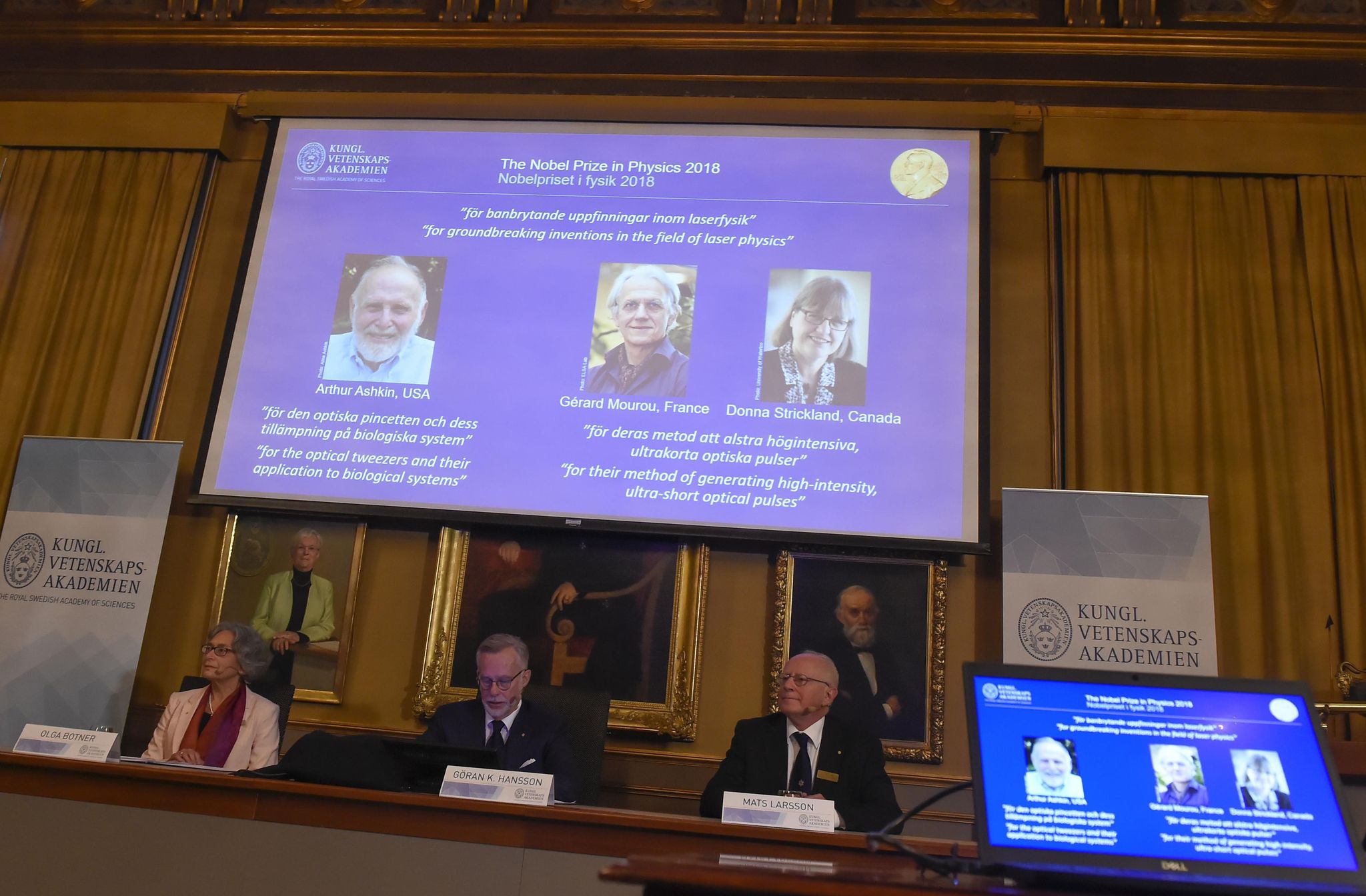
    STOCKHOLM (AP) — Three scientists from the United States, Canada and France won the Nobel Prize in Physics on Tuesday for work with lasers described as revolutionary and bringing science fiction into reality.

    One of them, Arthur Ashkin of Bell Laboratories in New Jersey, entered the Nobel record books by becoming the oldest laureate at age 96. Donna Strickland of the University of Waterloo in Canada is the first woman to have won a Nobel in three years and is only the third to have won for physics.

    Frenchman Gerard Mourou of the Ecole Polytechnique and University of Michigan shares have the prize’s 9-million-kronor ($1.01 million) with Strickland; Ashkin gets the other half.

    Sweden’s Royal Academy of Sciences, which chose the winners, said Ashkin’s development of “optical tweezers” that can grab tiny particles such as viruses without damaging them realized “an old dream of science fiction — using the radiation pressure of light to move physical objects.”

    The tweezers are “extremely important for measuring small forces on individual molecules, small objects, and this has been very interesting in biology, to understand how things like muscle tissue work, what are the molecule motors behind the muscle tissue,” said David Haviland of the academy’s Nobel committee.

    Strickland and Mourou helped develop short and intense laser pulses that have broad industrial and medical applications, including laser eye surgery. The academy said their 1985 article on the technique was “revolutionary.”

    Strickland’s award is the first to have gone to a woman in physics since 1963, when it was won by Maria Goeppert-Mayer; the only other one was Marie Curie in 1903.

    “Obviously we need to celebrate women physicists, because we’re out there. And hopefully in time it’ll start to move forward at a faster rate, maybe,” Strickland said in a phone call with the academy after the prize announcement.

    Michael Moloney, CEO of the American Institute of Physics, praised all the laureates and said “It is also a personal delight to see Dr. Strickland break the 55-year hiatus since a woman has been awarded a Nobel Prize in physics, making this year’s award all the more historic.”

    He credited the work of all three with “expanding what is possible at the extremes of time, space and forms of matter.”

    On Monday, American James Allison and Japan’s Tasuku Honjo won the Nobel medicine prize for groundbreaking work in fighting cancer with the body’s own immune system.

    The Nobel chemistry prize comes Wednesday, followed by the peace prize on Friday. The economics prize, which is not technically a Nobel, will be announced Oct. 8.

    ___

    Heintz reported from Moscow.

  • University of Manchester student union swaps clapping with more inclusive ‘jazz hands’

    The student union at Manchester University in England voted last week to ban clapping and whooping in favor of more inclusive “jazz hands” to pacify anxiety-prone students.

    The student union at Manchester University in England voted last week to ban clapping and whooping in favor of more inclusive “jazz hands” to pacify anxiety-prone students.

    The University of Manchester Students’ Union voted Thursday to use jazz hands, or the BSL (British Sign Language) sign for clapping, instead of traditional clapping and cheering at its sponsored events, the union’s newspaper, The Mancunion, reported.

    “This union notes that since 2015, the National Union of Students (NUS) has been using British sign language (BSL) clapping (or ‘jazz hands’), as loud noises, including whooping and traditional applause, can pose an issue for students with disabilities such as anxiety or sensory issues,” the motion read, The Guardian reported.

    The union resolved “to swap audible clapping out for BSL clapping at SU events in order to make them more accessible” and “to encourage student groups and societies to do the same, and to include BSL clapping as part of inclusion training.”

    The Mancunion said the motion, put forth by Liberation and Access Officer Sara Khan, received little opposition in the student senate.

    “I think a lot of the time, even in Parliamentary debates, I’ve seen that clapping, whooping, talking over each other, loud noises, encourages an atmosphere that is not as respectful as it could be,” Ms. Khan told the BBC.

  • Seoul: North Korea estimated to have 20-60 nuclear weapons

    A top South Korean official told lawmakers that North Korea is estimated to have up to 60 nuclear weapons, in Seoul’s first public comment about the size of the North’s secrecy-clouded weapons arsenal

    SEOUL, South Korea (AP) — A top South Korean official told lawmakers that North Korea is estimated to have up to 60 nuclear weapons, in Seoul’s first public comment about the size of the North’s secrecy-clouded weapons arsenal.

    Unification Minister Cho Myoung-gyon told parliament Monday the estimates on the size of North Korea’s nuclear arsenal range from 20 bombs to as many as 60. He was responding to a question by a lawmaker, saying the information came from the intelligence authorities. The National Intelligence Service, South Korea’s main spy agency, couldn’t immediately comment.

    Cho may have unintentionally revealed the information. His ministry said Tuesday Cho’s comments didn’t mean that South Korea would accept North Korea as a nuclear state, suggesting Seoul’s diplomatic efforts to rid the North of its nuclear program would continue.

    The South Korean assessment on the North’s arsenal is not much different from various outside civilian estimates largely based on the amount of nuclear materials that North is believed to have produced.

    According to South Korean government reports, North is believed to have produced 50 kilograms (110 pounds) of weaponized plutonium, enough for at least eight bombs. Stanford University scholars, including nuclear physicist Siegfried Hecker who visited North Korea’s centrifuge facility at Nyongbyon in 2010, wrote earlier this year that North Korea is estimated to have a highly enriched uranium inventory of 250 to 500 kilograms (550 to 1,100 pounds), sufficient for 25 to 30 nuclear devices.

    Many foreign experts say North Korea are likely running additional secret uranium-enrichment plants.

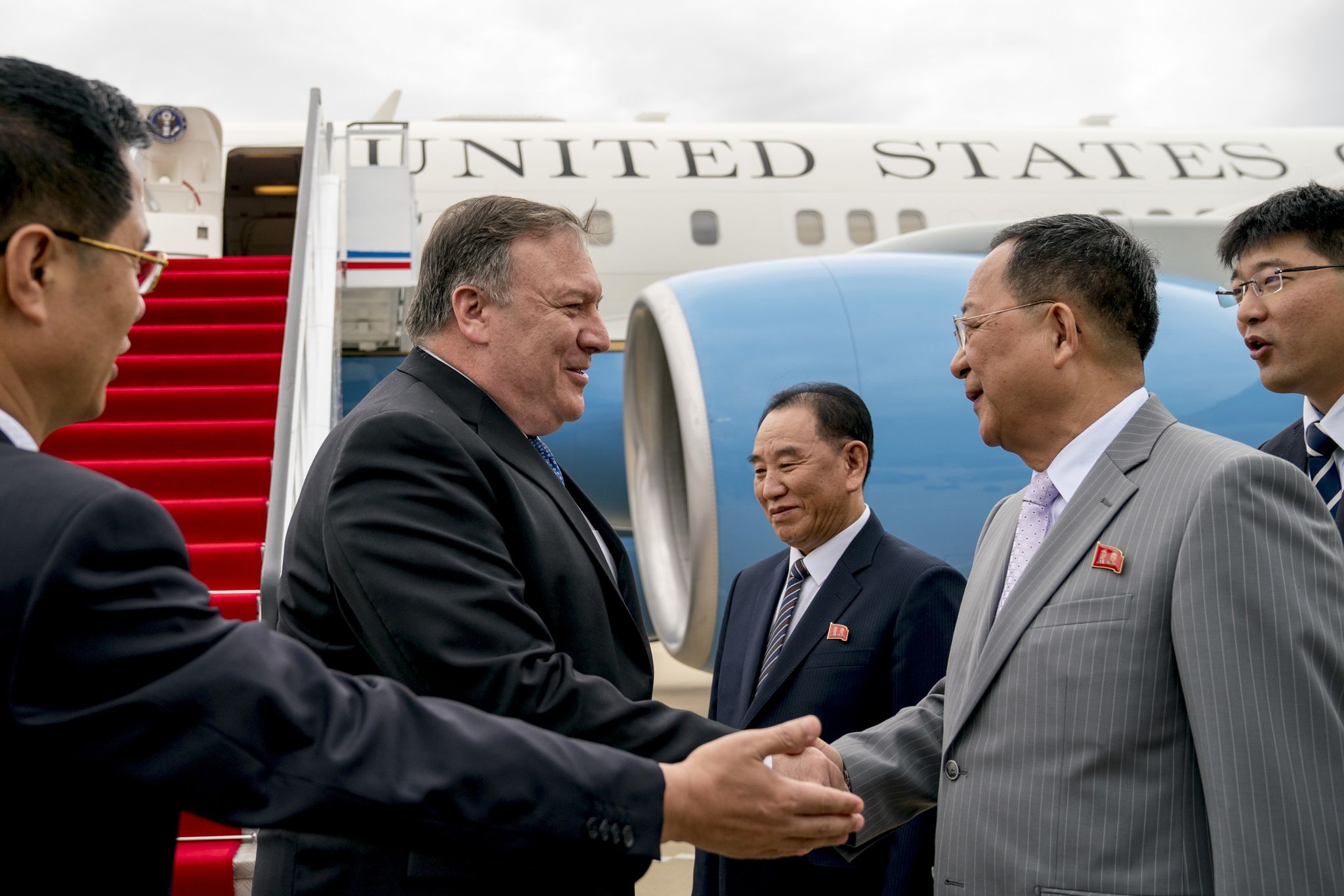
    The North entered talks with the United States and South Korea earlier this year, saying it’s willing to negotiate away its advancing nuclear arsenal. Nuclear diplomacy later stalled due to suspicions over how sincere North Korea is about its disarmament pledge, but U.S. Secretary of State Mike Pompeo is to visit Pyongyang this month to set up a second summit between President Donald Trump and North Korean leader Kim Jong Un.

  • Melania Trump opens Africa tour with a wave and baby in arms

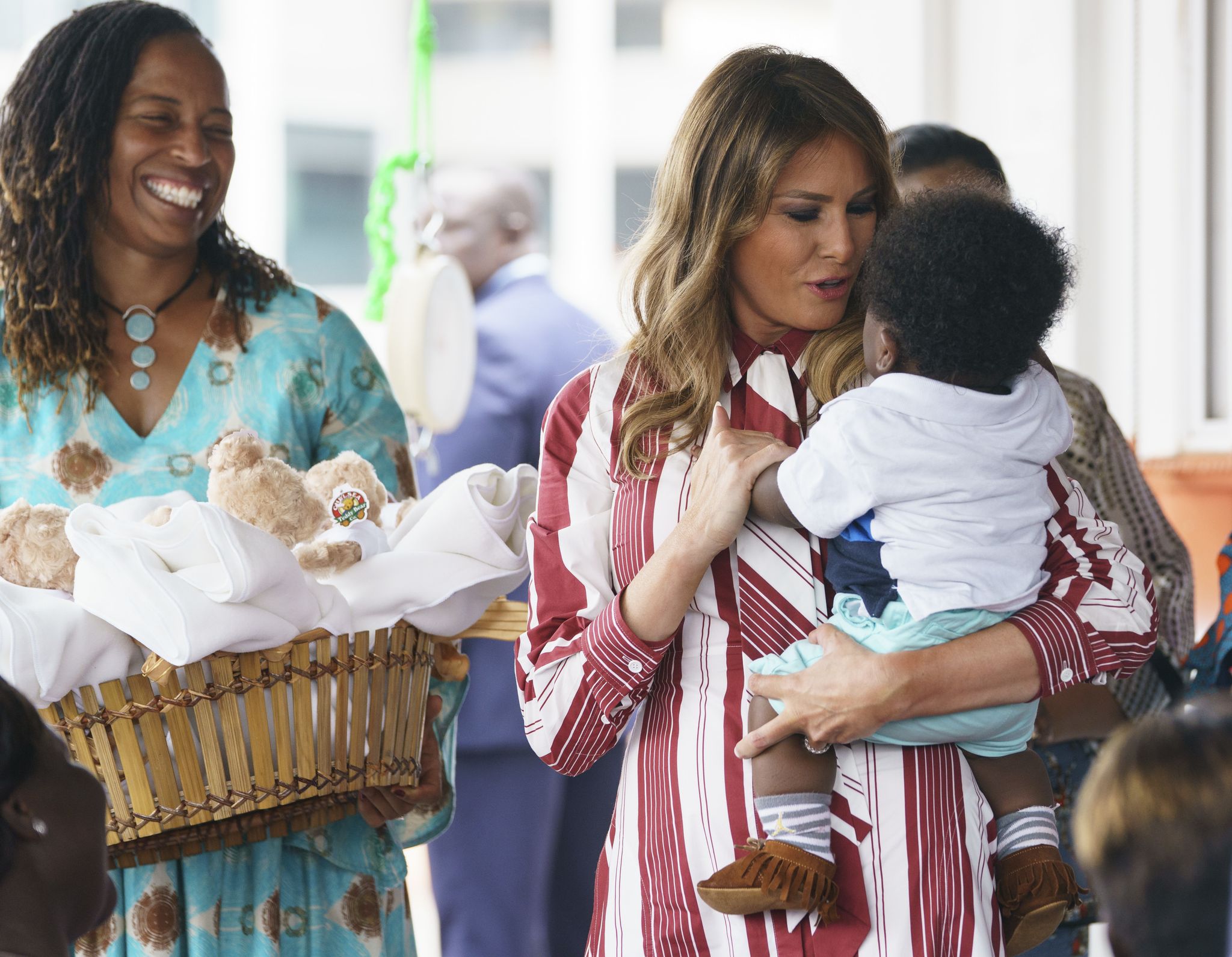
    Melania Trump opened her first big solo international trip as U.S. first lady on Tuesday with a wave, a smile and a baby in her arms, aiming to promote child welfare during a five-day tour of Africa.

    ACCRA, Ghana (AP) — Melania Trump opened her first big solo international trip as U.S. first lady on Tuesday with a wave, a smile and a baby in her arms, aiming to promote child welfare during a five-day tour of Africa.

    She arrived in the West African nation of Ghana after an overnight flight from Washington and quickly made her way to the Greater Accra Regional Hospital.

    The first lady saw how babies are weighed — they’re placed in sacks that are then hung from a hook attached to a scale. She also watched a nurse demonstrate how vitamins are administered to babies by mouth and toured the neonatal intensive care unit.

    Mrs. Trump also cradled an infant and declared the baby a “beautiful boy” as she handed him back to his mother.

    Mothers at the hospital for her visit received gifts of teddy bears nestled in white baby blankets, personally handed out by the first lady, according to her spokeswoman, Stephanie Grisham. The items carried the logo of “Be Best,” the child well-being initiative Mrs. Trump launched last May.

    With the Africa visit, the first lady aims to take “Be Best” and its focus on opioid abuse and online behavior to an international audience.

    The first lady also had a private tea and gift exchange with her Ghanaian counterpart, Rebecca Akufo-Addo. They exchanged gifts: a Chippendale silver tray embossed with an image of the White House inside a leather case signed by “First Lady Melania Trump” for Akufo-Addo, and Kente cloth and artifacts for Mrs. Trump, according to Grisham.

    The first ladies met privately for about a half-hour at Jubilee House, Ghana’s presidential palace. The two first met last week in New York at a reception on the sidelines of the U.N. General Assembly, where Mrs. Trump spoke about her upcoming trip.

    Mrs. Trump’s visit opened in low-key fashion. Several Ghanaians interviewed said they knew little about it.

    “Did you say President Trump’s wife just arrived in Accra?” street vendor Awo Yeboah told the AP. “l don’t think l have ever heard her name, Melania.” Other locals said they knew about the visit but didn’t know what Mrs. Trump was doing.

    Mrs. Trump landed in the capital of Accra on Tuesday morning after a more than 12-hour journey from Washington. She was welcomed at the airport with dancing and drumming, schoolchildren waving mini U.S. and Ghanaian flags and the gift of a flower bouquet.

    Akufo-Addo was at the airport to welcome her. Mrs. Trump also plans to visit Malawi, Kenya and Egypt.

  • U.S., NATO consider preemptive action against Russian cruise missile program

    The United States and its NATO allies are threatening preemptive action against Russia’s ongoing effort to build a new cruise missile, an effort Washington and its Western European partners say is in

    The United States and its NATO allies are threatening preemptive action against Russia’s ongoing effort to build a new cruise missile, an effort Washington and its Western European partners say is in violation of standing treaties between Moscow and the alliance.

    Alliance officials say the nuclear-powered cruise missile under development would allow Moscow to launch a ballistic weapon on targets inside Western Europe at a moment’s notice. Building and fielding such a weapon is in clear violation of several Cold War-era treaties agreed to by Russia and the West, officials contend

    Russian diplomats and top military brass have repeatedly refuted such claims. But U.S. Ambassador to NATO Kay Bailey Hutchinson said Tuesday that if Moscow continues down the path toward the new cruise missile, alliance members will have no other option than to respond with military force.

    “At that point, we would be looking at the capability to take out a [Russian] missile that could hit any of our countries,” she said during a press conference at NATO headquarters in Brussels.

    “Counter measures (by the United States) would be to take out the missiles that are in development by Russia in violation of the treaty,” she said, adding Russian officials “are on notice”

    The new, nuclear-powered cruise missile was one of several advanced weapons Russian President Vladimir Putin unveiled during a March press conference, designed to showcase the former Soviet Union’s military prowess

    “I want to tell all those who have fueled the arms race over the last 15 years, sought to win unilateral advantages over Russia, introduced unlawful sanctions aimed to contain our country’s development: All what you wanted to impede with your policies have already happened,” the Russian leader said at the time.

    “You have failed to contain Russia,” he added.

    In May, Moscow claimed to have developed the first combat-ready hypersonic missile. The weapon’s speed and versatility has positioned hypersonic weapons technology viable alternative to nuclear weapons — which is the only other weapon in the American arsenal that can travel as far as fast as a hypersonic weapon.

    Russian military officials announced the first deployment of the Kinzhal or “Dagger” hypersonic missile aboard 10 MiG-31 fighter jets on “test combat duty,” Russian Deputy Defense Minister Yuri Borisov said that month.

    “It is a cutting-edge weapon, namely a hypersonic long-range missile capable of overcoming air and missile defenses. It is invincible, having serious combat might and potential,” Mr. Borisov said, confirming the weapon’s deployment.

  • North Korean media silent on Mike Pompeo meeting in New York

    Domestic political pressure on Kim Jong-un to move slowly in denuclearization talks with the U.S. is so intense that North Korean state media is avoiding any mention of the high-level meeting the nati

    Domestic political pressure on Kim Jong-un to move slowly in denuclearization talks with the U.S. is so intense that North Korean state media is avoiding any mention of the high-level meeting the nation’s foreign minister had with Secretary of State Mike Pompeo last week in New York.

    Rodong Sinmun, the official newspaper of Mr. Kim’s ruling Workers’ Party, ran a report Tuesday featuring a long list of meetings Foreign Minister Ri Yong-ho had with others on the sidelines of the U.N. General Assembly — including with Chinese, Russian, Swiss, Kazakh, Venezuelan and other officials.

    But, according to South Korea’s Yonhap News Agency, the Rodong report neglected to point out Mr. Ri’s direct talks with Mr. Pompeo on Sept. 26, after which the secretary of state revealed that he had accepted an invitation to personally visit to Pyongyang in the weeks ahead to plan for a second summit between President Trump and Mr. Kim.

    The North Korean state newspaper also avoided any mention of talks that Mr. Ri had in New York with Taro Kono, the foreign minister of Japan, a close ally in the Trump administration’s ongoing push to get the Kim regime to abandon its nuclear weapons.

    Analysts say the denuclearization issue is sensitive for the regime because Mr. Kim’s father and grandfather spent decades staking their own legacies on developing the North Korean nuclear program.

    That Mr. Kim might now destroy the program — even if he did so in exchange for sanctions relief — is apparently deemed so risky by the 35-year-old dictator’s advisers that they’re downplaying progress the ongoing denuclearization talks.

    After stalling during the late summer, the talks have appeared to gain fresh momentum in recent weeks, following a three-day, mid-September summit in Pyongyang between Mr. Kim and South Korean President Moon Jae-in.

    Mr. Pompeo wrote on Twitter last week that he’d had a “very positive” subsequent meeting with Mr. Ri in New York.

  • U.S. slaps sanctions on Venezuelan President Nicolas Maduro’s wife for corruption

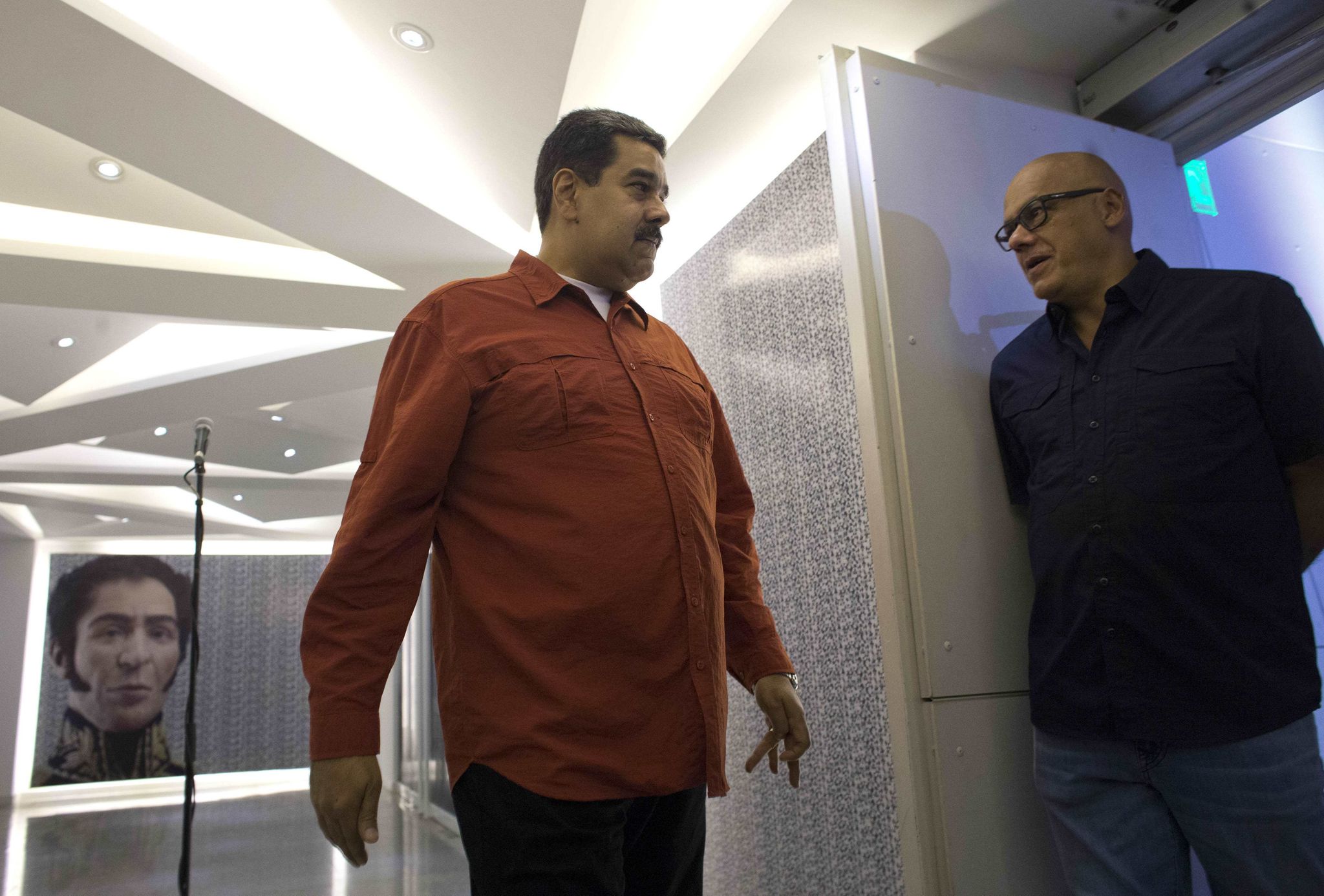
    The Trump administration on Tuesday announced new sanctions on Venezuelan President Nicolas Maduro’s wife and other Venezuelans from his inner circle in Washington’s latest move to further punish his regime for corruption and anti-democratic practices.

    Cilia Adela Flores de Maduro is the first lady, a former attorney general and head of the National Assembly. The U.S. Department of the Treasury’s Office of Foreign Assets Control (OFAC), which announced the designation, also named Delcy Eloina Rodriguez Gomez, Jorge Jesus Rodriguez Gomez, Vladimir Padrino Lopez.

    “President Maduro relies on his inner circle to maintain his grip on power, as his regime systematically plunders what remains of Venezuela’s wealth,” Secretary of the Treasury Steven Mnuchin said in a statement. “We are continuing to designate loyalists who enable Maduro to solidify his hold on the military and the government while the Venezuelan people suffer.”

    Mr. Mnuchin added: “Treasury will continue to impose a financial toll on those responsible for Venezuela’s tragic decline, and the networks and front-men they use to mask their illicit wealth.”

    The Trump administration has increased pressure on Mr. Maduro as the South American country continues to spiral into a historic political and economic crisis that has many Venezuelans struggling to afford scarce food and medicine. Masses are fleeing into neighboring countries, threatening to destabilize the region.

    Widely unpopular, Mr. Maduro has nevertheless clung to power through what Washington diplomats insist was a rigged recent election, in addition to massive corruption.

    “Today’s action shows that the United States will continue to take concrete and forceful action against those who are involved in the destruction of democracy in Venezuela as well as those who are enriching themselves at the expense of the Venezuelan people,” the State Department added in a statement.

    Later on Tuesday, President Trump is scheduled to meet with Colombian President Ivan Duque Marquez at the United Nations General Assembly. The two leaders are expected to discuss Venezuela’s refugee crisis which has exploded during Mr. Maduro’s reign.

  • WHO: Ebola metrics improving, but ‘perfect storm’ threatens DRC response

    The World Health Organization warned Tuesday that armed conflict, public distrust of global aid workers and political maneuvering may combine into a “perfect storm” that undermines the massive respons

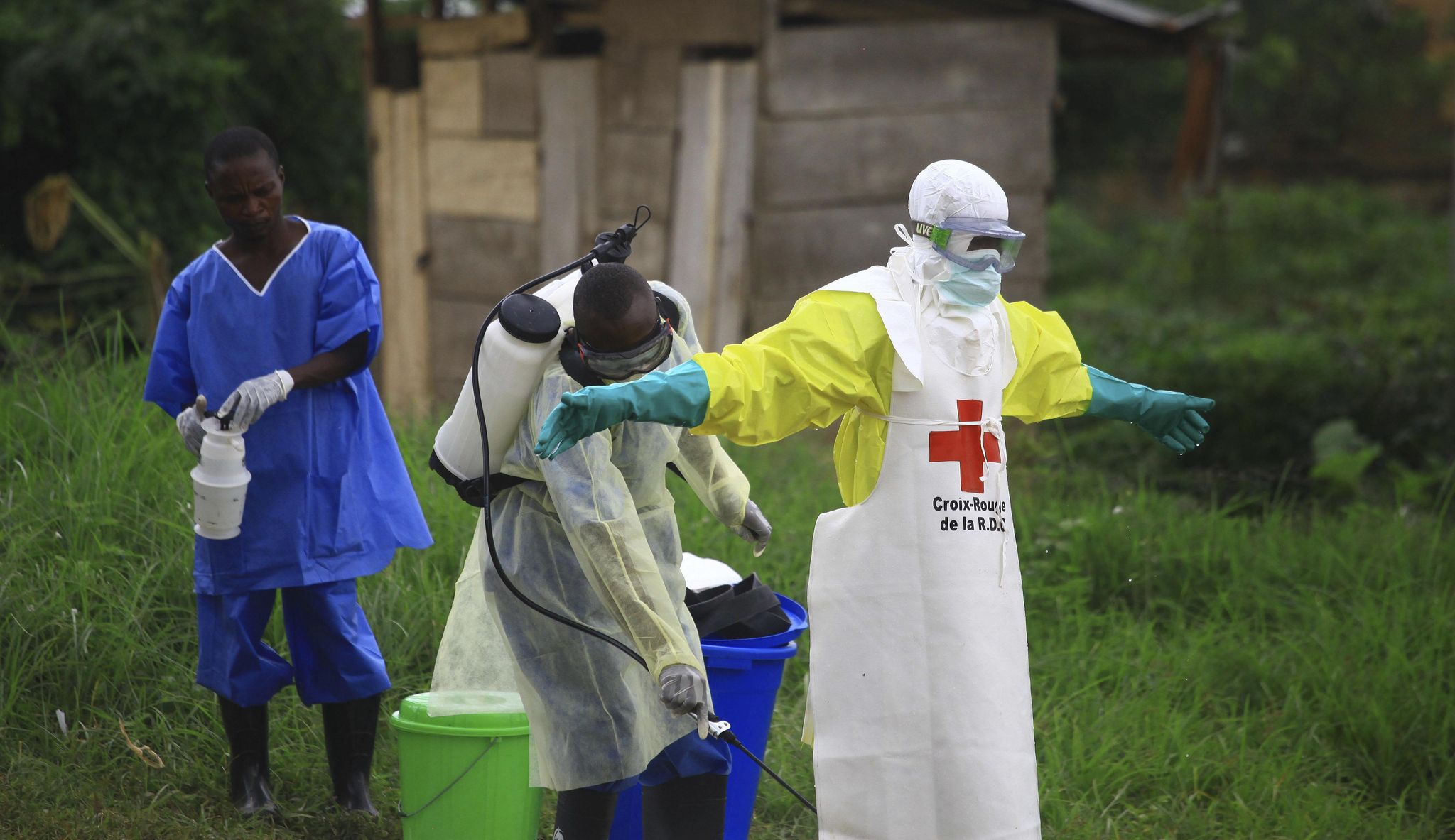
    The World Health Organization (WHO) warned Tuesday that armed conflict, public distrust of global aid workers and political maneuvering may combine into a “perfect storm” that undermines the massive response to Ebola virus in the Democratic Republic of Congo (DRC).

    WHO’s emergencies director, Peter Salama, said the response is showing progress overall, with 10 cases per week in the affected region compared to 40 per week at the start of the outbreak in August.

    However, a rebel attack on the WHO’s base town of Beni suspended critical response operations through Friday.

    “That means this entire week we may have cases that become more symptomatic and become more infectious that we’re unable to respond to,” Dr. Salama said, noting they were unable to reach three suspected cases around Beni on Monday.

    Typically, they can reach a potentially infected patient within 24 hours.

    So far, the outbreak in North Kivu province has been linked to 150 cases and 100 deaths.

    The outbreak is unfolding in a region marked by armed conflict between insurgent groups and the government.

    Dr. Salama said politicians eyeing an upcoming DRC election are making things worse, as opposition parties accuse the army and central government of failing to repel the attacks.

    By extension, locals begin to look askance at the governmental Ebola response, and allies like WHO feel that skepticism, too.

    Any response to Ebola is marked by suspicion vaccines and outsiders, and those fears have been exacerbated at times by social media posts, Dr. Salama said.

    Meanwhile, the rebel attack on Beni killed 14 civilians over the weekend, forcing multiple groups to suspend operations during a week of mourning and protest.

    “As the days go on, if we do see unsafe burials that we can’t be responded to if we do see symptomatic people that can’t be accessed, we can see this situation deteriorating very quickly, which is why there is the real potentiation for a perfect storm in the coming days and weeks,” Dr. Salama said.